Monday, September 7, 2015

Dinosaur gastroliths

Gastroliths are literally “stomach stones.” It has long been postulated that they were swallowed voluntarily by giant sauropods (herbivorous dinosaurs) for the purpose of aiding digestion by grinding food material. 

Gastroliths look just like highly polished river gravel, and this fact has helped convince some paleontologists that gastroliths are nothing more than sedimentary gravel and never used by dinosaurs to aid their digestion process. It would follow, therefore, that if you believe you have found "stomach stones," it would strengthen your hypothesis if you could show that they came from inside of a dinosaur skeleton in the stomach area.

Many years ago, a reputable vertebrate paleontologist gave me a stomach stone (see the red stone shown below), which he said that he had collected from the stomach area of a large sauropod of Late Jurassic age in the San Rafael Swell area of Utah.

A gastrolith 9 cm long (= a small cobble) from Utah. The rock, which is heavy, is an iron-bearing (reddish) quartzite.

The other picture (shown below) is of two other gastroliths, also from Utah. These specimens were part of a private collection that was sold.

Two gastroliths (small one is 1.8 cm long = large pebble; large one is 3.8 cm long = very large pebble) from Utah. The rock type, which is lightweight, is a hard but highly polished detrital sedimentary rock (probably coarse-grained sandstone).

Tuesday, August 25, 2015

Petoskey stones

Petoskey stone (4 cm in length) from Michigan.
A fossil commonly part of personal collections is a Petoskey stone, which is a fragment of a species of colonial rugose coral of Middle Devonian age (about 390 million years old) from lower Michigan. These fragments, which can be found along the shore of Lake Michigan, are commonly cut and polished (using lapidary techniques) into pebble- or small cobble-sized pieces with flat bottoms. Some are used in making designer jewelry.

The specimens show tightly packed, polygonal-shaped individual corals called corallites. The dark center of each corallite was the mouth area, surrounded by tentacles loaded with stinging cells used for catching prey. Radiating out from the center are distinct “lines” called septa, which were used for attachment of the soft parts of the coral. The name "Petoskey stone" comes from Ottawan Indian lore and means “rays of the rising sun.” It seems likely that this name was inspired by the presence of the septa. The Latin name for these Michigan specimens is Hexagonaria percarinata.

The Petoskey stones found in Michigan underwent transport and abrasion during the Pleistocene “Ice Age” by glaciers and running water, thus their colonial-coral structures have been worn down. When these specimens are polished by lapidary techniques, the colonial structures become even more worn.

For comparison, I include a photograph of a specimen of colonial-rugose coral that I collected from western Nevada. This specimen, which is of Mississippian age (about 350 million years old), is an  unworn example of Lithostrotionella jasperensis. The central area of each is corallite is raised and occupied by the columella, and the septa radiate from it.
Lithostrotionella jasperensis (4 cm length) from Nevada.
By the way, colonial-rugose corals went extinct at or near the end of the Permian Period (about 255 million years ago).


Tuesday, August 11, 2015

"Cantaloupe" concretions

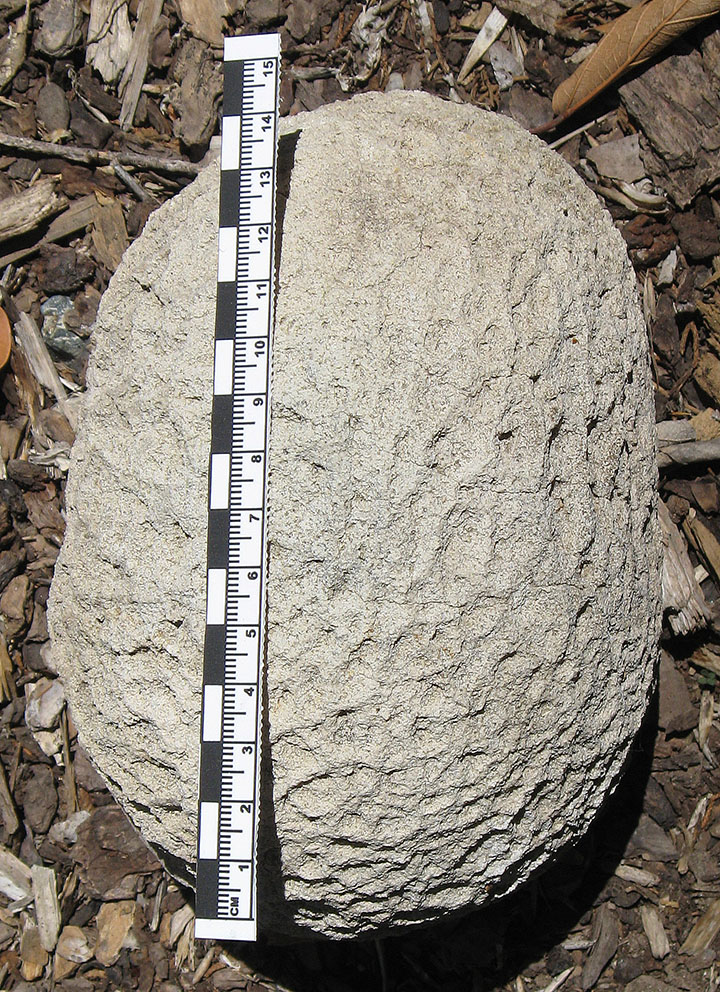
A few years ago, while doing field work just west of Simi Valley, Ventura County, southern California, I collected some spherical concretions that are quite interesting. They are mostly five to six inches in diameter and have a distinctive pitted appearance that strongly resembles cantaloupes, thus I have dubbed them the name “cantaloupe concretions.” They are fun to collect, and other members of my field party fell victim of trying to find perfect ones (like the one shown below).  


A spherical concretion (approximately 11 cm = 4.5 inches) that looks like a cantaloupe.
 The black-and-white rectangles of the scale are in centimeters.

Some of the concretions are elliptical shape, as shown below.


An elliptical concretion (approximately 14.5 cm = 6 inches).
The concretions occur in sandstones in the nonmarine Sespe Formation and are approximately Oligocene (30 million years) in age. These concretions were first noted in 1924 by W. S. W. Kew, who did some of the earliest geologic work in the area. He also reported that they have a pitted appearance.

Concretions form around some nucleus (an impurity, possibly a shell or plant fragment) when groundwater flows through sands.  The sand subsequently becomes strongly cemented. Differences in the strength of cementation of the sand grains in these Sespe Formation concretions were made apparent by weathering of the surface, thereby producing the pitted appearance. Some of the concretions were broken open, but there was nothing organic nor unusual in the central (core) area.

In one of my earlier posts dealing with "Pseudofossils," in July, 2014, I briefly discussed what concretions are and illustrated a common shape.


Tuesday, July 28, 2015

Hyracotherium, the First Horse

Hyracotherium was very small (small-dog size) and had four toes on its front legs. Although this genus gave rise to various lineages of horses that included successively larger and faster horses, Hyracotherium was not a runner. Instead, it moved slowly about in forests and relied on its own camouflage rather than swift running in order to protect itself from predators.

Hyracotherium (length 60 cm = 23 inches).
Hyracotherium was the first name given to this genus, based on specimens found in England. Later, based on specimens found in North America, it was mistakenly named again; this time as “Eohippus,” which means “dawn horse.” Eohippus is thus a secondary junior synonym of Hyracotherium, and in the international rules of naming of organisms, Hyracotherium has priority because it was named first.

 The tooth shown below is a single molar from the lower jaw of Hyracotherium angustidens of Eocene age from Wyoming. Its teeth were low-crowned with low cusps, which enabled the animal to eat both fruit and soft leaves.

Side view of a molar of Hyracotherium angustidens; specimen is 10 mm length, 5.5 mm height.

Top view of molar shown above.


The next picture shows how small an H. angustidens molar tooth is in comparison to a molar tooth of the modern horse Equus caballus.
Side view of a molar  (50 mm height = about 80% complete because the base is broken off) of Equus caballus versus the molar of H. angustidens shown above.

Thursday, July 16, 2015

A Late Cretaceous early mammal tooth

Multituberculates were early rodent-like mammals (see my sketch below) that lived from the Late Jurassic to early Oligocene. They have the longest mammalian lineage (approximately 125 million years) and are the only branch of mammals to have become extinct. They did survive, however, the mass extinction at the end of the Cretaceous Period 65 million years ago. In the early Oligocene, multituberculates were most likely out-competed by true rodents.

They were rat- to squirrel-size and were most likely the first herbivorous mammals. They were widespread, but most are known from Europe and North America.


An early multituberculate. P4 refers to its most forward molar tooth
 (see remarks given below).
Their fossil record consists of minute teeth, which are scarce. As shown below in the plaster replica, they had rodent-like front teeth (incisors), then a gap, followed by a series of gnawing cheek teeth (premolars and molars). The cheek teeth possess many cusps, or tubercles; thus, the derivation of the name “multituberculates.” The first premolar (P4) in the lower jaw was commonly of large size and used as a massive, blade-like tooth for shearing purposes.

Side view of plaster replica of jaws and teeth of Ptilolus? sp., an early multituberculate. This replica is about 15 times larger than the actual jaws and teeth.


                                                                top view of the lower jaw

An actual P4 molar tooth (3 mm width, 3.75 mm length) of  Ptilodus? sp., a Late Cretaceous squirrel-like multituberculate is shown below. This Cretaeous tooth was found in modern-day anthills in the Bug Creek  area of Montana. Paleontologists search these anthills for fossils because ants burrow into Upper Cretaceous rocks and bring the microscopic-sized fossils to the Earth's surface.

   side view of a P4 molar (3 mm width)