Friday, September 28, 2018

Common rock-forming minerals

The following is a very basic discussion of minerals, which is critical for the understanding the classification of igneous rocks, the topic of the next post.

Atoms (electrons, protons, and neutrons) make up elements (92 natural ones; (examples: oxygen, silicon, potassium).

Elements make up minerals (3,500 kinds).

     Minerals consisting of pure (native) single elements are rare     (e.g., gold, diamond, copper).

     Nearly all minerals consist of combinations of elements.

Only 20 minerals are common, and they are the rock-forming minerals. Seven of these are shown below.

white ("milky") quartz, 3.3 cm in height
Quartz (made up of the elements silicon + oxygen) is the most common mineral in the continental crust of Earth. The presence or absence of quartz in a rock is fundamental in the classification of igneous rocks. For more information, see my previous two posts, which review the subject of quartz.


potassium feldspar (K-spar), 3.7 cm in height
One of the largest groups of minerals is referred to as the "feldspar group," which consists of two subgroups. One of these subgroups is the "alkali feldspars,"which contain varying amounts of the elements potassium and sodium in their composition. The mineral pictured above is one of these alkali feldspars, which are generally called "potassium feldspar" or "K-spar" until x-ray and petrographic microscope studies are made to determine the exact mineral. 

plagioclase, 3.3 cm in height
The second subgroup of the "feldspar group" is called the "plagioclase feldspars," which contain varying amounts of the elements sodium and calcium in their composition. Plagioclase is characterized by the presence of striations, which can be seen as closely spaced lineations in the upper half of the specimen shown above.

flakes of muscovite, largest flake 4 cm height
Muscovite and biotite (see below) belong to the "mica group" of minerals. Both have one-dimensional cleavage, which splits into sheets or flakes. For a discussion of what cleavage is, see one of my more recent posts. Because of its clarity, large sheets of muscovite could have served as "windows" for pioneers living in wood cabins. Muscovite is common in quartz-rich igneous rocks (granite), metamorphic rocks like (schists and gneisses), and sedimentary rocks (siltstone and claystone).


large sheet of biotite, 6.5 cm height
Biotite has a more varied composition than does muscovite. For example, biotite has iron in its structure, which causes a dark coloration. Biotite occurs in igneous rocks, as well as a wide variety of metamorphic rocks. 


hornblende, 7 cm height
Hornblende has a very complicated composition and much chemical variability, depending on the chemicals available and the temperature of formation. Hornblende has two directions of cleavage (approximately at 60 degrees and 120 degrees). This mineral is found in a wide variety of igneous and metamorphic rocks. 
olivine, 3 cm height
The "olivine" group minerals contain varying amounts of iron and magnesium in their composition. "Olivine" is most common in quartz-free rocks and commonly has a green color.

In the minerals shown above, three of them occur as solid-solution series, which form when two elements can substitute for one another in a mineral. The three solid-solution series are the
alkali feldspars, plagioclase feldspars, and the "olivine" group.

Most of the minerals in these solid-solution series are not compositionally pure end members; rather they have an in-between composition.

Minerals make up rocks (3 main types: igneous, sedimentary, and metamorphic).

Rocks make up the Earth's crust (two kinds: continental and oceanic).

In the next post, igneous rocks will be discussed and illustrated, and the chart below is presented here to show how quartz is used to help define certain kinds of igneous rocks. For example, granite (think expensive kitchen-counter tops) is rich is quartz but basalt (think lava flows in Hawaii) is low in quartz.  


Friday, September 14, 2018

Varieties of Quartz: Part 2

The previous post showed some common varieties of macrocrystalline (visible crystals) of quartz (silica = SiO2). This post shows some common varieties of quartz that do not show any visible crystals and have a dense structure, referred to as  microcrystalline  [= cryptocrystalline] quartz. Two main groups are shown here: chalcedony and opal.

Chalcedony is the generic named given to materials that are composed of microcrystalline quartz. Chalcedony includes blue chalcedony, chert, "touchstone," agate, jasper, and "tiger eye." Examples of these are shown below: 


height 5 cm, from Nsanje District, Malaw (southeast Africa) 
Blue chalcedony (commonly called blue "quartz"). Chalcedony is a microcrystalline form of quartz (silica, SiO2), composed of intergrowths of quartz and moganite, and each has a different crystalline structure. 


height 3 cm
Chert is a hard, opaque chalcedony with an amorphous microcrystalline texture. Chert has conchoidal fracture, which produces very sharp edges, especially in flint (black or brown forms of chert). That is why chert was commonly used for making arrowheads.

height 7 cm
The image above shows a sedimentary rock consisting of chert layers (in black) alternating with impure white siliceous (silica bearing) material, referred to by some geologists as "porcelaneous chert" (i.e., resembles glazed porcelain).


height 7.5 cm
"Touchstone" is a black, nodular version of chert. For at least 2,500 years, it has been used by goldsmiths to test the purity of gold and silver by the streak left on the stone when rubbed against these metals. "Touchstone" is also called the "lydite stone," also spelled as "lyddite."
sliced and polished specimens, largest one height 7.5 cm
Agate is banded chalcedony and has a wide range of colors. The bands form over time and can have different colors, depending on the impurities. Agates form commonly in areas of volcanic activity or in limestone where waters, rich in dissolved silica flow through fractures and cavities in these rocks.


height 1.7 cm
An agatized snail, whose hollow interior was filled with agate.


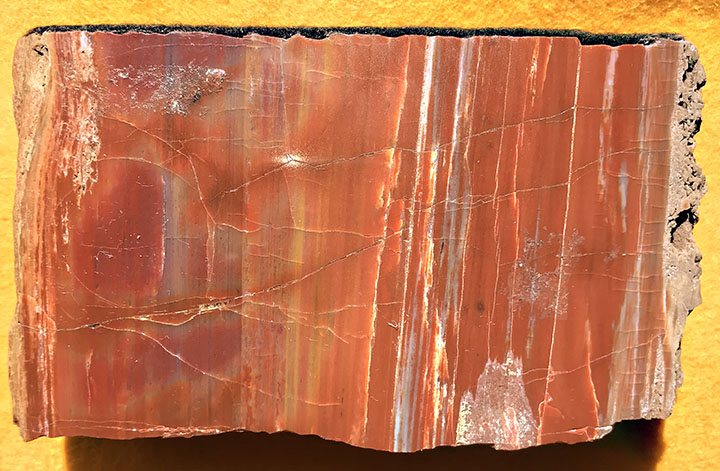
petrified wood (14 cm width), from Petrified Forest, Arizona
Petrified wood is, in most cases, wood replaced by chalcedony. Other minerals (like opal), however, are also known to replace wood.
height 5 cm
Jasper is an opaque aggregate of chalcedony and microgranular quartz. Jasper is an impure variety of silica, thus it can have red, yellow, brown, green, or other colors. The red color of jasper is because of iron inclusions.
polished specimen, height 3.7 cm
"Tiger eye" is a metamorphic rock consisting of chalcedony that formed by replacement of an asbestos-group mineral (called crocidolite). "Tiger eye" has a golden brown to very dark brown color and silky luster. 

The other group of microcrystalline silica is opal, which is a mineraloid consisting of hydrated amorphous silica (water content 3 to 21 percent by weight; commonly 6 to 9 percent). Opal is deposited at relatively low temperature, and it can be deposited in the fissures of any kind of rock, especially volcanic rock. Opal is the national gemstone of Australia.

Examples of "precious opal" are shown in the next two images below. "Precious opal" displays flashes of colors when exposed to light (= a form of iridescence). 


height 1 cm


height 2 cm


height 4.5 cm
This last variety of opal is "fire opal," which is bright red, yellow, 
or orange in color.


width 10 cm
Both macrocrystalline and microcrystalline quartz occur commonly in geodes, which are round rocks with a hollow cavity line with crystals. In the example above, the geode has two hollow cavities, both partly filled with druzy (macrocrystalline) quartz alternating with layers of chalcedony.


width 12 cm
Cavities completely filled with chalcedony (e.g., agate, jasper) are called nodules. In the nodule shown above, macrocrystalline amethyst mostly filled a geode. The remaining cavity was filled eventually filled completely with chalcedony. This unusual specimen was collected by my friend, the late George Edward Davis. 

Sunday, August 26, 2018

Varieties of Quartz: Part 1


Quartz occurs in a great number of varieties that differ in form and color. Quartz can occur as single crystals, crystals in druses, massive aggregates, and dense nodules. Quartz is colorless, if pure, but can assume any color because of inclusions of other minerals or because of the presence of built-in trace elements.

The more common varieties have been given their own names. The different varieties are commonly classified in two major groups:

One of these major groups is called macrocrystalline, which includes varieties that commonly form visible crystals. When people talk about quartz, they mostly think about macrocrystalline quartz. Some examples of macrocrystalline quartz are shown below:
Individual transparent crystals of euhedral quartz (= nice angular crystals), (largest crystal here is 2.3 cm height).

 
A cluster of transparent crystals of quartz (largest crystal 6 cm height). To get crystals like these, they must have free space to grow into.


7 cm height

4.5 cm height

The above two images are of transparent macrocrystalline crystals of quartz containing inclusions of the mineral rutile, thereby forming "rutilated quartz." The acicular (needle-like) crystals of rutile, a titanium oxide, form within the structure of the quartz crystal. The "needles" can be golden, black, or other hues.


Drusy quartz called "cactus quartz"(5.8 cm height) when it coats much larger, singular crystals of quartz.


Amethyst is the purple, violet, or lavender variety of quartz. The colors are the result of natural radiation emanating from the surrounding rock. This radiation affects any iron impurities that might be present in the quartz and consequently causes the coloration. This specimen is 9.5 cm in width.

Citrine is the yellow to orange variety of quartz, with the colors being the result of the presence of iron impurities. This specimen is 8.3 cm height.
Smoky quartz is the gray, brown, or black variety of quartz, with the colors being the result of exposure to radiation.


Rose quartz is the rose or pink variety of quartz. The color is due to nano fiber inclusions (see my May 31, 2016 post). Rose quartz does not form crystals or crystal faces, and it is never transparent. It is, however, classified as a macro crystalline variety of quartz, as it is made up of many inter grown crystals and subindividual crystals. This specimen is polished and 2.3 cm height.


Aventurine (unpolished [4 cm height] and polished pieces) is actually a quartzite (a metamorphic rock, not a mineral) composed on interlocking macro crystalline quartz grains and other color-imparting minerals. Aventure is commonly green but can be orange brown, gray, or blue. The color is due to the presence of small-sized reflective particles of the mineral mica or particles of iron. 


The next post will show some of the common varieties of the second group: cryptocrystalline (or microcrystalline) varieties of quartz.

Monday, August 13, 2018

Cleavage in minerals

Cleavage refers to the specific planes of weakness along which some minerals split. These planes (or directions) are smooth, shiny and parallel to the zones of weak atomic bonding inherent in the structure of the mineral. 

Cleavage is an important “tool” used in the identification of minerals. Unlike crystal faces, which can be also flat and smooth, cleavage is only evident when a mineral is broken.

Some of the more common types of cleavage are shown below:

PINACOIDAL = one direction of cleavage (like a sheet of paper), resulting in thin, flat sheets which can be peeled apart (e.g., mica).


Two views (oblique and side) of a sheet of biotite mica (maximum dimension 26.5 cm). 


RHOMBOHEDRAL = three directions of cleavage with the cleavage planes forming angles other than 90° (e.g., calcite).
rhombohedral calcite, 3 cm high
CUBIC = three directions of cleavage with the cleavage planes forming 90° angles; (e.g., halite).
cubic halite, 7.5 cm high; the lower right side has a piece broken off
OCTAHEDRAL = when a mineral breaks in the form of a diamond, resulting in eight nearly equal faces (octahedron); (e.g., octahedral fluorite).
octahedral fluorite, 3 cm high

DODECAHEDRAL = when a mineral breaks in the form of a polyhedron with 12 faces; (e.g., garnet).
dodecahedral garnet, 4 cm high
Not all minerals have cleavage (e.g., quartz), but all minerals show fracture, which is the tendency of a mineral to break along an irregular surface. In glass and some minerals, like quartz, the broken surface is called conchoidal fracture, and it does not follow any planar surfaces (i.e., crystal faces).
conchoidal fracture in quartz, specimen is 3 cm high
quartz crystal showing natural crystal faces, specimen is  4.5 cm high

Tuesday, July 31, 2018

Inoceramids

Inoceramid bivalves (clams) range from the Permian to latest Cretaceous. On a global scale, they were widespread and locally abundant during the Jurassic and Cretaceous. They went extinct just before the end of the Cretaceous. Inoceramids lived on the ocean floor and were filter feeders.

This first image is an "average-looking" Inoceramus specimen, showing the characteristic oblique outline of the shell and the prominently raised, concentric ribs. Well-preserved shells have "mother-of-pearl" luster on the inner layer. The outer shell layer consists of well-developed prisms of calcite.


This is a cross-section of a fragment of the prismatic layer of Inoceramus. The fragment is 1 cm in thickness and 2.5 cm in length. Even small pieces of the outer layer of well-preserved Inoceramus shells can show the very characteristic, well-developed (i.e., thick) prismatic shell structure.


Plaster cast (6 cm height) of Inoceramus orientalis ambiguus Nagao and Matsumoto, 1939, Cretaceous (late Santonian), Shasta County, northern California. 


This specimen is from Upper Cretaceous (upper Campanian to lower Maastrichtian) strata in the San Diego area, southern California. The drafting pen is 12.5 cm (5 inches) in length.

Inoceramids are excellent in fossils for "age-dating" marine rocks. This is because their species evolved rapidly, commonly averaging one per 0.2 to 0.5 million years. A normal bivalve species lasts for about 2 million years. Single species of inoceramids can occur in widely scattered parts of the world. About 75% of species and subspecies have intercontinental to cosmopolitan distribution in the Cretaceous, and, in many cases, exceed the precision of geologic age correlation found in co-occurring ammonite species and subspecies or the marine planktonic microfauna! Because of their widespread distribution, however, they are not very useful in defining paleobiogeographic regions.

Some genera, many species, and many subspecies of inoceramids can be frustratingly similar looking because they have so few determinate morphologic characters. Some researchers use complex statistical analyses (e.g., multivariate analyses) to help them define and recognize species and subspecies. Before the advent of computers, these statistical analyses were overwhelming to do by hand. Now, there is software that can help paleontologists, who must first digitize the morphological data.


Some inoceramid specimens can be large and rather thick walled, like this Cretaceous specimen from Kansas.

Photo is from wikipedia.org
Some species of inoceramids grew to giant size, up to 3 m (9.84 feet = 118 inches) in length, making them the largest bivalves of all time. Their giant size was probably an adaptation for living in murky bottom waters; the gills were probably corresponding large and allowed for survival in oxygen-deficient waters. These giants are all very flat valved. The unusual color of this specimen is because of the exposure of the inner shell layer (mother-of-pearl layer).

While alive, the valves of large inoceramids could serve a shelter for schools of small symbiotic fish, which can be preserved inside as impressions. In many cases, the exterior surfaces of the shells of inoceramids are encrusted by numerous small oysters.

Saturday, July 14, 2018

What's in a name?

What’s in a name? That question is extremely important in the world of paleontology.

The principle of scientific naming started with the binominal system of nomenclature established by Carl Linnaeus in 1758. For a species to be officially recognized, it must be given a latinized generic name and specific name (e.g., Turritella andersoni Dickerson, 1916). Note that these names must be italicized. The genus name is always capitalized, whereas the species name is not (this rule is internationally recognized although magazine and newspaper articles commonly do not follow it). The genus name can be abbreviated to a single letter (e.g., T. andersoni Dickerson, 1916), whenever the full name has already been mentioned, so that the reader is aware of the genus name.


Carl Linnaeus, also known as Carl von Linné (1707–1778), a Swedish naturalist.
Image modified from Wikipedia (2018).

The whole concept of naming involves taxonomy and systematics, which are basically synonymous. Taxonomy (or systematics) consists of two distinct components: Nomenclature, which deals with the purely legalistic aspect of names, and classification, which deals with the ranking or grouping of various categories of names (e.g., order, superfamily, family, genus, species). In modern times, DNA studies have revolutionized classification schemes.

The rules of nomenclature of genus and species names are given in the “International Code of Zoological Nomenclature” (ICZN). It provides widely detailed information about accepted procedures dealing with how names should be correctly established, which name must be used in case of name conflicts, and how scientific literature must cite names. The first edition of the Code was published in 1961. The present edition (4th) was published in 2000. A pdf of the Code is available online.


Title page of the ICZN.

If you are interested in the details of nomenclature, Wikipedia.org, has a very informative overview of the principles (e.g., priority, homonymy, type specimens upon which names are based [e.g., the holotype is the "name bearer" of a species], gender agreement of names, etc.). Also, you can Google the phrase “international code of nomenclature.”

Wikipedia also has a good overview of what a synonymy (list of equivalent names) is. Just "Google" the word “synonymy.”


Saturday, June 30, 2018

Beale's Cut, Newhall, Southern California

Beale's Cut is a narrow, man-made gap through a ridge near the town of Newhall, in northern Los Angeles County, southern California. This gap (or pass) dates back to 1854, when Phineas Banning dug out a 30-foot gash, in order to allow horse-drawn wagons and stagecoaches to travel through a narrow canyon whose head was blocked by solid rock. The gap occurs in an area that has had a succession of names: Fremont Pass, San Fernando Pass, and more, recently, Newhall Pass.

On the approach to Beale's Cut in April, 1985.
(the view is to the northeast)


Beale's Cut, April, 1985, with a partial silhouette of a person
 and a chain-link fence, for scale.


Beale's Cut, April, 1985.


 Google Earth (2018) image showing a
 bird's eye (vertical) view of Beale's Cut.

In 1861, Edward Fitzgerald Beale deepened the gap to 90 feet in height, thus allowing even better passage to places like Fort Tejon, to the north. At that time, the gap in the canyon became known as Beale's Cut. It was used for vehicles until 1910. It was also used for many silent westerns and was where the American actor Tom Mix and his horse allegedly "jumped the gap," in the movie "Three Jumps Ahead."

Beale's Cut is still in existence, but it suffered during the Northridge Earthquake in 1994. Today, it is only 30-feet deep again because of infilling by rock falls. 

It is located just off of Sierra Highway, which is west of Interstate 14. Spotting if from the road level is difficult. Along the side of Sierra Highway there is a small monument/plaque, but the entire area is fenced off now in order to reduce vandalism and trash dumping. There is no place to turn off the road to park your car. 

The gap occurs in the Saugus Formation, a Pleistocene fluvial (ancient river) sandstone deposit associated with the erosion of the adjacent San Gabriel Mountains.