Saturday, July 24, 2021

PART 6 of the Burgess Shale Fossils: 

Pikaia gracilens Walcott (1911, pl. 20, figs. 1. 2) is a legless, soft-bodied, ribbon-like animal, up to 2 inches (5 cm) long, whose closest relatives are the sea-lancelet Branchiostoma and the zebrafish. Although Pikaia was originally thought to be an annelid worm, it is not because it is unsegmented. In the 1970s, its remains were restudied and a notochord was discovered = a rod running along its back and resembling a backbone-like structure. In addition, there are markings on the sides of its body, and they resemble myomeres (chordate muscle bundles) found on living chordates (backboned animals). As a result of this discovery, Pikaia is now classified as probably as a basal, or “stem chordate,” ancestral to all back-boned animals (including fish to humans). In the 1970s, it was reported that Pikaia probably swam like an eel, but, in recent years, researchers have concluded that it was probably a slower swimmer and less flexible than an eel.


Key Reference: 

Walcott, C.D. 1911. Cambrian geology and paleontology. II. No. 5. Middle Cambrian annelids. Smithsonian Miscellaneous Collections. 


Friday, July 9, 2021

 PART 5 of the Burgess Shale Fossils:

Anomalocaris canadensis Whiteaves, 1892 is another part of my discussion on “Middle Cambrian Life: Exceptional Fossils” (Lagerstätt), from the Burgess Shale Member of the Stephen Formation, British Columbia, Canada. Genus Anomalocaris Whiteaves, 1892 ranges from the Middle to Late Cambrian (approximately 505 to 520 million years ago) and has been found at various places, but its principal locality is the Burgess Shale.


Please refer to my earlier post [dealing with the fossil Opabinia] for details about the kit of plastic replicas of some of these fossils, including Anomalocaris canadensis.


Anomalocaris (pronounced “ah-NOM-ah-LO-kar-is”) is a Greek word, meaning "unusual shrimp." Anomalocaris belonged to a group of ancestral arthropods, referred to as “stem-group” of arthropods.


Three views are shown below of a plastic replica of Anomalocaris canadensis: dorsal, side, and ventral, in that order. This replica is 5 inches (12 cm) in length. It is just a fraction of the maximum size of Anomalocaris, which was about 3 (one meter) to 4 feet in length.


Anomalocaris was a soft-bodied, bilaterally symmetrical and flattened animal, with lateral
flaps (attached to gills). Its streamlined body was well designed for swimming. The posterior half of its body was segmented and therefore flexible. On the underside of its body, Anomalocaris had a sturdy mouth, with jaws consisting of numerous plates (oval cones). The mouth was next to two large claws. The body also had two stalked compound eyes, which were advantageous for hunting purposes. 


Anomalocaris was an “apex predator” that probably preferred to eat trilobites.


Determining exactly the type of animal that Anomalocaris represented has a complex history, spanning 100 years! This is because only separate parts of its body were originally found, in a piecemeal fashion, at scattered localities. It was not until workers found enough of these disarticularted parts to finally figure out what the whole animal actually looked like. Thus, each part was described originally as a separate animal. For example, its jaws were described as a jelly fish, and one of its claws was identified as a shrimp. Eventually, a complete specimen was found, and that is when “it all came together.” 


“YouTube” has some really excellent animations about Anomalocaris. I strongly encourage you to “Google them.” They are readily available and extremely easy to use, without any  complicated downloads or troublesome links. Just click on the animations. They are worth watching! 


Saturday, June 26, 2021


PART 4 of Burgess Shale Fossils:

This fourth part of my series about the Early Cambrian fossils of the Burgess Shale in British Columbia, Canada is about Opabinia regalia Walcott, 1912. Wallace found the original material (see first image shown below) and named it. At first glance, it looks like a worm, but the latest interpretation is that this fossil was a member of a “stem group” of phylum Arthropoda (arthro, joint; pod, foot), which is the largest phylum of living organisms. Some modern examples of arthropods are barnacles, crabs, insects, and spiders. Like annelids (worms), the arthropod body is segmented, but in arthropods, there is a fusion and specialization of segments, with two or three major body regions. Opabinia shows some degree of fusion of its segments, thereby indicating a relationship to an arthropod.


Side view of an actual imprint of O. regalia is from Walcott, 1912 (pl. 27, fig. 6). The fossil is about 5.5 cm in length.
 The original reference is Walcott, C.D. 1912. Middle Cambrian Branchiopoda, Malacostraca, Trilobita and Merostomata. Cambrian geology and paleontology, II. Smithsonian Miscellaneous Collection 57:146–228.  

In the images below, I used a plastic model to highlight the anatomical details of Opabinia. Many years ago, one of my graduate students visited a museum gift store, and came across a commercial “kit” with examples of Burgess Shale fossils. The plastic three-dimensional replicas are actually very good, and I used them for teaching purposes in my geology and paleontology classes. Their color schemes are certainly “made up,” but they help to show the dominant anatomical features. I believe that these kits were part of a “limited edition,” thus they are now hard to find. In my previous and subsequent write-ups about some other the Burgess Shale fossils, you will see that I used additional plastic models.


The following images show the dorsal, right side, and ventral views (in that order) of Opabinia regalis, and lastly, a closeup of its five compound (faceted) eyes. Notice the segmented body, numerous legs, tail, fins, and a single (very large) claw. The model shown here is 9.5 cm long, but, as mentioned earlier, the original specimens are up to approximately 5.5 cm in length.


Other Useful References:


Whittington, H.B. 1975. The enigmatic animal Opabinia regalis, Middle Cambrian, Burgess Shale. Philosophical Transactions of the Royal Society of London B, v. 271:1–43.


Briggs, D.E.G. 2015. Extraordinary fossils reveal the nature of Cambrian life: a commentary on Whittington (1975) “The enigmatic animal Opabinia regalis, Middle Cambrian, Burgess Shale, British Columbia. Philosophical Transactions Royal Society B, vol. 370. 


Sunday, June 13, 2021


PART 3 of the Burgess Shale Fossils:

This post is part of a series of six posts dealing with “Middle Cambrian Life: Exceptional Fossils” (Lagerstätt) from the Burgess Shale Member of the Stephen Formation, British Columbia, Canada. Please see my previous two posts; the first of which serves as an introduction to this broad topic.

Wiwaxia corrugata (Matthew, 1899) (new combination) is shown below. There has been considerable controversy about what kind of animal group it represents. It was a soft-bodied, slug-like animal covered in carbonaceous scales and, along its dorsum, with two rows of 7 to 10 blade-like spines. Although some early workers believed that Wiwaxia might be an annelid (worm), that idea has fallen out of favor because Wiwaxia shows no evidence of segmentation. The general consensus is now that Wiwaxia represents a “stem group mollusk” that existed at the time when annelids and mollusks branched off from each other, in an evolutionary sense. Phylum Mollusca (mollusks) is a large group today and consists manily of chitons, scaphopods, bivalves, gastropods, and cephalopods.


The three views below show the bottom (mouth is the "v" shaped structure), top, and side of a plastic replica of Wiwaxia, in that order. The original size of this animal was about 5.5 cm in length.


Some researchers have classified Wiwaxia as a halkieriid, which is a group of Early to Middle Cambrian “small shelly fossils” that consisted of mineralized sclerites, or armored shell plates, which commonly disarticulate upon death. While alive, however, halkieriids looked like slugs in "chain mail."


On its ventral (basal) side, Wiwaxia has a small feeding apparatus consisting of two (rarely three) tooth plates, which are like a mollusk radula (a toothed ribbon of teeth) or the jaws of an annelid.


The name “Wiwaxia” is derived from the Stoney First Nation Nakota language, meaning “windy.” Although, Wiwaxia has been found (mostly as disarticulated scales) at various localities in the world (e.g., China), its principal locality is the Burgess Shale. 


Monday, May 31, 2021

PART 2 of the Burgess Shale Fossils:

One of the most unusual-looking Burgess Shale fossils is Hallucigenia sparsa (Walcott, 1911). Hallucigenia is found in the Burgess Shale in British Columbia, and it is found in slightly earlier rocks in China. It is also found as isolated spines elsewhere in the world. Its geologic age is approximately a half a billion years old.


Hallucigenia sparsa (length between 1 and 5 cm long) does not have jointed legs, nor a segmented body, nor a hard exoskeleton. This fossil has been interpreted as being a predecessor to arthropods. It branched off in an evolutionary sense prior to the arrival of arthropods in the fossil record. In other words, Hallucigenia is “an almost arthropod.” It has many sharp, long spines, which Conway-Morris (1977) believed were used as walking legs. 


Hallucigenia sparsa was originally described as a species of a polychaete worm belonging to genus Canadia Walcott, 1911. Walcott did not figure this fossil until 1931. Conway-Morris (1977) redescribed this fossil and assigned to his new genus Hallucigenia, which was commonly referred to as “the worm with the missing head” because its “head” turned out to be just a stain of decomposed organic matter. The name Hallucigenia is Latin, meaning “wandering of the mind.


Ramsköld and Xianguang (1991) reinterpreted Hallucigenia as belonging to a stem group of onychophorans (or velvet worms), which are rare, caterpillar-like animals alive today in rain forests. There are about 100 living species). Ramsköld and Xianguang (1991) discovered also that Hallucigenia actually has legs, thus they inverted the life-orientation of this fossil and reported that the spines were used for protection, not for walking.


Cited References:


Conway-Morris, S. 1977. A new metazoan from the Cambrian Burgess Shale of British Columbia. Paleontology 20:623-640. [requires a subscription or pay-per-view fee].


Ramsköld, L. and H. Xianguang. 1991. New Early Cambrian animal and onychophoran affinities of enigmatic metazoans. Nature 351 (6323):225-228. [requires a subscription or pay-per-view fee].


Walcott, C.D. 1911. Cambrian geology and paleontology. II. Middle Cambrian annelids. Smithsonian Miscellaneous Collections 57(5):109-144.


Friday, May 14, 2021


THE MIDDLE CAMBRIAN Burgess Shale

In the early 1900’s, a sharp-eyed paleontologist named Walcott was doing field work in British Columbia, and he found a Lagerstätte from the Middle Cambrian Burgess Shale Member of the Stephen Formation. 


The Cambrian Period began 541 million years ago. The Burgess Shale is of Middle Cambrian age in the earliest part of the Paleozoic.

A “Lagerstätte” is a German word used to designate any exceptionally well preserved fossil fauna or flora. Walcott and subsequent researchers collected and described more fossils. They stored them in established museums so that other paleontologists could access them for detailed study. Eventually, researchers began to realize that the Burgess Shale Lagerstätte represented soft-bodied animals that existed near the beginning of complex animal life on Earth. The research process took many years, and the findings were, in some cases, quite controversial about the exact type of organism that each different fossil represented. Research continues to the present day. The Burgess Shale fossil area is now a World Heritage Site. The localities are protected and require authorization to visit. Unauthorized collecting is prohibited.


The modes of preservation of the Burgess Shale Lagerstätte are either impressions (as shown above in the example of a an early “velvet worm” type of animal) in brown mudstone, or, more spectacularly, as  paper-thin carbonized (whitish to gray) imprints in very fine-grained black to gray siliceous mudstone. 


One popular interpretation about their burial environment is that the animals lived in shallow-marine waters at the edge of an underwater cliff. They were transported a short distance by currents over the cliff and down into deep-quiet waters, where they were rapidly buried by muds. Like most interpretations, this one was recently challenged, and some workers maintain that the animals actually lived at the bottom of the cliff and were not transported there. 


The next five posts highlight examples of fossils found in the Burgess Shale strata. These examples show some rather strange-looking animals, including (the last of the examples) of possibly the first back-boned animal.

Saturday, May 1, 2021

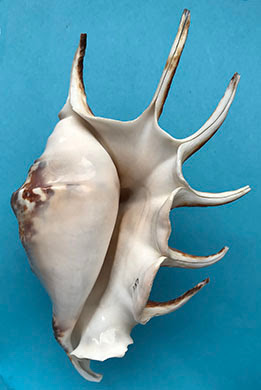
Lambis, the "Scorpion" Conch

The shallow-marine gastropod genus Lambis Röding, 1758 belongs to family Strombidae, which makes up the “true conchs” of the world. 

Three of the 10 living species (not including 14 hyrbrid “species”) of Lambis are illustrated in this post. They all live in very shallow waters in the Indo-Pacific, and, in much less common cases, the Red Sea. Their shells are large and thick, with many long, hollow digitations along the side of the shell, and knobs or protuberances can be present on the dorsum (top) of the shells. In addition, they all have a “peep-hole” notch (called the strombid notch) for the right eye. Their anterior end has a short or long anterior canal.


Lambis scorpius (Linnaeus, 1758), height 11.3 cm, width 5.5 cm, thickness 3 cm; three views: ventral, dorsal, and right side, in that order. This moderately common species lives in coral-reef areas in the Indian Ocean and Western Pacific regions. Its knobby digitations help this gastropod “blend in” with the rubble it lives in.

---------------


Lambis lambis (Linnaeus, 1758), height 15 cm, width 8.5 cm, thickness 5.5 cm. Three views: ventral, dorsal, and right side, in that order. This Indo-Pacific species lives in mangroves or on reef flats from low tide to 5 m depths.

-----------------------


Lambis millepeda (Linnaeus, 1758), height 14.5 cm, width 5.5 cm, thickness 3 cm. Three views of one specimen: dorsal, ventral, and right side, in that order. An internal view (cut section) of another specimen. This Indo-Pacific species lives on sand and rubble in shallow waters. This specimen is from Marshall Islands, Jaluit Atoll.

---------------------


Lambis is known with certainty only from the Recent record. This geologic range of this genus has been reported in some online databases as being Paleocene to Recent, but these reports are taxonomically out-of-date and incorrect. The current consensus among most experts is that these Paleocene and Eocene reports pertain to the gastropod Sulcogladius goniophora (Bellardi, 1852) of Eocene age from Western Europe and Pakistan. That species belongs to family Rostellariidae. A few experts have put forth the concept that Sulcogladius belongs in the Rostellariidae genus Rimellopsis Lambiotte, 1974.