Monday, January 31, 2022

THE MOHS HARDNESS SCALE


This scale (from1 to 10) provides a qualitative indication of the scratch resistance of common minerals versus a “standard” of known minerals. Using this “scratch test,” one can quickly establish the hardness of an “unknown” mineral relative to a series of common minerals whose hardness is already known. For example, if some sample is scratched by fluorite but not by quartz, the hardness of the sample on the Mohs Scale would fall between 4 and 6.


The scale was created in 1822 by the German mineralogist Friedrich Mohs. According to Wikipedia, this scale has been used to even evaluate the hardness of smartphone screens. Most modern ones use “Gorilla Glass,” which scratches at level six.


The Mohs Scale is ordinal: corundum [includes sapphire and ruby] (9) is twice as hard as topaz (8), but diamond (10) is four times as hard as corundum.


Some useful comparisons:

Your fingernail scratches talc, gypsum, and graphite.

Quartz scratches glass.

Diamond scratches all other minerals.

Artificial compounds (simulants), like cubic zirconium has a hardness of 9, and moissanite (see one of my previous posts) has a hardness of 9.5 to near 10.

A streak plate (unglazed porcelain) has a hardness of approximately 7.0.


Scratch kits for determining Mohns Hardness are available for a modest sum (but diamond is not included!).


The following 10 minerals, given in an increasing order of hardness, are used commonly as “standards” in the Mohs Scale:


                                                     talc


                                                 gypsum


                                                   calcite


                                                fluorite


                                                 apatite


feldspar


                                                  quartz


                                                   topaz


                                                 corundum


                                                 diamond


Sunday, January 23, 2022

 The largest known ammonite

Parapuzosia seppenradensis (Landois, 1895) is the largest known planar coiled (coiled like a rope) ammonite. It is from Germany and is of Late Cretaceous (early Campanian) age, and it is 1.8 m (5.9 feet) in diameter. Its shell is incomplete because the living chamber is missing. The largest specimen of this species was found in Germany. Many museums throughout the world have replicas of this desmoceratid ammonite species on display, including the Los Angeles County Museum of Natural History. Ammonites are extinct cephalopods that died out at the end of the Mesozoic Era (65 million years ago). Living cephalopods include the chambered Nautilus, squids, octopods, and a few other groups. 


Sunday, January 9, 2022

GROSSULAR GARNET

Garnet is not a single neosilicate mineral; rather it is comprised of several groups of closely related silicate minerals. The generalized chemical formula for the entire garnet group is Ca3Al2Si3O12, but there can be much substitution of other elements (e.g., iron, magnesium, manganese, chromium] for the calcium [Ca] and the aluminum [Al]. As a result, there is a huge range of colors in each of the groups, and identification as to the specific group of garnet can be difficult. Some crystals of garnet are gemstones because of their beautiful color and/or rarity. Garnets can form in both metamorphic and, to a lesser extent, in igneous rocks.

This post concerns two examples of grossular [also called grossularite] garnet. 


The pure form of grossular garnet is colorless, but if iron substitution takes place, the color can be white to brownish red to green or black (no color). A South African variety of grossular garnet with considerable iron substitution is called “South African Jade” or “Transvaal Jade.” It is, however, not jadeite or nephrite (see my recent post concerning these two minerals). 


The first three images show different crystals of a cinnamon-brown grossular garnet. Their provenance is probably Mexico. They are all 3 cm in height. The first image shows the rhombic dodecahedron crystal habit found in all garnets. The next two are interior views: one showing a cross-section of a large black core (iron rich), surrounded by an outer thick lighter color zone (much less iron). The next view shows fine internal layering of a partial specimen. The dark color of the core and the layering within the outer (lighter) core might be the result of compositional zonation related to temperature change during the complicated formation of the crystal.


The last image, shown below, is a hand specimen (8 cm maximum dimension) of quartz-rich rock containing abundant garnets. The provenance is unknown to the writer. There are two kinds of garnet in this rock. One is possibly a brownish-red grossular garnet. Its crystals are abundant, large in size (up to 1 cm), and brownish red, with a few having black cores. The other kind is green grossular? garnet. Its crystals are mostly small-sized and can contain some tiny “dots” of black inclusions. A few of the green grossular? crystals are large (up to 1 cm).


Monday, December 27, 2021

Herkimer Diamonds

These are not true diamonds, but they have their own beauty. Herkimer “Diamonds” are naturally double-terminated (also called “double point) quartz crystals that can have amazing clarity (truly crystal clear). Each crystal is a six-sided prism terminated at both ends by a rhombohedron: thereby making 18 crystal faces (facets). When the terminations are equally developed, the appearance is that of a hexagonal dipyramid. 


Herkimer “Diamonds” are unlike diamonds in that the former are natural and do not require cutting and smoothing by humans. Herkimer “Diamonds” have a hardness of 7 on the Mohs Scale (note: all quartz has a hardness of 7); thus they are not as hard as true diamonds, which have a hardness of 10.


Herkimer “Diamonds” are found at and near Herkimer, Herkimer County, New York, about a 4.5- hour drive west from New York City. These crystals occur in the very fine-grained, gray-colored Little Falls Dolostone of Cambrian age (500 million years old). Dolostone is a combination of dolomite and limestone, and dolostone fizzes weakly in a 10% solution of hydrochloric acid.


The Herkimer “Diamond” crystals always occur in vugs (cavities, like those associated with geodes) within the dolostone, and the precipitation of these crystals probably took place during the Carboniferous age, about 300 million years ago. The Herkimer “Diamond” crystals need air space. Without the “air space,” they cannot form doubly terminated crystals. They do not adhere to the dolostone. They can adhere, however, to each other, but only at the end points of the crystals. Thus, they weather out of the outcrop as individual crystals. Their value depends on the their size and how clear (translucent) they are. Some of the crystals have inclusions (small fragments of impurities), which are most commonly pieces of black hydrocarbon material.


Shown below, is a tiny Herkimer “Diamond” quartz crystal (5.5 mm long and 2.5 mm wide) still inside a tiny vug in the Little Falls Dolostone. 


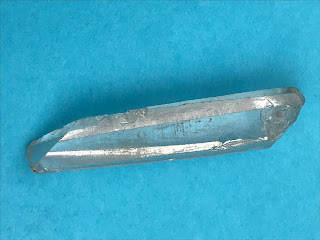
Below, a larger Herkimer “Diamond” crystal (22 mm long and 9 mm wide) is shown. This crystal is not perfectly clear. It has some incipient milky quartz cloudiness, which comes from microscopic inclusions of fluids stemming from when the crystal grew. This specimen also has some black hydrocarbon inclusions.


If you are ever in the vicinity of Herkimer County, you might want to stop and do your own collecting (for a fee). It is not every day one finds doubly terminated quartz crystals that are so perfectly clear.

Tuesday, December 14, 2021

REMARKABLE SLUMP-FOLDED BEDS


This post concerns an “eye-popping” section of extremely slump-folded sandstone beds within the Chatsworth Formation, in the Simi Hills of Ventura County, southern California. You have to see the actual beds, or see a picture of them, in order to believe it.

These slump-folds are of Late Cretaceous age (late Campanian/early Maastrichtian age, about 70 million years old). They are located on protected land.


Three images of these slump beds are shown below (a person provides the scale): the first two are essentially the same view, but the second of these two was taken under different lighting. The third image is of the same channelized flow but a several meters westward, near the lowermost part of the slump feature.


The folded/crumpled beds consist of numerous wedge-outs of sand-rich deposits (with a sandstone to mudstone ratio of 12:1). These beds filled a braided-channel, turbidite deposit in a deep-sea-fan system of a submarine middle-fan environment (see references below for all the gory details). Turbidites are deposits of sediment-gravity flows which include turbidity currents, fluidized sediment flow, grain flow, and debris-flow mechanisms. The beds were originally in a semi-liquid state, unstable, and slid down a slope.


For more details, see the following references:


Link, M.H. 1981. Sand-rich turbidite facies of the Upper Cretaceous Chatsworth Formation, Simi Hills, California. Pp. 63–70, in Link, M.H., R.L. Squires, and I.P. Colburn, (eds). Simi Hills Cretaceous turbidites, southern California. Pacific Section, Society of Economic Paleontology and Mineralogy [Guidebook]. Los Angeles, California. 134 pp.


Note:  This slump fold was illustrated also on the cover of AAPG, v. 67, no. 3, 1983.


Link, M.H., I.P. Colburn, and R.L. Squires. 1984. Slope and deep-sea fan facies and paleogeography of Upper Cretaceous Chatsworth Formation, Simi Hills, California. The American Association of Petroleum Geologists, v. 68 (no. 7):850-873, 22 figs., 4 tables. Note: See Fig. 12D for a picture of the slump fold illustrated in this present blog post. 


Thursday, December 2, 2021

How And When Did Monkeys Get To South America?

Monkeys live today in the Old World (Africa and Asia) and in the New World (South America, Central America, and southern Mexico). The consensus has been that they originated in Africa, but it is not known with certainty how they managed to get to South America. You might think that the answer is they that they simply walked from Africa to South America, but the answer is not that straightforward. 

Here are the paleontologic facts: 


The earliest known fossils of monkeys are found in Africa (Egypt) and in South America (Bolivia and in the Amazon region of Peru). They are all about the same geologic age: latest Eocene/early Oligocene (about 33-35 million years ago). The problem is that there was 1,400 km of open ocean between Africa and South America at that time (and previously for a long time—millions of years earlier, during Cretaceous time).


So, that nagging question is: “how did monkeys get from Africa to South America.” The usual answer, which that has been around since the 1960s and is still in vogue today, is that African monkeys floated on clumps of forest vegetation (e.g., modestly large forested islets) that floated downriver and eventually ended up in the ocean. These clumps then drifted across the Atlantic Ocean to South America during late Eocene/early Oligocene time. The shortest distance would have would been 1,400 km, and the drifting is estimated to have taken at least 60 days. Then monkeys then would have had to transverse overland a long distance, from the eastern shores of South America, in order to reach the inland jungles of Bolivia. This widely believed “floating-vegetation theory” is commonly referred to as the “accidental transoceanic dispersal” theory. 


Another theory is that the earliest monkeys reached South America via southern North America during late Eocene time. This theory, as well as the one discussed above, are questionably indicated on the following known paleogeographic map that shows the position of South America, relative to North America and Africa during the late Eocene. The few scientists who advocate this second theory of a dispersal route via North America have proposed, furthermore, that monkeys originated even earlier that late Eocene time. For example, in Wyoming, a sparse record of early Eocene fossils that resemble marmosets (= New World monkeys) is known.


While you contemplate the unsolved mystery of the ancient geographic dispersal of monkeys, it is useful to give you some background biologic information to consider. Monkey are primates. Primates include the prosmians (lemurs, bush babies, lories, pottos, and tarsiers) and also the anthropoids (monkeys, gibbons, apes, and humans). Old World monkeys consist of several families, and these are referred to as the catarrhines. They are characterized by having nostrils separated by only a thin partition, and they also have jaws with two premolars. Two examples of catarrhines are the macque monkey and baboons. Old World monkeys do not have prehensile tails. Old World monkeys include both arboreal (live in trees) and ground-dwellers.


An example of a modern-day catarrhine monkey (from Japan) is shown above. Photo credit: Wikipedia, 2021.


The New World (South America, Central America, and southern Mexico) monkeys are referred to as the platyrrhines. They are characterized by having nostrils that are quite separate, and they also have jaws with three premolars. Two examples of platyrrhines are shown here: cebids and marmussets New World monkeys have a grasping prehensile tails. New World monkeys are only arboreal.


An example of a modern-day platyrrhine monkey (cebid) from Costa Rica. Photo credit: Wikipedia, 2021.


A second example of another modern-day platyrrhine monkey (marmoset). Photo credit: Wikipedia, 2021.


A relatively recently published comparative study of mitochondrial genes of primates has been interpreted as agreeing with the fossil data showing that platyrrhines split from catarrhines at around 35 million years ago. The authors of the mitochrondrial study also advocated the “floating on vegetation” theory (see discussion above).


USEFUL REFERENCE;

For an excellent article concerning evolution of mammals in South America, I highly recommend: https://dcpaleo.org/south-americna-fossil-mammals/

Sunday, November 28, 2021

TERROR BIRDS

The generalized term “terror birds” is the focus of this post. It refers to a group of extinct similar looking birds that could be up to 8 or 10 feet tall and weighing 400 pounds. There were several genera/species, and they make up an extinct group of carnivorous flightless birds, referred to as the phorusrhacids. They were the largest apex predators to live in South America during the Cenozoic Era.


One example of this group is genus Phorusrhacos [pronounced For-us-Rah-koss], of middle Miocene age, about 14 million years ago, from Santa Cruz, southern Argentina. Although it superficially resembles an ostrich, it is not one. The skull of Phorusrhacos is very different. Phorusrhacos was 8 feet tall and weight 300 pounds or more. A model of this genus is shown below. 


The geologic time range of “terror birds” is most of the Cenozoic, from late early Paleocene, late Danian Stage [=62 million years], through the early Pleistocene [=1.8 million years]; an interval of approximately 60 million years. Why did they go extinct? Most likely, it was because of changing habitat (related to changing climate during the Pleistocene Ice Age). Also the Panamanian Land Bridge emerged during the Pleistocene, and South America became connected to North America, and large predatory cats and dogs migrated southward into South America for the first time.


It is interesting to mention that the geologically youngest “terror bird” (Titanis walleri = 8 feet tall and 300 pounds), of early Pliocene to early Pleistocene, lived in Texas and Florida. This shows that at least a “terror birds” migrated northward into North America, but their presence there did not last long.


The geologic history of birds, in general, is a complex subject. They originated during the “time of dinosaurs” during the Jurassic Period, but their diversity increased significantly during Cenozoic time. A very generalized cartoon showing the major different groups of Cenozoic birds is shown below. The “story” of bird evolution is still unfolding.  


I encourage you to “Google” the words “terror birds” or Phorusrhacos. There are MANY online colorful renditions of what this animal and its relatives looked like.