Thursday, February 24, 2022

HUMOROUS SCIENTIFIC NAMES

Prior to the early part of the 19th century, there was much confusion regarding the naming of extinct and extant organisms. Following the publication of the 10th edition of the Systema Naturae by Linnaeus in 1758, rules were established and occasionally updated for the creation of binominal names (genus and species) of names (e.g., they have to be Latinized, the genus name is capitalized and the species name is lowercase). These rules, which are given in the International Code of Zoological Nomenclature, have been adopted worldwide now and continue to fully utilized in modern times. In some cases, mild humor has made its way into the names.

In my career as a paleontologist, I have come across some humorous scientific names. Some are funny genera names, and some include funny associated species names. They are given below, with the author, the year the named was created, and some useful background information.


Agra cadabra Erwin, 1986—a carabid ground beetle.


Agra phobia Erwin, 1983, a beetle.


Agra vation Erwin, 1983—a carabid beetle from Peru.


Aha ha Menke,  1977—an Australian wasp.


Ba humbug Solem, 1983—a rare land snail endemic to the Ba District of the Fijian Island of Viti Levu. This snail is highly endangered because of deforestation and probably the influence of invasive species (Pacific rat, house mouse, and various ant species).


Chaos chaos (Linnaeus, 1767)—a giant amoeba.


Disaster L. Agassiz, 1835 [if pronounced like the word “disaster”]—a fossil echinoid.


Eurygenius LaFerté-Sénectére, 1849—an antlike flower beetle.


Extra extra Jousseaume, 1894—a marginellid marine gastropod, now referred to as Marginella.


Gelae Miller and Wheeler, 2004—[pronounced “jelly”]—a round-shaped beetle found in North America and Central America. There are four species:

   Gelae bean

   Gelae rol

   Gelae fish

   Gelae donut


Godzillius Schram, Yager, and Emerson, 1966—a crustacean.


Hallucigenia Conway Morris, 1977—a Cambrian animal from the Burgess Shale in British Columbia (see one of my previous posts).


Han solo Turvey, 2005—an Ordovician trilobite from China.


Hunkydora novozelandica (Reeve, 1859)—a marine myochamid bivalve of small size from New Zealand.


Ittibitium Houbrick, 1993—pronounced “it-tee-bit-tee-um”—a very small marine cerithiid gastropod.


Kamera lens (O.F. Muller) Patterson and Zölffel, 1991—pronounced “cam-era lens”—a single-cell micro-organism.


Lalapa lusa Pate, 1947—pronounced “la-la-pa-lusa”—a large, wasp-like insect in No. America.


Meomyia Evenhuis, 1983—[pronounced “me-o-my-e-ia”]—a flying insect in Australia.


Mini mum Scherz et al. 2019—one of the world’s smallest frogs.


Pieza Evenhuis, 2002—[pronounced “pizza”]—a fly from northern Venezuela. There are three species:

   Pieza kake

   Pieza pi

   Pieza rhea


Spongiforma squarepantsii Desjardin, Peay, and Bruns, 2011—a sponge-like, rubbery fungus found in Malaysia.


Ytu brutus—pronounced “you-too Brutus”—a Brazilian beetle in the genus Ytu Spanger, 1980.

___________________


For additional comments about humorous or weird names, see:


Conniff, R. 1996. What’s in a name? Sometimes more than meets the eye. Smithsonian Magazine, pp.66-68, 70.


Judd, W. 2014. Weirdest species names.


https://www.australiangeographic.com 


Wikipedia.org was also very useful in researching the author information.               www.curioustaxonomy.net


Monday, February 14, 2022

CRUCIBULUM: AN INTERESTING SEA SNAIL

This post concerns two species found today in the tropical waters of the west coast of the Americas. They belong to Crucibulum Schumacher, 1817, a genus of sea snails (gastropods) that resembles some tide-pool limpets, but is not one. By the way, Crucibulum is also a genus of fungi (found in birds’ nests), but this usage does not conflict with Schumacher’s name because snails are classified in Kingdom Animalia.

Two species of Crucibulum are illustrated below. The first is Crucibulum umbrella (Deshayes, 1830), from the state of Jalisco, which fringes the Pacific Ocean in western Mexico. This species lives on wave-swept rocks at low tide. Three views are shown:

Dorsal, side, and ventral. Notice the conical internal “cup.” At its apex, it is attached to its shell, but this “cup” is otherwise free along its margin. Note: This specimen of C. umbrella is usually large. Most specimens of this species are less than 60 mm wide, but this specimen has a maximum diameter of 87 mm and is 23 mm tall (probably a world’s record for this species). 


The second species is Crucibulum scutellum (Wood, 1828) from Baja California (exact locality not know, but this species lives from Cedros Island, Baja California to Ecuador. This species lives on other shells on intertidal mudflats to offshore depths of 27 m. Three view are shown: dorsal, side, and ventral. Notice that the conical internal “cup,” which is  attached at its apex is also attached via a narrow, curving ridge (indicated by the red arrow). The illustrated specimen is 55 mm wide, 30 mm tall, and 75 mm in length.


At first glance, genus Crucibulum, the snail, resembles a limpet gastropod, but Crucibulum belongs to a wholly different group of gastropods. Crucibulum belongs to family Calyptraeidae, commonly referred to the “cup-and-saucer” sea snails. Fossils of this family have a geologic record extending back to the Cretaceous, and the geographic distribution of this family (with its lowly moderate number of genera) is widespread. 

Monday, January 31, 2022

THE MOHS HARDNESS SCALE


This scale (from1 to 10) provides a qualitative indication of the scratch resistance of common minerals versus a “standard” of known minerals. Using this “scratch test,” one can quickly establish the hardness of an “unknown” mineral relative to a series of common minerals whose hardness is already known. For example, if some sample is scratched by fluorite but not by quartz, the hardness of the sample on the Mohs Scale would fall between 4 and 6.


The scale was created in 1822 by the German mineralogist Friedrich Mohs. According to Wikipedia, this scale has been used to even evaluate the hardness of smartphone screens. Most modern ones use “Gorilla Glass,” which scratches at level six.


The Mohs Scale is ordinal: corundum [includes sapphire and ruby] (9) is twice as hard as topaz (8), but diamond (10) is four times as hard as corundum.


Some useful comparisons:

Your fingernail scratches talc, gypsum, and graphite.

Quartz scratches glass.

Diamond scratches all other minerals.

Artificial compounds (simulants), like cubic zirconium has a hardness of 9, and moissanite (see one of my previous posts) has a hardness of 9.5 to near 10.

A streak plate (unglazed porcelain) has a hardness of approximately 7.0.


Scratch kits for determining Mohns Hardness are available for a modest sum (but diamond is not included!).


The following 10 minerals, given in an increasing order of hardness, are used commonly as “standards” in the Mohs Scale:


                                                     talc


                                                 gypsum


                                                   calcite


                                                fluorite


                                                 apatite


feldspar


                                                  quartz


                                                   topaz


                                                 corundum


                                                 diamond


Sunday, January 23, 2022

 The largest known ammonite

Parapuzosia seppenradensis (Landois, 1895) is the largest known planar coiled (coiled like a rope) ammonite. It is from Germany and is of Late Cretaceous (early Campanian) age, and it is 1.8 m (5.9 feet) in diameter. Its shell is incomplete because the living chamber is missing. The largest specimen of this species was found in Germany. Many museums throughout the world have replicas of this desmoceratid ammonite species on display, including the Los Angeles County Museum of Natural History. Ammonites are extinct cephalopods that died out at the end of the Mesozoic Era (65 million years ago). Living cephalopods include the chambered Nautilus, squids, octopods, and a few other groups. 


Sunday, January 9, 2022

GROSSULAR GARNET

Garnet is not a single neosilicate mineral; rather it is comprised of several groups of closely related silicate minerals. The generalized chemical formula for the entire garnet group is Ca3Al2Si3O12, but there can be much substitution of other elements (e.g., iron, magnesium, manganese, chromium] for the calcium [Ca] and the aluminum [Al]. As a result, there is a huge range of colors in each of the groups, and identification as to the specific group of garnet can be difficult. Some crystals of garnet are gemstones because of their beautiful color and/or rarity. Garnets can form in both metamorphic and, to a lesser extent, in igneous rocks.

This post concerns two examples of grossular [also called grossularite] garnet. 


The pure form of grossular garnet is colorless, but if iron substitution takes place, the color can be white to brownish red to green or black (no color). A South African variety of grossular garnet with considerable iron substitution is called “South African Jade” or “Transvaal Jade.” It is, however, not jadeite or nephrite (see my recent post concerning these two minerals). 


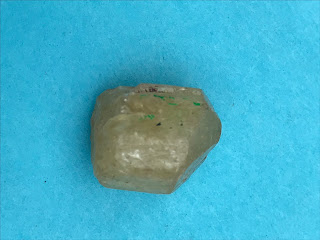
The first three images show different crystals of a cinnamon-brown grossular garnet. Their provenance is probably Mexico. They are all 3 cm in height. The first image shows the rhombic dodecahedron crystal habit found in all garnets. The next two are interior views: one showing a cross-section of a large black core (iron rich), surrounded by an outer thick lighter color zone (much less iron). The next view shows fine internal layering of a partial specimen. The dark color of the core and the layering within the outer (lighter) core might be the result of compositional zonation related to temperature change during the complicated formation of the crystal.


The last image, shown below, is a hand specimen (8 cm maximum dimension) of quartz-rich rock containing abundant garnets. The provenance is unknown to the writer. There are two kinds of garnet in this rock. One is possibly a brownish-red grossular garnet. Its crystals are abundant, large in size (up to 1 cm), and brownish red, with a few having black cores. The other kind is green grossular? garnet. Its crystals are mostly small-sized and can contain some tiny “dots” of black inclusions. A few of the green grossular? crystals are large (up to 1 cm).


Monday, December 27, 2021

Herkimer Diamonds

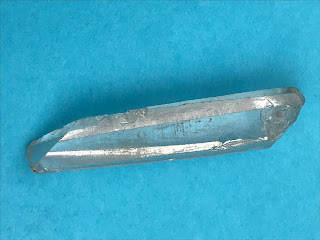
These are not true diamonds, but they have their own beauty. Herkimer “Diamonds” are naturally double-terminated (also called “double point) quartz crystals that can have amazing clarity (truly crystal clear). Each crystal is a six-sided prism terminated at both ends by a rhombohedron: thereby making 18 crystal faces (facets). When the terminations are equally developed, the appearance is that of a hexagonal dipyramid. 


Herkimer “Diamonds” are unlike diamonds in that the former are natural and do not require cutting and smoothing by humans. Herkimer “Diamonds” have a hardness of 7 on the Mohs Scale (note: all quartz has a hardness of 7); thus they are not as hard as true diamonds, which have a hardness of 10.


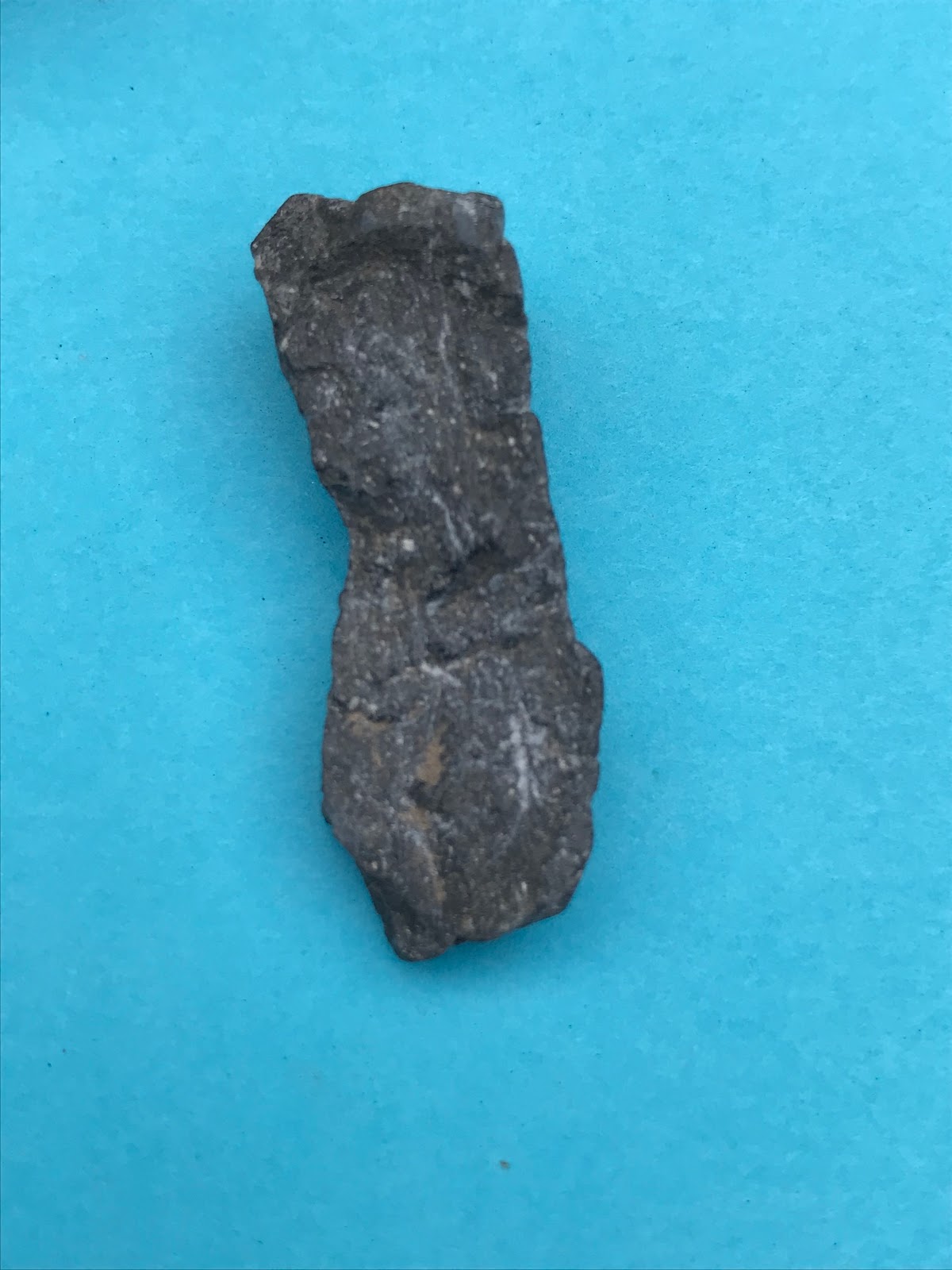
Herkimer “Diamonds” are found at and near Herkimer, Herkimer County, New York, about a 4.5- hour drive west from New York City. These crystals occur in the very fine-grained, gray-colored Little Falls Dolostone of Cambrian age (500 million years old). Dolostone is a combination of dolomite and limestone, and dolostone fizzes weakly in a 10% solution of hydrochloric acid.


The Herkimer “Diamond” crystals always occur in vugs (cavities, like those associated with geodes) within the dolostone, and the precipitation of these crystals probably took place during the Carboniferous age, about 300 million years ago. The Herkimer “Diamond” crystals need air space. Without the “air space,” they cannot form doubly terminated crystals. They do not adhere to the dolostone. They can adhere, however, to each other, but only at the end points of the crystals. Thus, they weather out of the outcrop as individual crystals. Their value depends on the their size and how clear (translucent) they are. Some of the crystals have inclusions (small fragments of impurities), which are most commonly pieces of black hydrocarbon material.


Shown below, is a tiny Herkimer “Diamond” quartz crystal (5.5 mm long and 2.5 mm wide) still inside a tiny vug in the Little Falls Dolostone. 


Below, a larger Herkimer “Diamond” crystal (22 mm long and 9 mm wide) is shown. This crystal is not perfectly clear. It has some incipient milky quartz cloudiness, which comes from microscopic inclusions of fluids stemming from when the crystal grew. This specimen also has some black hydrocarbon inclusions.


If you are ever in the vicinity of Herkimer County, you might want to stop and do your own collecting (for a fee). It is not every day one finds doubly terminated quartz crystals that are so perfectly clear.

Tuesday, December 14, 2021

REMARKABLE SLUMP-FOLDED BEDS


This post concerns an “eye-popping” section of extremely slump-folded sandstone beds within the Chatsworth Formation, in the Simi Hills of Ventura County, southern California. You have to see the actual beds, or see a picture of them, in order to believe it.

These slump-folds are of Late Cretaceous age (late Campanian/early Maastrichtian age, about 70 million years old). They are located on protected land.


Three images of these slump beds are shown below (a person provides the scale): the first two are essentially the same view, but the second of these two was taken under different lighting. The third image is of the same channelized flow but a several meters westward, near the lowermost part of the slump feature.


The folded/crumpled beds consist of numerous wedge-outs of sand-rich deposits (with a sandstone to mudstone ratio of 12:1). These beds filled a braided-channel, turbidite deposit in a deep-sea-fan system of a submarine middle-fan environment (see references below for all the gory details). Turbidites are deposits of sediment-gravity flows which include turbidity currents, fluidized sediment flow, grain flow, and debris-flow mechanisms. The beds were originally in a semi-liquid state, unstable, and slid down a slope.


For more details, see the following references:


Link, M.H. 1981. Sand-rich turbidite facies of the Upper Cretaceous Chatsworth Formation, Simi Hills, California. Pp. 63–70, in Link, M.H., R.L. Squires, and I.P. Colburn, (eds). Simi Hills Cretaceous turbidites, southern California. Pacific Section, Society of Economic Paleontology and Mineralogy [Guidebook]. Los Angeles, California. 134 pp.


Note:  This slump fold was illustrated also on the cover of AAPG, v. 67, no. 3, 1983.


Link, M.H., I.P. Colburn, and R.L. Squires. 1984. Slope and deep-sea fan facies and paleogeography of Upper Cretaceous Chatsworth Formation, Simi Hills, California. The American Association of Petroleum Geologists, v. 68 (no. 7):850-873, 22 figs., 4 tables. Note: See Fig. 12D for a picture of the slump fold illustrated in this present blog post.