Monday, August 21, 2023

PORCUPINES: A PRICKLY SUBJECT

The name “porcupine” means “quill pig” in Latin, but the porcupine is a rodent, not a pig. Porcupines are mammals that are most closely related to beavers, caviomorphs, capybaras, and other rodents. Porcupines have soft hair mixed with very sharp, stiff quills [= modified hairs] embedded in their skin musculature. There are no quills on their belly, face, or feet.

A group of porcupines is called a “prickle” (I am not kidding!).


In the “Old World” today, there are seven genera and 30 species of porcupines (all in family Hystricidae). They live in Africa, Europe, and Asia (including Sumatra and Malaysia). “Old World” porcupines have no microscopic bards on the ends of their quills.


An example of an “Old World” porcupine, i.e., a Hystricidae porcupine. It lives in forests, is an omnivore (eats plants and carrion), and does not climb trees.


In the “New World” today, there are four genera and 12 species of porcupines (all in family Erethizontidae). They live in northern Argentina to Ecuador, Brazil, southern Mexico, and North America (as far north as Alaska and northern Canada). “New World” porcupines have quills possessing microscopic bards, which are pointed shafts that overlap one another. The bards help prevent the quills from being pulled out of the predatory animal they are in.


An example of a “New World” porcupine: Erethizone dorsatum, a herbivore that inhabits forests, shrublands, and grasslands in the region from Mexico to Canada and Alaska. This species is 8 to 40 pounds in size, has black to brown fur and long claws, and is nocturnal. It does not hibernate. It can climb trees.


A porcupine quill, length 3.7 inches (83.5 mm). Locality unknown. 


Porcupines are characterized by their very sharp-tipped quills (as shown above).  Contrary to popular opinion, porcupine quills cannot be “shot” into the animal that is bothering them, but the quills do easily detach from the porcupine when a predator attempts to bite it. The quills have various shapes depending on their location on the animal. A single porcupine can have up to 30,000 quills. Porcupine quills are solid at the tip and the base but hollow for most of the shaft, thereby allowing the animal to float in water, if necessary. The quill material is keratin, a substance also found in human hair and fingernails. 


The quills protect the rather shy porcupines from their many predators, which include dogs, foxes, wolves, coyotes, bobcats, lynxes, mountain lions, lions, weasels, bears, eagles, owls, dogs, and humans, etc. 


If a porcupine loses a quill, it grows a new one. Their quills have natural antibodies that prevent infection if a porcupine get stucks by its own quills. 


Porcupine quills have long been used by indigenous people in making artwork and decorative clothing. Today, one can buy small bags of porcupine quills online for use in hobbies, etc.


The early evolutionary history of porcupines is not well established. The reasons are because of the pacucity of remains of their immediate ancestors, as well as the paucity of early porcupine fossils. Additionally, porcupines are morphologically closely transitional with other early Cenozoic rodents (e.g., rats and caviomorph rodents); thereby causing considerable uncertainty for paleontologists.


According to Sheng et al. (2020), who used DNA studies, the earliest porcupine fossils are late Miocene in age in both China and Europe.  


There are very sketchy reports that New World porcupines “appeared” as early as Oligocene age in age South America. It remains a perplexing mystery as to how porcupines “came to be” in South America. Some researchers believe that they floated on vegetation rafts from Africa, but there is no scientific proof of this hypothesis, which has been used to is explain how primates from Africa arrived in South America (see my previous post on primates). For those of you who are interested in reading more about this "floatation hypothesis," I highly recommend reading an online article (Bechly, 2018), which has an excellent review of this topic, as well as an extensive literature list with links.   


Procupines were present in South America at least somewhat prior to Pliocene time in South America. They are known to have migrated during late Pliocene time from South America into North America (i.e., during the Great American Biotic Exchange = GABI; [see my November 1, 2022, blog post entitled "A Compilation by R. Squires

of Cenozoic Land Bridges" concerning this migration event]).


Prehensile-tailed porcupines are native today in South America: Venzuela, Guiana, Brazil, Bolivia, Paraguay, northernmost Argentina and also on the island of Trinidad. These porcupines, which are notcurnal, use their tail to "hang out in trees." (national zoo.si.edu)


REFERENCES CONSULTED:


The Animal Diversity Web (online) at https://animaldiversity.org


Animals.sandiegozoo.org/animals/porcupine


Bechly, G. 2018. Hypothesis that some animals were carried over the            Atlantic Ocean on rafts of vegetation. evolution news.org/2018/06rafting-stormy-waters-when-biogeography-contradicts-common-ancestry/


Prehensile porcupines: https:/nationalzoo.si.edu


Sheng, G. and 7 others. 2020. Ancient DNA of northern China Hystricidae sub-fossils reveals the evolutionary history of old world porcupines in the late Pleistocene. BMC Evolutionary Biology 20, no. 88. (a free pdf)


Thursday, August 17, 2023

AARDVARK AND AARDWOLF DIFFERENCES

AARDVARK

This word means “earth pig” in Afrikaans and is derived from the Middle Dutch language. An aardvark is not a pig! Rather, it is a specialized carnivore that is the only living species of the carnivore mammal group known as tubulidentates. Arrdvarks belong to genus Orycteropus, and they live today mainly in southern Africa. They do not like rocky areas or soggy ground.


Aardvakrs are characterized by their stocky body, “naked” skin, long ears, pig-like tubular snout, extenable tongue, and powerful digging claws (hooves). These features are adaptations to its preference of feeding on termites and ants; thus arrdvarks can be referred to as insectivores. Some people refer to this animal as an anteater mammal, but it is actually a specialized carnivore mammal. The arrdvark and true anteaters (which belong to a totally different order, family, and species) are examples of convergent evolution: they have similar life habits, thus they resemble one another.


A representative specimen of the living aardvark from Africa (figure based on a figure on p. 58 of Savage and Long, 1986).


The aardvark is a nocturnal burrowing mammal. It is medium size (up to 2 feet tall at its shoulder) and weighs 88 to 140 pounds.


The fossil record of aardvarks is sparse. Its earliest known fossils are fragmentary remains from lower Miocene deposits in East Africa. It is also known as Miocene fossils in Frnace, Greece, Turkey, and India; as well as Pleistocene fossils from Madagascar.


AARDWOLF


This word means “earth-wolf” in Afrikaans. It is not a wolf! The scientific name of arrdwolves is Proteles cristata. It is a close relative of hyaenids, and like them, arrdwolves are carnivores. Furthermore, aardwolves represent specialized hyaneid with very reduced teeth adapted to feed only on termites and ants. Aardwolves are therefore more accurately described as insectivorous carnivores.


Individuals of Proteles cristata are about 3.5 feet long and weight between 17 and 30 pounds. Like its meat-eating hyaenids cousins (of which there are three living species), P. cristata has a posterior-sloping backbone, and a disproportionally large size of the forelimbs. Also, the fur of P. cristata has black stripes, like the majority of the other hyaenids. Proteles cristata is, however, smaller than its meat-eating cousins. Proteles cristata is a shy, nocturnal animal that lives on the arid plains of South and East Africa. There are no known fossils of aardwolves.

A representative specimen of the aardwolf Proteles cristata from Africa (figure based on a figure from on p. 61 from Savage and Long, 1986).  


Reference:

Savage, R.J.G. and M.R. Long. 1986. Mammal evolution, an illustrated guide. British Museum (Natural History), 259 pp.

Tuesday, August 15, 2023

DENDRITES: MINERAL DEPOSITS THAT RESEMBLE PLANTS

Dendrites are actually superficial chemical stains that grew over rock or mineral surfaces. Dendrites include a variety of manganese-oxide minerals, which form when supersaturated solutions of hydrous iron-manganese oxides penetrate a surface and precipitate on it. They are commonly found on bedding planes of siltstone, shale, or limestone. They can also occur in rock fractures and on the sides of crystals of quartz, etc. Dendrites are paper thin and branching. In many cases, they do resemble fossil plants, but they are not fossils.


A slab (15 cm tall and 21 cm wide) of dendrites on a bedding plane of siltstone.


Tuesday, August 8, 2023

CAVITURRITELLA: AN INTERESTING GASTROPOD LIVING IN BAJA SUR , MEXICO

The shallow-marine gastropod family Turritellidae  has a long
geologic record ranging from the Early Cretaceous (late early Albian = about 115 million years ago) through modern day. Its shells have a long slender shape, with a sharp apex, and tightly coiled shells with spiral ribs. Fossil specimens can be very common locally and highly useful for differentiating geologic time and ancient-nearshore conditions. Turritellids are vegetarians and feed on detritus. 

Today, there are several species of turritellids living in the warm waters of the Gulf of California. One of these has been long known as Turritella gonostoma Valenciennes, 1832, but recently it has been identified (see Friend and Anderson, 2023) as belonging to genus, Caviturritella.  Unlike specimens of similar looking Turritella, it is possible to extend a needle up through the axis for the entire length of the long spiral shell of Caviturriella gonostoma (Valenciennes, 1832). 


Caviturriella gonostoma, which is found as far south as Ecuador, has a light gray to dark purplish brown shell (up to 115 mm long and 22 mm diameter), and mottled with white. Its sculpture varies from several spiral cords per whorl, with impressed sutures, to almost smooth and flat-sided whorls (Keen, 1971:p. 392, fig. 438).


Two views: apertural view of a shell of C. gonostoma  (length 14.4 cm, diameter 3.3 cm) of C. gonostoma from Mulege, Baja California Sur, Mexico (see map below). The brown circular area in the upper image is the "horny" operculum "trap door" of this shell. The small arrow in the lower image points to the diagnostic hollow central area of the axial area of the shell. 

                                           Map of Baja California Sur, Mexico.


Highway bridge crossing the mouth of the Mulegé River immediately east of the town of Mulegé, Baja California Sur, Mexico (March, 1989). This is the only main river (although small) along the coast of Baja California Sur.

Many years ago, one of my geology major students, Nikki Vaughan, also a scuba-diver, examined a population of this species in very nearshore shallow-marine waters immediately south of the mouth of Mulegé River, at the town of Mulegé, Baja California Sur, Mexico. She discovered this population living in a colony just below the sea floor, in water depths between 7 and 10 feet deep, where the gastropods were crawling around in order to feed. The dominant consensus among biologists at that time was that turritellids are sessile animals (i.e., ones that do not move about)! Nikki was one of the first scientists to provide evidence to dispute that false claim. As part of her study, she also put some of the specimens in an aquarium and watched them move and feed. They even climbed the walls of the aquarium and concentrated around a tube that oxygenated the water. I was one of the first people to watch these movements of gonostoma and confirm her field observations. In 1983, she wrote an abstract about it and, in 1992, co-authored a scientific paper about her important discovery (see below: References Cited).


The C. gonostoma specimens prefer living adjacent to the walled-off outlet of this river into the Gulf of California. They apparently like the brackish water environment and probably migrated there to feed at various times of the year.


References Cited:


Allmon, W.D., D.S. Jones, and N. Vaughan. 1992. Observations on the biology of Turritella gonostoma Valenciennes (Prosobranchia, Turritellidae) from the Gulf of California. The Veliger 35(1):52–63.


Anderson, B. M., D.S. Friend, and W.D. Allmon 2023. Abstract presented at the WSM Meeting June 24, 2023 (50th Annual Meeting, Chapman College, Orange, California).


Keen, A.M. 1971. Sea shells of tropical west America-marine mollusks from Baja California to Peru. 2nd edition. Stanford University Press, Stanford, CA, 1064 pp.


Vaughan, N. 1983. A study of the ecology of Turritella gonostoma living in the Gulf of California, Mexico. Annual Report (for 1982), Western Society of Malacologists 15:13–14.

Wednesday, August 2, 2023

BARCHAN SAND DUNES

Barchans are among the most distinctive sand dunes because of their crescent shape. In order to form, they need winds of moderate velocity that blow in a constant direction. They can be found in deserts of Earth, and they occur also on planet Mars. 

Aerial view of a single barchan dune, Mojave Desert, California. Dune length is approximately 100 m.

Three chains of barchans dunes on the surface of Mars (Credit:NASA/JPL-Caltech/University of Arizona). Each dune chain stretches many kilometers.


As shown in the above sketch, barchan dunes have a crescentic ground plan: a convex side (the windward side) faces the wind and a concave slip face faces downwind (the leeward side). The slip face  has a slope angle of approximately 34° (with a range between 30 and 35°). The sand blows over the apex of the convex side of the dune and  avalanches down the concave slip face. At each far end of the slip face, there is a “horn,” which always points downwind. Thus, in an aerial photograph, it is easy to determine which way the dominant wind direction is/was by seeing which way the “horns” point toward.


The “horns” always point downwind. Barchans move horizontally, at the rate of from 1 to 100 meters/year.


With shifts in the wind direction, one horn can become larger than the other one. Barchan dunes are typically isolated dunes, but they can occur in a chainlike fashion (like those shown above, in the Mars image). If one horn becomes much more elongate than the other, then a barchan dune can transition into a linear-shaped dune.


Vegetation stabilizes (stops) the horizontal movement of barchans. 


The Namib Desert in Namibia of southwest Africa has some well developed dune fields with abundant barchans (Google Earth, 2023). 


Examples of barchan dunes in the coastal region of the Namib Desert (Google Earth, 2023). As viewed, north is at the top of the image; the winds that formed these dunes blew to the north. 

References Consulted:


Bates, R.L. and J. A. Jackson. 1984. Dictonary of geological terms. Anchor Press/Doubleday, Garden City, New York. 571 pp.


Hamblin, W.K. and E.H. Christiansen. 1995. Earth’s dynamic systems. Prentice-Hall, Inc. New Jersey. 740 pp.


Wikipedia.org (2023)


Friday, July 28, 2023

LARGE PECTINID BIVALVES THAT LIVE OFF THE WEST COAST OF NORTH AMERICA

Introductory Note 1: Bivalves belonging to family Pectinidae (the pectens) are commercially referred to as scallops.

Introductory Note 2: For some additional images, see my previous post (Nov. 27, 2017) concerning “Colors of Scallops”).


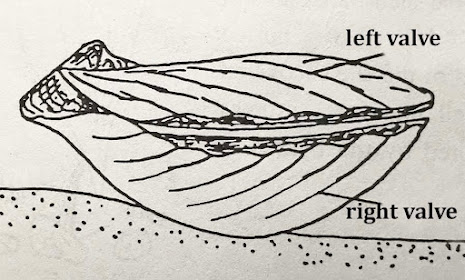
Introductory Note 3: Life position of a pectinid bivalve: 


Introductory Note 4: Morphologic parts of a right-valve exterior of a

pectinid valve:


    ____


Patinopecten caurinus (Gould, 1850)


This species, which is a free swimmer throughout its life, is the largest living scallop in the world. The average size of this bivalve in Alaska is 24 cm in diameter (Foster, 1991). Its valves, which are circular and nearly flat (with small auricles (“wing-like ears”) at the ends of the hinge, have 20 low ribs (Fitch, 1953).


The following information is primarily from <www.sealifebase.ca>


Common Names: “Giant Pacific Sea Scallop” and the “Weathervane Scallop.”


Exterior color: whitish brown; interior color: white.


Geographic Range: Eastern Pacific, from Pribilof Islands, Alaska; Washington; Oregon; and as far south as Point Sur, California (Ignell and Haynes, 2000).


Water Temperature: Temperate (preferred) to boreal. 


Depth Range/Habitat: Usually 60–120 m; total range 2–300 m; found in small depressions on sandy-gravelly substrates; free living (unattached).


Maximum Size: Diameter 22.8 cm (Coan et al. (2000, p. 240).


Other Characteristics: Shell is very lightweight and thin.


Fossil Record of the Species: Pliocene (CA) and Pleistocene (CA). 


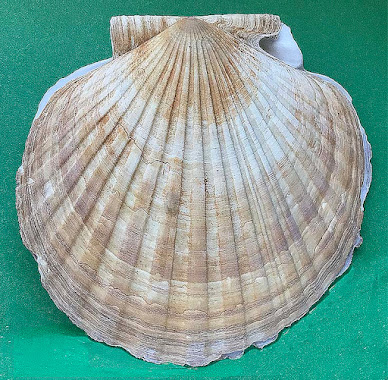
(Top image): right-valve exterior and (bottom image) left-valve exterior of the same Recent specimen of Patinopecten caurinus from Skagway, Alaska. Height 16.5 cm, diameter 17 cm.


Right-valve exterior of a fossil specimen (middle Pleistocene age) of Patinopecten carurinus, Santa Barbara County, Southern California. Height 14.5 cm, diameter 16 cm.


Nodipecten subnodosus (G.B. Sowerby I, 1835)


Common Name: “Giant Lion’s Paw”


Exterior Color: Considerable color variation, from dull purplish-white to brilliant orange and to purplish orange. Interior color: separate bands of purple or white.

For pictures showing color variation, see pectensite.com/Nodipecten%20subnodosus.html 


Geographic Range: Pacific coast of Baja California Sur, Mexico [as far north as Guerrero Negro and Cedros Island] and into the Gulf of California [from as far north as Bahia de Los Angeles, Mexico and southward to the southern tip of Baja California] (Smith, 1991). In El Niño years, this species has been detected at Santa Catalina Island in southern California (Coan et al., 2000).


Water Temperature: Warm temperate to subtropical.


Habitat: Low tide to 110 m depth, in small depressions in sand. Absent near river deltas and estuaries.


Maximum Size: Length 21.7 cm (Coan et al., 2000, p. 242).


Other Characteristics: Shell is heavy and thick; 8 to 9 radial ribs, overlain by fine radial riblets; elongate nodes on the ribs are mainly on the main part (= the bulged-out) umbo region of the shell, when viewed from the side.


Fossil Record of the Species: Terrace deposits in Baja California, Mexico––Middle Pliocene and Pleistocene (Smith, 1991, p. 99).


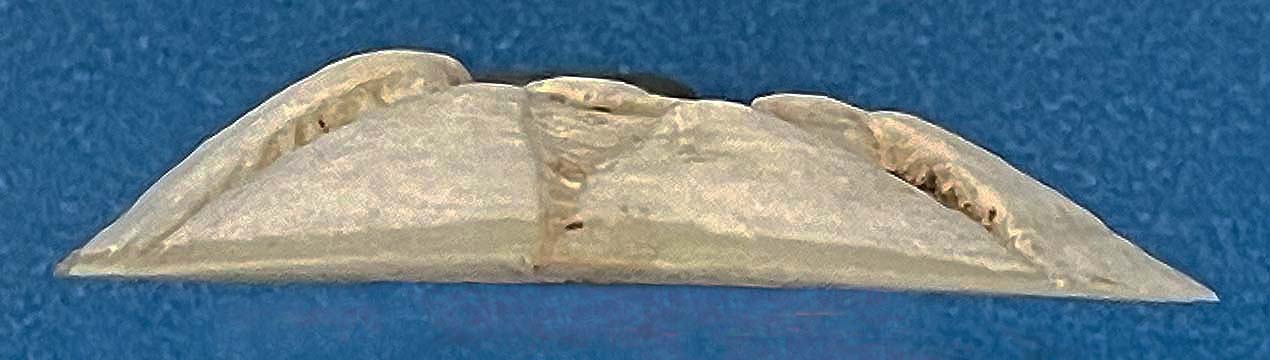
(Top image) right-valve exterior and (bottom image) left-valve exterior of the same Recent specimen of Nodipecten subnodosus From the Gulf of California (exact location unknown), length 14.5 cm, diameter 15.4 cm, thickness (both valves together) 5.5 cm.


References:


Coan, E.V. and P. Valentich-Scott, and F.R. Bernard. 2000. Bivalve seashells of western North America (from Arctic Alaska to Baja California). Santa Barbara Museum of Natural History Monographs Number 2, Studies in Biodiversity Number 2, 784 pp.


Fitch, J.E. 1953. Common marine bivalves of California. Bish Bulletin no. 90, State of California Department of Fish and Game Marine Fisheries Branch, 106 pp.


Foster, N.R. 1991. Intertidal bivalves a guide to the common marine bivalves of Alaska. University of Alaska Press, 152 pp.


Ignell, S. and E. Haynes. 2000. Geographic patterns in growth of the giant Pacific sea scallop, Patinopecten caurinus. Fish. Bulletin 98:849–853. [free pdf available online].


pectensite.com/Nodipecten%20subnodosus.html 


Smith, J.T. 1991. Cenozoic giant pectinids from California and the Tertiary Caribbean Province: Lyropecten, “Macrochlamis,” Vertipecten, and Nodipecten species. United States Geological Survey Professional Paper 1391, 155 pp., 38 pls.


www.sealifebase.ca

Sunday, July 23, 2023

“TURTLE BARNACLES”

Most people think of barnacles as being attached to one another [in colonies] or attached to boat bottoms, submerged bottles, sea shells, rocks, or even shoreline plants [see my recent post, June 2, 2023, on "Barnacles Living in Salton Sea of Southern California]. There are, however, some species of specialized barnacles that can attach to the carapaces of sea turtles and crabs, as well as to the skin of dugongs, and whales, etc. The generalized name “turtle barnacles” is commonly given to all these various specialized barnacles. 

This present post concerns a species of turtle barnacle found associated with a washed-up, dead sea turtle on a beach in the warm waters of the Gulf of California in Baja California, Mexico. An anonymous collector had identified the material as the barnacle Coronula testudinaria Linnaeus, 1758. Based on the available literature, I provide the updated taxonomy of this barnacle, which is be more accurately identified as Cheloniba testudinaria (Linnaeus, 1758). 


 Three views (top, bottom, and side) (length 31 mm, width 27 mm, and height 6 mm, respectively) of the shell of a sea-turtle barnacle “Chelonia testudinaria” from the carcass of a sea turtle found in the Gulf of California, Baja California. The total length and total width of the opercular plates (those in the center of the shell) are 11 mm and 3 mm, respectively. 


The classification of turtle barnacles is the following:


Phylum Arthropoda/Class Crustacea/Subclass Cirripedia/Order Thoraeica/Suborder Ballanomorpha/Superfamily Coronuloidea/Family Coronulidae.


Chelonibia is the largest and least specialized genus of turtle barnacles, and C. testudinaria is common in all warm seas, including the eastern Pacific (Morris et al., 1980). According to Zardus and Hadfield (2004), this barnacle is perhaps the most cosmopolitan of turtle barnacles, and is the largest in size (diameter up to 120 mm). It is occasionally found on the scales of the head and flippers of sea turtles. In total, it is known to associate with seven species of marine turtles.


The shell of this species characterized by its low, dome-shaped shell, supported internally by numerous closely spaced, radiating septal buttresses (Morris et al., 1980). The shell is strong, oval shaped, smooth, and white in color, and grooved with six prominent radii that create a “star-like” appearance (Darwin, 1854). The widest part of the shell is on the posterior of the shell. The four opercular plates (those that close off the operculum) are long and narrow. 


Chelonibia is the least specialized genus of turtle barnacles. Superficially, its wall appears to be made up of six plates, but studies show that early in its development, there are actually eight plates. In the initial shell development (within only 24 hours) however, the rostro-lateral plates undergo coalescence (fusion), thereby producing seemingly only six plates (Zardus and Hadfield, 2004). This apparent “tripartite” rostrum of Chelonibia is a vestiage of the eight-plated ancestry of all balanomorphs (Morris et al., 1980).


Based on fossil occurrences in the Mint Springs and Byram formations of Mississippi, genus Chelonibia has a geologic range from the Oligocene to recent (Zullo, 1982).


References Used: 


Darwin, C. 1854. A monograph on the sub-class Cirripedia with figures of all the species. The Balanidae, the Verrucidae, etc. London: Ray Society, 684 pp. Available online (free) at: darwin-onliine.org.uk


Morris, R.H., D.P. Abbott, and E.C. Haderlie. 1980. Intertidal invertebrates of California. Stanford University Press, Stanford, California, 690 pp.


Zardus, J.D. and M.G. Hadfield. 2004. Larval development and complemental males in Cheloniba testudinaria, a barnacle commensal with sea turtles. Journal of Crustacean Biology 24, issue 3, pp. 409-421. Available online (free) at: https://doi.org/10.1651/C-2476


Zullo, V. A. 1982. A new species of the turtle barnacle Chelonbia Leach, 1817, (Cirripedia, Thoracica) from the Oligocene Mint Spring and Byram Formations of Mississippi. Mississippi Geology 2, no. 3:1-6. Available online (free).