Showing posts with label Pliocene. Show all posts

Monday, April 19, 2021

The Only Cowrie Living On The West Coast of the United States

Neobernaya spadicea (Swainson, 1823) (the “chestnut” cowrie), a member of family Cypraeidae, lives today only from Monterey Bay, Monterey County, California to southern Baja California Sur, Mexico. Cowries are marine gastropods found most commonly throughout the world in warm to tropical, shallow-marine waters. There are approximately 260 living species and many extinct species. Living cowries are among the favorites of sea-sea collectors because the cowrie shell is glazed (highly polished) and can have an array of beautiful colors and patterns. The geologic record of cowries is from the Jurassic to Recent. There are many Cenozoic cowries in the fossil record of the west coast, and most of them lived during times that were much warmer than today in this area.

The cowrie now known as Neobernaya spadicea (Swainson, 1823) was misidentified as to genus [e.g., Cypraea], until 2000, when it was recognized as actually belonging to genus Neobernaya. The fossil record of N. spadicea is Pliocene to Recent.


The following four  images are of a specimen of N. spadices (49 mm length [distance between the posterior and anterior]; 29 mm width; and 24 mm height [distance between the base/bottom and the dorsum/top]. This specimen was collected in beach drift from a beach in Santa Barbara County, Southern California.


                                                         dorsal (dorsal)  view


                                                  ventral (base/bottom) view


                                right-side view (outer lip side)


                                  left-side view (inner lip side)


The name “spadicea” refers to the chestnut-brown color although there is a variation of the color of the top surface of the shell of this species: from chestnut brown to rust to red. The base (lower surface) and lower parts of its sides of the shell, however, is white.


This species lives in moderately cool waters, from intertidal to 50 m depth, especially the sublittoral zone near ledges and rocky areas. It lives in the near vicinity of forests of the giant kelp Macrocystis pyrifera, where this gastropod preys on bryozoans, hydroids, sponges, anemones, tunicates, and molluscan eggs. At least one of octopus apparently feeds on N. spadicea.


After hatching from eggs, the young of N. spadicea transition into a free swimming stage (veliger), but they are slow swimmers and many settle quickly to the ocean floor and begin to grow into adults. The juvenile stage of this species, like all cowries, is called the “bulla” stage. Its shell is very thin and elongate. Eventually, this stage will transition into the glazed over, strong shell of an adult. The maximum, full adult shell size is about 80 mm length.


Interior of a N. spadicea specimen showing the juvenile bulla stage. The entire specimen (length 46 mm, width 27 mm) was collected also as beach drift from a beach in Santa Barbara County, Southern California.


Much of the information used in this post is from the following very useful and up-to-date reference:


Groves, L.T. 2019. The family Cypraeidae Rafinesque, 1815, in the northeast Pacific: One spectacular species. Zoosymposia 13:131–138 (James H. McLean Memorial Volume).   


Tuesday, September 13, 2016

The world's oldest fossils (maybe).


In September of 2011, the discovery of the so-called "world's oldest fossils" was written up in   Nature Magazine, mentioned in newspapers, and discussed online.

These "fossils" are 3.7 billion years old and were found in southwestern Greenland following recent melting of some snow. They might be stromatolites made by cyano-bacteria, and, if so, they would be 220 million years older than previous substantiated previous finds of Precambrian cyano-bacteria.

I include the best picture I could find online showing these Greenland "fossils."

The Greenland "fossils," 1 to 4 cm high. Picture credit: Allen Nutman/Nature Magazine. To see more information about these "fossils" go to <www.livescience.com>
Upon seeing the photo above, my immediate reaction was that they might be flame structures, which are sedimentary (non-organic) structures created by dewatering of "soupy sediment" when it is compacted. The sediment literally is squeezed into the overlying sediment and "flows" as it does, creating the appearance of "flame tips." Flame structures can be of any geologic age.

I include a picture of a flame structures in an outcrop that I came across several years ago while doing some geologic mapping. This example is in deep-sea turbidite deposits in the lower Pliocene Towsley Formation in northern Los Angeles County, southern California. You will have to admit, at least, that the resemblance is striking.

A flame structure (closeup shown on the right) in the Towsley Formation just north of Sunshine Canyon, Santa Susana Mountains, southern California. The staff is 1.5 m in length, and the flame structure is a few centimeters high. Note: There is a watch (for scale), without a band, on the talus slope just left of the flame structure.


Tuesday, June 14, 2016

Fossil dragonfly nymph from California


Dragonfly nymphs have an aquatic existence for a short time before morphing into winged adults. Nymphs live in lakes and streams and are voracious carnivores. Although it would seem that the muddy and quiet burial environment on the bottom an ancient lake would have resulted in nymphs being commonly preserved, their remains in the fossil record are uncommon.

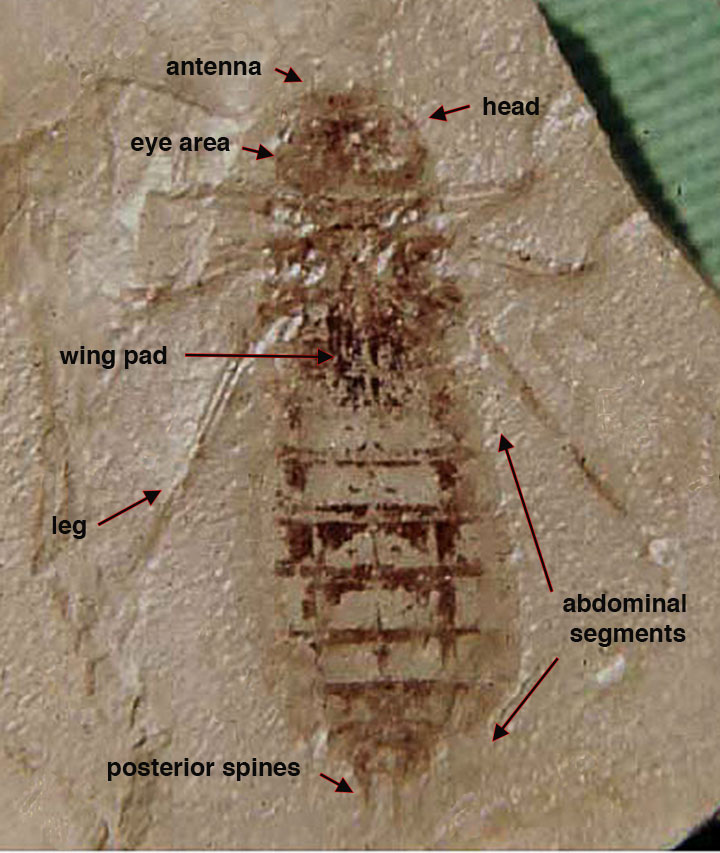
The specimen shown below is a carbonized impression of dragonfly nymph of Pliocene age (approx. 4 million years old) from an ancient lake just north of Los Angeles in southern California.


The specimen is the dorsal view of a carbonized impression of a dragonfly nymph (nearly 35 mm long = nearly 1.5 inches) belonging to family Libelluidae? (genus cannot be determined). It has its antennae (barely visible), left-eye area, both wing pads (probably broken), legs, and posterior spines preserved.


Burial of this specimen must have been rapid, otherwise scavengers would have obliterated the remains.

The specimen was found in a shale bed with associated fish and plant remains (aquatic reedlike plants and nodules of presumably seed-pod origin). 

Sunday, September 7, 2014

fossil pine cones


a fossil pine cone, height 10.5 cm


I have always been intrigued by fossil pine cones, especially the ones that were transported by river currents to a ocean shoreline and ended up being deposited in the shallow-marine environment alongside Turritella shells (see some of my earlier posts) and shark teeth. 

The rare specimen shown above is from float material (weathered out and laying loose on the surface) from the Pico Formation near Newhall, southern California. The formation in this area was deposited in a marine-delta environment. There had to have been pine trees growing in the adjacent, ancient San Gabriel Mountains east of the delta. This pine cone floated down a braided river (full of coarse debris consisting of pebbles and cobbles) and was deposited in fine-grained sandstone near the ancient shoreline. 
another fossil pine cone, height 8.5 cm


The rare specimen shown above is from float material found near Topanga State Beach, southern California. Much less is known about its provenance (origin) than the Pico Formation specimen.


Identification as to the family or genus of pine tree for both of the illustrated specimens is needed. The identification process is not an easy task. Just the presence of pine cones in a sedimentary rock deposit is most helpful, nevertheless, because they indicate that a mountainous area was adjacent to the burial site.