Friday, August 21, 2020

Bowen's Reaction Series

Igneous rocks (e.g., granites, lava flows) are those created by the cooling of molten material called magma. As the magma cools, volatiles are lost, early formed minerals crystallize out and react with the remaining magma, and changes (either in a continuous fashion or a discontinuous one) in composition take place. This is called fractional crystallization. There is a sequence as to which minerals form first, second, third, and so on. This process is known as the Bowen's Reaction Series.


Note: The poster shown below depicts this process. I made it many years ago to help my students visualize the crystallization sequence. It was not made with the intention of showing it online. This explains why the the writing on the poster is a little hard to read, because I had to stand way back with my camera in order to photograph all the writing. Although the dark minerals do not show up very well, this poster is, nevertheless, useful because it conveys the main concept of the progressive sequence of crystallization of an ideal magma as it cools. It is especially helpful because I used actual minerals instead of just their names. 


The Bowen's Reaction Series is the result of research in the 1920's and 1930's by Norman Bowen, who was able to explain why certain types of minerals tend to found together (e.g., olivine and labradorite--see one of my earlier posts on labradorite) whereas others are almost never associated with one another (e.g., olivine and quartz). He experimented with powdered rock material that was heated until it melted and then allowed to cool to a target temperature, whereupon he observed the types of minerals that formed in the rocks produced. He repeated the process with progressively cooler temperatures, and the results allowed him to formulate his reaction series. His work showed that a geologist can infer, from the minerals present in a rock, the relative conditions under which the magma had formed.

The Bowen's Reaction Series can be combined also with crystal size and texture of the rock to determine whether the rock formed under the Earth's surface (plutonic igneous rocks with large crystals visible to the eye) or on the surface (volcanic igneous rocks with microscopic crystals). The rock names (e.g., peridotite, gabbro, granite) are indicated on the left side of the poster.

The following comments are intended only for individuals who are really interested in the details of the Bowen's Reaction Series.

The Bowen's Reaction Series consists of two main branches, the discontinuous reaction series (depicted on the left side of the poster: olivine, augite, hornblende, and biotite) and the continuous reaction series (depicted on the right side: anorthite, bytownite, labradorite, andesine, oligoclase, and albite). The last minerals (especially quartz) are generally considered to be the residual phases. Temperature cools as crystallization proceeds, with the high-temperature minerals forming first, and the low-temperature forming last. The word "continuous" refers to the continuous, series of solid solutions that are produced during the cooling. The word "discontinuous" refers to the ferro-magnesium minerals (e.g., augite) that form during the cooling process. They react with the melt and abruptly produce a new mineral, with different crystal structure and considerably different composition than the mineral that preceded them.

For the Bowen's Reaction Series to work in the perfect "flow chart" fashion (as shown on the poster) requires a magma with an ideal chemical composition and a long time for cooling. In reality, which minerals form are dictated largely by the chemical composition of the original molten material. Also, the Bowen's Reaction Series only goes to completion if there is enough time for the reactions to take place and enough Na, Al, and Si in the remaining melt to form each successive mineral. In the ideal situation, eventually only SiO2 (mineral quartz) is all that remains.

As the temperature (and pressure) decrease, a progression of feldspar minerals takes place. The plagioclase feldspars (anorthite, bytownite, labradorite, andesine, oligoclase, and albite), which have the formula (Ca, Na)(Al, Si)3O8, represent a single mineral (plagioclase) consisting of a solid-solution series with varying amounts of calcium (Ca) and sodium (Na). The highest temperature plagioclase (anorthite) has the highest calcium content. The lowest temperature plagioclase (albite) has the highest sodium content. In between, these ions mix in a continuous series with the calcium/sodium ratio varying from 100% Ca and 0% Na, to just the opposite.  This variable chemical composition creates the different colors of plagioclase. 

The cooler temperature alkali feldspars have varying amounts of potassium (K) and sodium (Na), and the ratio of these two elements also changes as the crystallization process proceeds. There are several of these minerals (anorthosite, microcline, sanidine, and orthoclase). Only orthoclase (KAlSi3 O8)is shown on the poster. 

The high-temperature minerals (e.g. anorthite, bytownite, labradorite) are the most unstable at the Earth's surface and quickest to weather because the Earth's surface is most different from the conditions which they were created. On the other hand, the low-temperature minerals (e.g., muscovite and quartz) are much more stable because the conditions at the surface are much more similar to the conditions under which they formed.

Sunday, August 9, 2020

"Keyhole Limpets"

This post accompanies my previous one about “Shells with a Selenizone.” This new post, however, focuses on gastropod shells with only a single natural perforation (hole), rather than a spiral band of them.

Gastropod shells with only a single natural hole belong to family Fissurellidae (common name of this family is “keyhole limpets"). They have flattened, oval shells with an excurrent opening on their dorsal (top) surface. Their early stages have a spiral shell, but as the shell grows, the spiral shell is lost. Three examples of fissurellids are shown below. All three live attached to rocky surfaces, just like their selenizone-bearing relatives, the abalones.


 Megathura crenulata Sowerby. This shell is 7.5 cm long, but some individuals can secrete shells up to 15 cm long. During life, the shell is covered mostly by a fleshy mantle. The shell is radially striated, with a large, nearly central perforation. This gastropod lives in the low tide to subtidal depths on rock surfaces in the cool-coastal waters from Monterey Bay, California to central Baja California. The animal attaches itself to rocks. The common name of this gastropod is the “Giant Keyhole Limpet.”

Diodora aspersa. This shell is 5.5 cm long and is from the intertidal zone on the Olympic Peninsula, Washington State. The common name of this shell is “Rough Keyhole Limpet.” The shell is heavy, elevated, and has rough, coarse, radial ribs. This species ranges from Alaska to northern Baja California, Mexico. It is most abundant in the northern part of its range, where individuals can reach a size of 7 cm.

Fisssurella nodosa. This shell is 2.3 cm long and is from the West Indies. It is like other Fissurella shells in having an elevated conical shell, but the fleshy animal is unable to retract within the shell. Its natural opening in the shell is definitely keyhole-shaped. Fissurella gastropods are intertidal species that live primarily only in tropical waters. There is only one species found in the cool waters of California.

Tuesday, July 28, 2020

Shells with a selenizone

This post concerns gastropod shells having a selenizone, which is spiral slit or a spiral band consisting of small individual openings. Selenizones are the  result of so-called "less-derived"gastropods (or in older terminology ("primitive" gastropods) having paired gills which used the selenizone for exhaling streams of water.

Some Paleozoic gastropods have a selenizone (for example, please use the search engine for this blog and see my previous post on bellerophont gastropods). During the Paleozoic and Mesozoic, selenizone-bearing gastropods lived in shallow-marine waters. Unfortunately for them, they became easy prey for large fish and reptiles. To gain protection from predators, near or after the end of the Cretaceous, selenizone-bearing gastropods either largely retreated to deeper waters or lived in rocky shoreline environments where most predators were not likely to invade.

Today, selenizone-bearing gastropods are represented by three families: Pleurotomariids, Haliotidae, and Sissurellidae.

Pleurotomariids are restricted mainly to deep waters on the continental shelf, typically in waters of 100 m depth or greater. They are uncommon and hard to catch, and fishermen have to use nets or submarines. Thus, they are considered to be rare and, therefore, worth a lot of money. The discovery of the first living one in 1856 caused a lot of scientific excitement.
Mikadotrochus hirasei Pilsbry, 1903 is a prime example of a living pleurotomariid, and its common name is the "emperor slit shell." It is found in the Western Pacific, especially off the coast of Japan, China, and Taiwan. On the specimen pictured above (side view), you can readily see the long slit (selenizone), located at and in the proximity of the end of the last whorl of this top-shelled shell. This particular specimen is 3.25 inches tall and 4.5 inches in diameter. Its shell interior has a characteristic "mother-of-pearl" luster.
The mother-of-pearl luster is also discernible in the ventral view of the same specimen, where outermost layer of shell are not present or are not thick.

Haliotids have a flat shell, thereby allowing the animal to attach its large muscular "foot" to various hard substrates (rock, pilings, other shells, etc.). Sea water is drawn in under the edges of the shell, passes over the gills, and exits via the natural holes.

Haliotis rubra Leach, 1814 ("abalone"). This specimen (2.5 inches diameter), which is from the south coast of New South Wales, Australia, shows about 10 open holes and about two dozen or so "closed" holes. The latter are present all the way to the top of the spiral tip of the shell. They were formerly open, when the gastropod was young, but as the gastropod grew, it filled in these early holes to keep out marauding predators. 
Haliotis rufescens Swainson, 1822 ("red abalone"). This specimen (7 inches diameter) is from California. This species is the largest of all abalones, reaching over 11 inches in diameter. It ranges from Sunset Bay, Oregon to Turtle Bay, Baja California. It requires active surf and wave conditions, and it inhabits mainly intertidal rocky shores in certain areas, and it is most abundant in northern California. Abalones are vegetarians.


This image shows the interior of the same specimen. You can readily see the iridescent "mother-of-pearl" nacre layer, which is a well-known characteristic of genus Haliotis. Its shell is used in costume jewelry.


Scissurellids are minute gastropods having a spiral slit (selenizone). The geologic record of this family is Late Cretaceous (rare) to Recent.

This image of a modern scissurellid (a few millimeters in diameter) is from en.wikipedia.org.


Monday, July 20, 2020

An Eocene volute gastropod from the Llajas Formation of southern California

This post focuses on a middle Eocene (about 48 million-years old) shallow-marine gastropod belonging to the family Volutidae. The term "volute" is a shortened term, referring to this family.

Eocene volutes are not that common in the coastal area of California, Oregon, and Washington. Locally, however, specimens can be found but usually require persistent collecting. An example of one of these volutes is a species of Lyrischapa from middle Eocene beds in southern California.

The scale in all the photographs has centimeter increments. The largest specimen shown below is 5.5 cm in height, but this specimen is somewhat incomplete.


All the views are of the back (abapertural) side of Lyrischapa lajollaensis (Hanna, 1927). These specimens show a growth series, from juvenile to adult size. The second largest  specimen has many boreholes made by boring algae or sponges. 


Front (apertural) views of Lyrischapa lajollaensis (Hanna, 1927): these are three of the same specimens (the second, fourth, and fifth ones) shown in the preceding image.

Genus Lyrischapa had wide distribution in the world during the Paleocene and Eocene, when warm-shallow seas were widespread. 


Monday, July 6, 2020

Articulate Brachiopods


This post is the second of two parts, and this one pertains only to the articulate brachiopods. 

Articulate brachiopods, which have their two valves held together by teeth and sockets, are epifaunal (attached to hard surfaces by means of a short pedicle) animals. Their shells consist of calcite. This group of brachiopods has a geologic range of Cambrian to Recent.

  One of the most important organs of all brachiopods is the lophophore. It consists of two ciliated coiled tentacles (brachia), whose function is to circulate water, distribute oxygen, and remove carbon dioxide. water currents generated by the cilia move food particles toward the mouth.


The following image shows two views of a specimen of the modern-day articulate brachiopod Laqueus californicus, which is found off Catalina Island, southern California, in waters depths between 240 and 300 feet deep. The valves are egg-shell thin and allow some light to pass through them.


                          Brachial-valve view (width 37 mm).

Side view showing the commissure (the margin separating the two valves). The valves (width 37 mm), which barely open up, do so just far enough to see the delicate structure that supports the lophophore. Any further opening would break the hinge. width 31 mm


The following three images are of a closed-valved, complete specimen of the articulate brachiopod Terebratalia hemphilli Dall, 1902, from upper Pliocene (about 2.5 million-years old) sandstone in Los Angeles County, southern California. The specimen has a thickness (both valves together) of 6.25 cm. The specimen is 6.25 cm height and 5.3 cm wide. 

side view


                                      Brachial-valve view.


Pedicle-valve view.


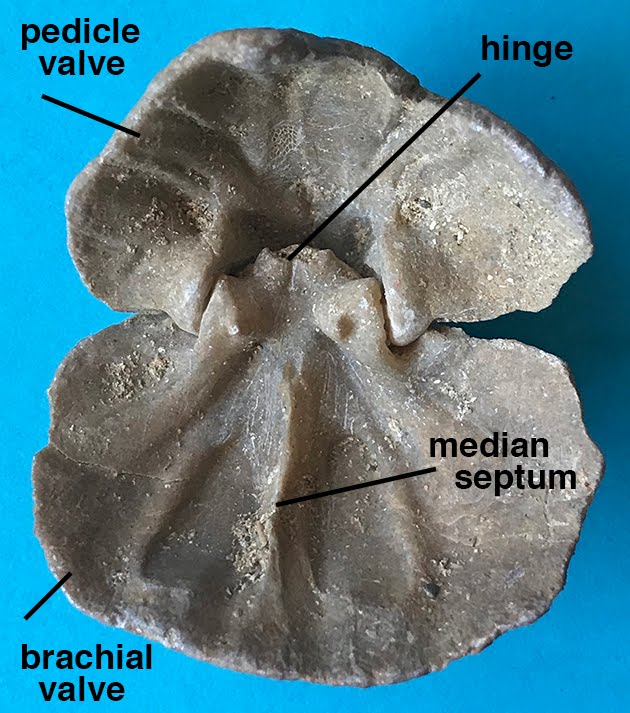
The next image is a another T. hemphilli from the same locality as the previous specimen and shows the partial interior views of both valves (a rare sight!). The maximum width of this partial specimen is 4.2 cm. Its hinge still works. Its two valves move back-and-forth and have no tendency to separate.


It is important to mention, at this point, that although brachiopods are "bivalved" (= consists of two valves) and can resemble some clams (bivalves), brachiopods and clams are NOT the same phylum! There are numerous soft-bodied differences (e.g., brachiopods have a lophophore, whereas clams do not) and there are numerous differences in shell characteristics (e.g., there hinges are different, the interiors of their valves are different, and brachiopod valves have a pedicle opening (foramen), although the foramen might not be obvious on some brachiopods.

Articulate brachiopods were extremely abundant in shallow-marine faunas during Ordovician through Permian times. After the Late Permian mass extinction, they declined in diversity and never returned to the "glory days." Today, they are minor constituents in marine faunas, and some have seeked deeper waters as a refuge. Below are some examples of commonly found Paleozoic articulate brachiopods.


Ordovician, two views of same specimen, 33 mm width.


A Late Paleozoic articulate referred to as a spiriferid (has elongate "wings").


Two views of a Late Paleozoic articulate brachiopod referred to as a productid. This group is characterized by having one of its valves  convex, and the corresponding valve is concave.