Sunday, September 18, 2022

“Cystoids”: A Paleozoic Group of Echinoderms with a Twist

“Cystoids” are Middle Ordovician (about 460 million years old) to Late Devonian (about 560 million years old) echinoderms that lived attached to the ocean floor via a column (stem). Modern echinoderms are starfish, brittle stars, sand dollars, etc. As indicated by the use of quote marks around the name “cystoids,” their classification  in a state of flux and has been for many years. They are currently regarded as consisting of two classes: the rhomboiferan “cystoids,” and the much less common diploporites “cystoids” (Prothero, 2004).

The rhomboiferan “cystoids” were never very abundant, but they are common in some Middle Ordovician rocks.  


Both classes of “cystoids” have an ovoid shape exoskeleton. Their food-catching ambulacral arms (also called brachioles) extend into the water column rather than being fused to the sides of their calyxes (bodies) as found on blastoid echinoderms (e.g., Pentrimites--see my previous post).  The calyx plates of cystoids are characterized by being perforated by tiny tubes or canals (thecal pores). The arrangements of these thecal pores (they can be concealed or raised) is very important in the classification of cystoids.

This image shows the main morphological parts of a cystoid.


The image above shows a partial “cystoid” exoskeleton with the basal part of the exoskeleton and its accompanying main-body section (slightly crushed, diameter 23 mm), including its minute thecal pores. But, only the lower parts of some of its segmented ambulacral arms are present.


An even more incomplete “cystoid” shows only the lower part of the basal area (diameter 12 mm); (note: the minute thecal pores present) and a small part of the column. 


The diploporites “cystoids” are characterized by having a very flexible prehensile column that could wrap around a foreign stationary object. 


Sketch of a diploporite “cystoid” with a prehensile (flexible) column.


Reference:

Prothero, D.R. 2004. Bringing fossils to life: an introduction to paleobiology. McGraw    Hill. 503 pp. 

Monday, September 12, 2022

The Blastoid Pentremites

Genus Pentremites, of Carboniferous age, belongs to phylum Echinodermata, which includes two main types of echinoderms: those attached (e.g., blastoids, crinoids, cystoid) to the ocean bottom and those that are free-to-move around (e.g., starfish, brittle stars, sea urchins, and sand dollars). All echinoderms have a complex water-vascular system, which is an internal apparatus containing watery fluids. This apparatus resembles nothing else in the animal kingdom. Its primary function is to operate the tube feet, which serve food gathering, locomotion (in mobile echinoderms), and sensory functions, as well as respiratory requirements and burrow building.

The skeleton of echinoderms consists of porous calcite (calcium carbonate) plates, which are spiny and covered by a thin skin. The echinoderm skeleton is a product of internal secretion, like the bony skeleton of vertebrates, and the individual hard parts increase in size during the life of the echinoderm.

A sketch of the side view of a blastoid echinoderm Pentremites, which is characterized by having three main body sections: calyx, column (stem), and roots.

Sketch of the dorsal view of a blastoid showing the position of the mouth and the 5-ray symmetry characteristic of the calyx, with five ambulacral areas and five spiracles. The ambulacral areas are covered by feeding grooves, used for transporting food particles upward to the top of the calyx, where the mouth was positioned. The spiracles were used regulating the pressure of seawater that travelled thorough the porous calyx.

Sketch of the side view of two of the ambulacral areas of a calyx.


Side view of a specimen showing two of the ambulacral areas of a blastoid. Actual specimen is diameter 13 mm. 


Dorsal view of a specimen showing the five actual ambulacral areas and spiracles. Specimen slightly crushed, diameter 14 mm.


Tuesday, September 6, 2022

A Very Distinctive Fossil: the Bryozoan Archimedes

The subject of this post, the fossil genus Archimedes, belongs to phylum Bryozoa (bryo, moss; zoon, animal), which has an extensive fossil record. These animals are always colonial, and the colonies range in size from microscopic to, rarely, more than 1 meter across. Bryozoans live (and lived in the past) mainly in marine environments from shallow seas to abyssal depths and from tropical to polar regions.


The fenestrate bryozoa (Ordovician–Triassic) comprise a distinct group within the Bryozoa. They have delicate lattice-like morphology that grew in upright fan-shaped or funnel-like colonies (expansions) cemented to some foreign object by means of a root-like structure, near the base of the colony. Fenestrate bryozoans ate microscopic organic matter that they strained out of the water.


One of the most spectacular fenestrate bryozoan fossils is named Archimedes, which is a Greek name for a screw used to elevate water. Archimedes has a calcified corkscrew-shaped central spiral axis, and branching off from the axis are lattice-like fenestrate fronds. Finding a spiral axis with its branches intact is very rare.


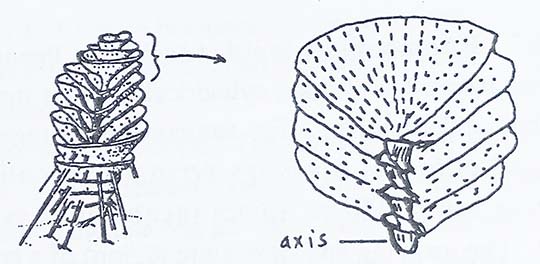
A complete colony of an Archimedes is shown on the left. Also, an enlarged view of some of the fenestrate fronds are shown to the right.


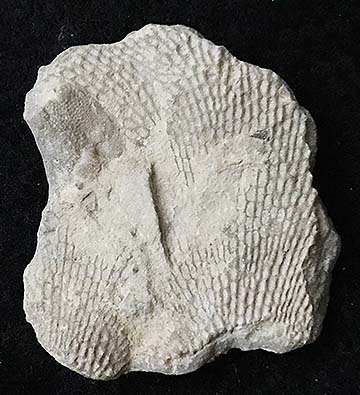
An actual specimen of just the fenestrate fan part (36 mm wide and 40 mm high) of an Archimedes fossil. 


The spiral axes (or screws) of Archimedes can have either sinistral (anticlockwise) or dextral (clockwise) coiling direction, and this phenomenon is referred to as “chirality.” Two “screws” shown above are both 33 mm in length. The one on the left is sinistral coiled, whereas the one on the right is dextral coiled.


To the uninitiated, large specimens of just the central spiral axis (like those shown above) of Archimedes can resemble the backbone of an animal. I know this first-hand because one of the first fossils I ever saw was of a large Archimedes collected by one of my relatives, on his farm near St. Louis, Missouri. I thought that it was a backbone, but many years later when I was an undergraduate in college, my historical geology instructor quickly identified it as an Archimedes. Per his request, I donated that specimen to the “Mineralogy and Paleontology Museum” of the University of New Mexico in Albuquerque. As far as I know it is still there and still on display.


Archimedes is common in the Paleozoic fossil record, with a geologic range from Carboniferous (Mississippian and Pennsylvanian) to Permian. The Carboniferous age specimens are 350 to 325 million years old and are found in the mid-western United States (especially Missouri, Arkansas, and Kentucky). A few Permian species have been found in Russia. During the Carboniferous, the mid-western United States was part of the supercontinent  called Pangea and was located just north of the equator. This area was covered by shallow, warm seas.  


Some references:


Condra, G.E. and M.K. Elias. 1944. Study and revision of Archimedes (Hall). Geological Society of America Special Paper 53:1–243. This is a classic study. NOT FREE.


Taylor, P.D. and C. Sendio. 2013. Chirality in the Late Paleozoic fenestrate bryozoan Archimedes. Bastalleria 19:41–46. Online for FREE!

Monday, August 22, 2022

FOSSILS THAT LOOK LIKE GRAINS OF RICE

Fusulinids are much larger than most foraminifera, which are extinct single-cell protists that consisted of an amoeba-like organism surrounded by a cylindrical/tubular calcareous shell (test = exoskeleton). Most fusulinids, which are between 5 and 20 mm in length and shaped like grains of rice, are of Late Paleozoic (Carboniferous (Late Mississippian) and Permian) age. They show rapid evolutionary development during the Permian. They were bottom-dwelling (benthic) organisms that chiefly lived in warm-water, shallow-marine offshore environments. Their calcareous remains (tests) are commonly major components of limestone. They did not inhabit brackish water nearshore or high-saline embayment environments. Fusulinids have been used extensively by oil companies for determining geologic ages of strata cored during oil-well drilling.


A hand specimen (19 cm wide and 80 cm high) of calcareous (limy) siltstone containing many specimens of fusulinids of Permian age from the Guadalupe Mountains in southeastern New Mexico. The largest specimen (20 mm length) is on the upper middle right side of the rock.


Numerous specimens (about 100) of Fusulina sp. tests weathered out of their enclosing rock matrix. The largest ones are 10 mm in length. These specimens are of Middle Pennsylvanian in age and from shale rock in the Hueco Mountains, near El Paso, Texas.


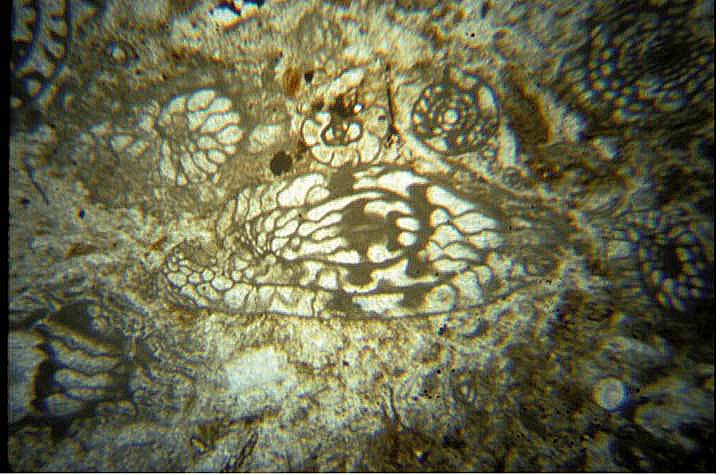
Because the tests of the approximately 50 known genera of fusulinids can be externally very similar looking, it is necessary to cut thin sections of their tests in order to microscopically examine their distinctive internal structures and thus determine their genus and species. A longitudinal section (axial) and a cross section (sagittal) are illustrated in the following sketch shown below. 


Axial and sagittal cross-section views.


The center of this photomicrograph (taken via a microscope) shows an axial view of a fusulinid test in a thin-section of rock. In the background are some sagittal views of nearby specimens. 

Thursday, August 11, 2022

EQUISETUM: A LIVING FOSSIL

Equisetum (Latin, meaning horsetail) is a distinctive plant whose geologic time range is Eocene to Recent. It is native to North America, but it has spread to other continents (e.g., South America and is considered an invasive plant in New Zealand). There are about 15 species today, and they inhabit salt flats, banks of streams, and moist low parts of forests. They cannot live in water.

The higher classification of Equisetum is in a state of flux. It is closely allied to ferns based on how they both reproduce via spores and not by seeds. But Equisetum differs: Equisetum is stiff not soft, it does not have true leaves, it bears its spores in a capsule at the top of the plant rather than underneath leaves.


Above is a close-up of Equisetum showing the structures that contain the spores at the top of the plant. 


Equisetum is the only living genus of joint-stem trees, which range back to Late Paleozoic time (Devonian Period), and had slender, unbranching, and longitudinally ribbed stems with a thick core of pith and rings of small leaves at each transverse joint. These trees were most abundant in sands and muds that accumulated along levees and floodplains of rivers but were uncommon in permanently wet swamps. During the Carboniferous interval, joint-stem trees were especially common.


Equisetum, also called “horsetail rush” or “water rush bamboo,” grows rapidly and can reach heights of up to 8 feet (2.5 m). Except for its relatively small size, modern-day Equisetum is very similar to the Late Paleozoic forms. Once a Equisetum plant gets established, it spreads via its rhizomes and can quickly colonize a substantial area if left unchecked. It is best to contain the plant with barriers.


Most species of Equisetum are referred to as “scouring rushes.” They have stems that are rough and abrasive due to the presence of silica deposits in the outer layer of the stem. They were used for cleaning (scouring) pots and pans in colonial days and are still used by many modern-day campers.


Another name for Equisetum is “snake grass.” The main reason is probably because it resembles a snake, with its tube-like body. In my experience, another reason is because when you walk through a stand of it, there is a harsh grating sound (because of the silica in the stems) that can sound like the rattle sound made by a rattlesnake!


Nurseries sell Equisetum for modest prices. It is a hardy plant that has a distinctive decorative look to it. The images below are of a stand of cultivated Equisetum hyemale that I found growing in small plot of land adjacent to a pool of water in a patio of a commercial building. These plants which have leafless stems standing erect 2 to 5 feet tall, with rigid dark-evergreen hollow jointed nodes with a blackish rim around them. 


Equisetum (about 3.5 feet tall) growing in a small plot of land surrounded by walls. The locale is Los Angeles, Southern California.


A more close-up view of the same plot of Equitsetum.


An even more close-up view of the same plot of Equisetum.


INOCERAMUS: A WIDESPREAD EXTINCT BIVALVE (CLAM) GENUS

The name Inoceramus is Greek, meaning “strong pot.” This genus, which ranges from the Permian? Period (about 255 million years ago) to very near the end of the Cretaceous Period (about 68 million years ago), is very useful for geologic time correlation.  Species of this genus were lived epifaunally on the ocean floor in depths ranging from nearshore sands to deep-sea muds. Their larvae were readily dispersed by currents, and some species became widely distributed. They preferred temperate waters. 

Inoceramus is characterized by having a thin shell with relatively few morphologic characters to distinguish it from similar looking genera; also, the species of Inoceramus can be morphologically similar. In general, both the valves of Inoceramus are somewhat lowly inflated, and they are longer than they are wide. Concentric ribs are common, but radial ribs are rare. The prismatic microstructure of their shells, as well as minute details of their hinges, are useful in helping to differentiate Inocermamus from some other similar looking Mesozoic (Jurassic and Cretaceous) bivalves (e.g., Buchia). Some species of Inoceramus have a small posterior winglike extension, which makes them superficially resemble “winged pearly oysters” of the extant bivalve genus Pteria. 


Overall Inoceramus valves resemble “Ruffle Potato Chips.” Some workers have lumped species, whereas others have overnamed them. Specimens can range up to giant size (3 meters in length!). While alive, these giant valves could serve as a shelter for schools of small fish, which have been found preserved as impressions inside of the bivalves.

ab                                         

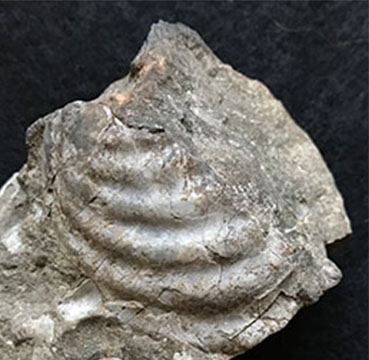
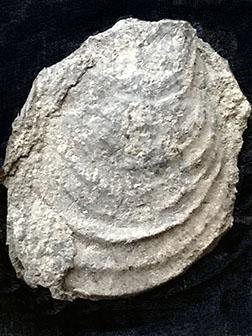
Inoceramus subundatus Meek, complete specimen, (a) left valve and (b) right valve, Late Cretaceous (Campanian Stage), h 6 cm, w 5 cm. Southern California, California.


Inocermaus subundatus Meek RLS collection, incomplete right-valve specimen, h 4.5 cm, w 3.7 cm. Late Cretaceous (Campanian Stage), Chatsworth Formation, Simi Hills, southern California.


Inoceramus subundatus Meek, partial valve, h 3 cm, w 2.6 cm, Late Cretaceous, Santa Monica Mountains, southern California.  


Inoceramus orientalis ambiguous Nagao and Matsumoto, 1939, plaster
cast, h 6.5 cm, w 4 cm, Late Cretaceous (upper Santonian Stage), Clover Creek, Millville quadrangle, Shasta County, northern California.


Inoceramus sp. Partial valve, h 8 cm, w 5 cm, Late Cretaceous (upper Santonian Stage), Wheeler Springs area, southern California. Specimen is in situ in the outcrop.


Thursday, August 4, 2022

THE RED-BELLIED PIRANHA FISH

This fish is well known to the public because movies and television shows have usually made piranha fish to be  senseless “killers” of any unfortunate animal that happens to be wounded and falls into an Amazon River. Some of these rumors surrounding the ferocity of this fish stem from “staged” incidents where the fish were captured, starved, and then fed meat.


Yes, this fish, and its many relatives can feed on flesh, but, piranha are classified scientifically as omnivores, which means it can eat plants and meat. Piranhas are known to be attracted by blood and activity in the water. Thus, it would not be a good idea to be thrashing about in a wild Amazon River if you have an open (bleeding) injury.


The derivation of the word “piranha” is not exactly known, but it probably stems from the words pirá [meaning fish] and ánha, meaning [cut], or sainha [meaning tooth]. In summary, piranha most likely means “biting fish.”


There are four genera and anywhere between 30 to 60 species. All of these are indigenous to the Amazon Basin in South America and its main tributaries; especially in the Venezuela and Colombia river systems, as well as in some other river systems (e.g., in Paraguay, and the coastal rivers of northeast Brazil). Most of the species are restricted to a single river system (for example, the Orinoco River System).


Adult piranhas are mostly between 5 and 14 inches long. The largest living species is the red-bellied piranha, Piranaha Pygocentrius natteri, which is illustrated below. They are the least aggressive of piranhas. Some adults of the extinct Megapiranha are up to 28 inches long.


All piranhas have a single row of extremely sharp teeth in both jaws. Their triangular-shaped teeth are bladelike, tightly spaced, finely serrated, and are interlocking (via small cusps). They are very effective for rapid puncture and shearing. Piranhas have one of the strongest bites found in bony fishes. They occur in "schools"  when hunting their prey.


Right-side view of fish. Length of fish is 8.5 inches. Its eyes are large, almost 0.5 inches wide. This allows them to see well in murky waters.


Top view of fish.


View looking directly downward into its mouth, which is 1.5 inches wide.


Oblique side view of the jaws. The opening is slightly over 1.25 inches high. The largest teeth are 1/4 inches tall. All of the teeth are pointed and, as mentioned before, extremely sharp!