Monday, December 26, 2022

AMBELODONTIDAE: "SHOVEL" TUSKERS

The ambelodontids are an extinct family of proboscideans. Early workers classified them as gomphopheres (see my previous post) because they look similar in body shape and size and have tusks. The lower tusks of ambelodontids however are strikingly different. The lower tusks of ambelodontids are flattened and closely spaced (nearly fused in some species), thereby forming an effective spatulate “shovel” for putting vegetation in their mouths.


About eight genera of ambelodontids are known. Most are only Miocene in age. At least three are endemic to North America (e.g., Ambelodon, Eurybelodon, and Konobelodon). Two other genera, Archaeobelodon and Platybelodon are found in North Africa and Europe, and Aphanobelodon is found in China. 


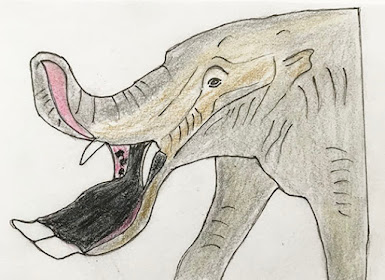
Head view of Platybelodon of middle Miocene age (approximately 15 million years old) of Mongolia (my sketch is modified from a figure from Savage and Long (1986: p. 152), who mistakenly referred to it as a mastodon. 


Reference Cited:

Savage, R.J.G and M.R. Long. 1986. Mammal evolution: an illustrated guide. British Museum (Natural History). 259 pp.

Wednesday, December 21, 2022

GOMPHOTHERES: AN INTERESTING EXTINCT LAND MAMMAL WITH A CONFUSING TAXONOMIC HISTORY

The genus name “gomphothere” and its family name “Gomphotheriidae” are derived from ancient Greek and mean “wedge beast,” in reference to the teeth of this animal. The root of these names does not help to understand as to what kind of “beast” the animal actually was. In fact, until about 20 years ago, before modern scientific techniques (e.g., cladistics and collagen studies) became widely used, the only thing that most vertebrate paleontologists could agree on about gomphotheres was that they belonged to a group of extinct proboscideans that included mastodons, mammoths, and elephants. Classification of gomphotheres is still unsettled, and ongoing research is trying to clarify their evolutionary history (which is a formibable task to say the least, as I discovered while working on this blog post). There is also the confusing problem of having gomphotheres with Latinized names including with the suffix “mastodon” (e.g., Notiomastodon, Sinomastodon, Stegomastodon, etc.).


Gomphothere bodies tend to have long, low-sloping foreheads with tapered trunk areas. Their molar teeth are distinctive: moderately tall and with bun-like tops = bunodont teeth. The majority of gomphotheres have four tusks (incisors): two upper and two lower. They curve upward and outward. Some gomphotheres have only two tusks.


Two views (side and head-on) of a plastic model of Gomphotherium with four tusks.


Gomphotherium skull, side view.

In this post, I recognize the following nine genera of gomphotheres. The number of tusks each genus had is given in parentheses [note: the tusks of Cuvieronius were long (up to three meters) and very sharp]. 


Gomphotherium (4)

Gnathabelodon  (4)

Eubelodon (4)

Blancotherium (4)

Rhynchotherium (4)

Cuvieronius (2) Its two tusks were very long (3 m) and sharp.

Notiomastodon (2)

Sinomastodon (2)

Stegomaston (2)


The diagram shown above depicts the paleobiogeographic distribution of gomphotheres through time. Some of the nine genera names are plotted on this chart, but no attempt was made to include all of them because a few are not well studied.  New age-dating techniques combined with current thinking on plate tectonics reveal that gomphotheres originated in Africa and spread to Eurasia during the early Miocene (19 m.y. ago) and reached North America during the early Miocene (16 m.y. ago). 

Gomphotheres had widespread distribution. They migrated into North America from Asia several times during middle Miocene time via the land bridge Beringia 2. Their peak diversity was in the late Miocene (7-10 mya). Remains of two genera of gomphotheres, Gomphotherium and Stegomastodon, have been found in Miocene (about 9 mya) rocks in the Anza-Borrego Park area in southern California. Also, Gomphotherium remains are found Miocene strata at Redrock Canyon, Mojave Desert, south-central California and in strata at Mint Canyon, southern California.


About 2.7 mya, gomphotheres migrated from North America to South America via the Panama Isthmus land bridge event (GABI). They went extinct in the Pleistocene.


Gomphotheres preferred savannah habitats over forests and grasslands. Thus, when grasslands became more plentiful during the middle Cenozoic, gomphopheres, like other non-grass-eating land mammals, went into decline because they could no longer successfully compete.


References Used:


en.wikipedia.org


Savage, R.J.G. and M.R. Long. 1986. Mammal evolution an illustrated guide. British Museum of Natural History. Chapter 10 of this very informative book needs updating becaue it confusingly regards some gomphopheres as matodons. New information, which is utilized in this current blog post, has clarified some of this confusion but not all of it. 


McDaniel, G.E. 2006. Mammoths and their relatives. Pp. 217-233. In Fossil Treasures of the Anza-Borrego Desert. The last seven million years. G.T. Jefferson and L. Lindsay (eds.).Sunset Publications, San Diego, California.


UCMP.berkeley.edu   =  (University of California Museum of Paleontology) website.


Tuesday, December 13, 2022

ANCESTRAL PROBOSCIDEANS (Earliest "Elephants")


The early geologic history of proboscideans is based on some poorly known early genera of Paleocene/Eocene age from northern Africa and also some additional genera of unknown affinities of Oligocene to early Miocene age. By middle Miocene time, the proboscidean record became better established, because by then, the mastodons, mammoths, and elephants evolved. These conclusions are depicted below in my generalized diagram, which is based on my overview of the literature.

There is a lack of agreement among the experts as to whether or not the Paleocene/Eocene “proboscideans” were truly proboscideans. By a series of gradual evolution, these early genera progressively became more and more proboscidean-like (i.e., tusks-like teeth becoming more evident, head becoming larger, and the body becoming heavier). An overview of some of most of these genera is shown in the following four figures.


Eritherium: Paleocene (about 60 million years ago), Morocco, North Africa; fox-size. This genus is commonly mentioned as being the earliest possible proboscidean. It would be the smallest proboscidean and the least evolutionarily derived (i.e., basal member). It did not have true tusks, but it does have what looks like “incipient tusks” in its lower jaw. Not every expert, however, is convinced of that conclusion.


Numidotherium: Early to middle Eocene (about 46 million years ago), southern Algeria, North Africa; three feet high at the shoulder and weighing up to several hundred pounds. It has an “incipient tusk” in its upper jaw. Apparently, this animal, which also had a “trunk,” might have been semi-aquatic in its life habits.


Barytherium: Late Eocene, Sahara, North Africa; six feet high at the shoulder and weighing several hundred pounds. It had two pairs of tusks (one pair in the lower jaw and another pair in the upper jaw). Barytherium was similar in shape to a hippo but apparently with a trunk.


Moerithium: Late Eocene to early Oligocene, Egypt, North Africa; modern-day tapir in size. Skull tapered. It had neither a trunk nor tusks although one of the upper and lower incisors are elongate and could have been “incipient tusks.” This animal also had five toes and a long tail. Drawings of the reconstructed shape of this fossil vary greatly in their appearance! This animal might have lived in swampy areas.


During the Oligocene and early Miocene, there were a few genera (e.g., Phiomia) of proboscidean-like animals with “unknown affinities.”  By middle Miocene time, undoubted proboscideans had evolved and soon became widespread.


Wednesday, December 7, 2022

Paraceratherium

The world’s largest land mammal that ever lived was the odd-toed, hornless, perissodactyl ungulate Paraceratherium that stood an estimated 5.3 m at the shoulder, with a long neck and 1.3 m (4.3 ft.)-long skull. This animal, which was a browser and could reach vegetation over 8 m above the ground, probably had a weight of around 15 to 20 tons. It was 4.5 times as heavy as the heaviest recorded elephant (6.6 tons). Its legs were long and pillar-like. Its total body length has been estimated as 8.7 m (28.5 ft) from front to back. At least one paleontologist has suggested that it had large ears in order to help reduce overheating of the animal. 


This diagram shows the comparative size of Paraceratherium, which is an estimated 4.8 m at the shoulder, versus the modern-day African elephant Loxodonta africana, which is up to 2.4 m at the shoulder, and also versus the Late Jurassic dinosaur Brachiosaurus, which is 7.3 m at the shoulder.


A major complication in studying Paraceratherium is that specimens are incomplete. As a result, early and modern-day researchers are not in much agreement when it comes to what family this genus should be assigned. The taxonomic history of Paraceratherium and its species have, therefore, a long and complicated history; a good summary of which is given by en.Wikipedia.org. Paraceratherium is sometimes referred to as Baluchiterium  or Indicricotherium, but these names are now obsolete and should not be used.


The general consenus today is that Paraceratherium is a hornless rhino-like animal but in its own family. In other words, it might be closely related to rhinoceroses but is not one. For example, the enlarged incisor teeth of Paraceratherium do not resemble the resemble the chisel-tusk incisor combination seen in family Rhinocerotidae. 


There were some dog-size to cow-size animals in North America that might have been the earliest ancestors of Paraceratherium. They lived during the latest Eocene to early Oligocene, and they could have migrated via Beringia 1 (see one of my recent previous posts) into Asia. 


Several genera of Asian Oligocene animals that closely resemble Paraceratherium have been named, but making comparisons can be difficult because of inadequate fossil remains. Diagnoses of these genera are based primarily on a few molar teeth (each molar tooth was the size of a human fist) and on skull characteristics.


Most modern workers agree that Paraceratherium lived only during Oligocene time and was confined to Asia. It ranged from Caucasia through Central Asia, Kazakhstan, Tibetan Plateau, Pakistan, Baluchistan, Mongolia and northwestern China. It lived probably in dry, temperate to subtropical woody shrublands. This animal lived during an interval of global cooling. During the Miocene, the climate warmed up, grasslands replaced widespread shrublands, and Paraceratherium went extinct. It is likely that they were replaced by gomphotheres, which were newcomers that ate grass rather than leafy shrubs. 


I strongly recommend watching “The Rise and Fall of the Tallest Mammal to Walk the Earth.” It is a PBS video on YouTube about Paraceratherium. It is really good and has been watched by over 3 million viewers! 


Useful References:


*Prothero, D.R. 1994. The Eocene-Oligocene transition: Paradise lost. Cambridge University Press, New York, 291 pp. (paperback). See pp. 195–200. 


*en.wikipedia.org


*www.prehistoric-wildlife.com

Friday, December 2, 2022

UINATHERES

Uintatheres were rhino-like animals of Eocene age. The genus with the best fossil record is Uintatherium, a name derived from the Unitah tribe of indigenous native Americans that lived in the region now known as Utah. There is one known species: Uintathere anceps (Marsh, 1871) of early to middle Eocene age (56-38 million years ago) from the western United States. There are also a few species belonging to two other genera of uintatheres from this region.


Uintatherium anceps was 4 m (13’) long, 1.7 m (5.6’) high, weighed up to two tons, and had with robust legs with hooves. Uintatherium resembled a rhino, but the sternum of Uintathermum is quite different. Also the skull of Uintaterium is flat and concave, both of which are rare features not found in any other animal, except the extinct brontotheres.


Uintatherium anceps had a skull adorned with three pairs of bony protuberances. The posterior pair was the largest (up to 25-cm-long). The males had a pair of 15-cm-long sabre-like upper canines. Rhinos, giraffes, deer, and cattle have also have skull protuberances but lack sabre canines, except some antlerless deer, which have very large canines.


Genus Uintatherium is classified commonly as belonging to order Dinocerata, family Uintatheriidae, and subfamily Uintatheriinae. Genus Uintatherium was named by Leidy in 1872 for fossil material found in Bridger Basin near Fort Bridger, southwest Wyoming. Since that time, there have been discoveries of at least two other genera in the western United States. There have also been discoveries of closely related fossil material in Asia, namely in Mongolia, Kygyzstan, Kazakstan, and in the People’s Republic of China. The geologic age of these fossils is generally Eocene but might be late Paleocene in a few cases. Although the discoveries in Asia have been assigned to the same family as Uintatherium, some paleontologists place these Asian uintatheres in different subfamilies and in various genera (e.g. subfamily Gobiatheriinae/genus Gobiatherium). One of these species, G. inseperatus, is of middle to late Eocene age (48 to 34 mya) from Henan in east-central China (south of Beijing). More research is probably needed to sort out all the morphologic details as to how these Asian and western United States uintatheres differ.


The paleobiogeographic distribution of uintatheres is indicative of the presence of a former land bridge between North America and Asia. As I discussed recently in one of my previous blogs concerning Cenozoic land bridges, the Eocene land bridge between these two continents is known as “Beringia 1.” 


Useful Reference:


Wheeler, W.H. 1861. Revision of the unitatheres. Peabody Museum of Natural History Yale University, Bulletin 14, 93 pp., 14 pls.


Thursday, November 24, 2022

BRONTOTHERES: EOCENE RHINO-LIKE MAMMALS

Brontotheres are perissodactyl land mammals, a large group that includes tapirs, rhino-like animals, rhinoceroses, and horses. According to Mihlbachler and Prothero (2021), bronthotheres were the dominant herbivore land mammals of the middle and late Eocene of North America (South Dakota, Nebraska, Wyoming, Colorado) and a few places in Asia.

Brontotheres [“bront” is Greek, meaning thunder, and “ther” is Greek, meaning beast]. Brontotheres have been referred to, therefore, as “thunder beasts” and less commonly as  “thunder horses.” They have also been referred to as “titanotheres” (also derived from Greek, meaning giant beasts).


The rhino-like brontotheres first “appeared” during the early Eocene in both western North America and Pakistan (Asia) during the Eocene. Contrary to what early workers believed, brontotheres did not live during the Oligocene. It has been difficult to determine which country they actually originated in, but the general consensus is that they likely originated in North America. Brontotheres then migrated via the Bergingia1 land bridge (see one of my recent previous posts) to western Asia and eventually to eastern Europe. There were, however, some migrations brontotheres from Asia into North America (Mihlbachler, 2008). 


The early Eocene brontotheres were small size, but by middle to late Eocene, they reached their largest size. Most of the Eocene genera and species were hornless, but horns appeared during the late Eocene. Horns were highly variable in size and shape within single species of brontotheres, thereby confusing early workers who overnamed the species of these fossils.


Fig. 1. The late Eocene Megacerops gigas  had two large nasal horns. 


Fig. 2. The skeleton of the skull of Megacerops gigas a late Eocene brontothere from Colorado. This species, which is endemic to western North America, was 8 feet tall at the shoulder and 15’ in length, which would have been larger than any living rhinoceros. This exhibit is in the Mammal Hall of the Los Angeles County Museum of Natural History.


Fig. 3. Closeup of the skull of the same skull of Megacerops gigas shown in Figure 2.


Figure 3: Fragments of late Eocene brontothere teeth from the nonmarine Sespe Formation in Simi Valley, southern California. The largest fragment is 2 mm in height. Brontotheres have been found also elsewhere in Southern California Eocene deposits (e.g., San Diego area). 


The worldwide cooling event that began near the end of the Eocene (and continued during the Oligocene) was responsible for grasslands replacing the forests. This dramatic change in vegetation was undoubtedly responsible for the demise of the brontotheres, which were browsing herbivores that lived in forests. 


Fig. 4. A modern-day African rhinoceras (5 feet tall at the shoulder = substantially smaller than Megacerops) housed at the Los Angeles County Museum many years ago. True rhinoceroses first evolved during Miocene time. They occurred in both North America and Asia. They went extinct in North America during the Pliocene, but they continued to thrive in Africa, Asia, and Europe. Today, only five species are left and they live in tropical climates. Two species live in Africa, and three are found variously in India, Sumatra, and Java. 


Further information:


Prothero, D.R. 1994. The Eocene-Oligocene transition: Paradise lost. Cambridge University Press, New York, 291 pp. (paperback). See pp. 34, 153–164. 


 www.fossilguy.com

An excellent overview of the subject.


References Cited:

Mihlbachler, M.C. 2008. Species taxonomy, phylogeny, and biogeography of the Brontotheridae (Mammalia: Perissodactyla). Bulletin of The American Museum of Natural History 311:1–145.


Mihlbachler, M.C. and D. Prothero. 2021. Eocene (Duchesnean and earliest Chadronian brontotheres (Brontotheriidae), Protitanops curryi and cf. Parvicornus occidentalis, from west Texas and Mexico. Palaeontologia Electronica. DOI: 10.26879/944 
  

Wednesday, November 16, 2022

GEOLOGIC HISTORY OF TAPIRS

Tapirs belong to the three-toed perissodactyl group of ungulate land mammals. Other members of this group are rhinoceroses, horses, brontotheres, and chalicotheres. Tapirs resemble pigs, but tapirs have a prehensile (flexible) nose.

Tapirs are tropical browsing mammals. There are four living species (Tapirus terrestris, T. bairdii, T. pinchaque, and T. indicus), and they live in forests and woodland near water. Tapirs survive today in Central America (Honduras and Panama), northern South America (i.e., Brazilian Amazon, Brazilian Pantanal, and Peruvian Amazon), and southeast Asia (i.e., southern Thailand, south Myanmar through the Malayan Peninsula, and Sumatra in Indonesia).


Tapirs first appeared about 55 million years ago during early Eocene time in North America, with seven genera during in the Eocene. Bones/skulls of tapirs have been found in Wyoming, the Dakotas, and southern California. They have been found also in lower Eocene deposits on Ellsmere Island of Canada. There were also tapir-like rhinoceroses during the Eocene in North America. Tapirs have a good fossil record in Eurasia. There were also tapir-like horses during the Eocene in Europe. They persisted in the warmer areas of Europe, Asia, and North America (see next paragraph) until late Pleistocene time.


In North America, there were 3 genera of tapirs during the Oligocene, 4 in the Miocene [there was some overlap of these genera in the Oligocene and Miocene], 1 in the Pliocene, and 1 in the Pleistocene (De Santis and MacFadden, 2007). Early Miocene remains of tapirs have been found in Oregon (John Day fossil beds), South Dakota, Nebraska, and the Texas coastal plain. Remains of a Miocene tapir (Miotapirus sp.) have been found in the basal bone bed at Sharktooth Hill in south-central California. Rare remains of Tapirus merriami have been found in Pleistocene Saugus Formation north of Los Angeles, California. Rare remains of late Pleistocene tapirs have been found also at Rancho La Brea in Los Angeles, southern California.


North American species of tapirs migrated via the Great American Biotic Interchange (GABI) southward to Central America and South America. 


Very rare remains of tapirs have even been found in the late Pleistocene La Brea Tar Pits.


The dispersal route out of North America and the timing of this migration took place have not been documented yet for Asian tapirs, including the modern-day Malaysian tapir. Some paleontologists during the 1940s through 1980s dealt with these thorny questions by saying that the route was likely via a land bridge between Alaska and Siberia during Miocene time (= Beringia 2). Some subsequent researchers have been much more cautious and typically say “it is assumed that they reached eastern Asia during the middle Cenozoic.” Is it important not to confuse this early migration (Beringia 2) out of North America with Beringia 3 = the “Ice Age Beringia land bridge,” which took place during Pleistocene time.