Tuesday, July 28, 2020

Shells with a selenizone

This post concerns gastropod shells having a selenizone, which is spiral slit or a spiral band consisting of small individual openings. Selenizones are the  result of so-called "less-derived"gastropods (or in older terminology ("primitive" gastropods) having paired gills which used the selenizone for exhaling streams of water.

Some Paleozoic gastropods have a selenizone (for example, please use the search engine for this blog and see my previous post on bellerophont gastropods). During the Paleozoic and Mesozoic, selenizone-bearing gastropods lived in shallow-marine waters. Unfortunately for them, they became easy prey for large fish and reptiles. To gain protection from predators, near or after the end of the Cretaceous, selenizone-bearing gastropods either largely retreated to deeper waters or lived in rocky shoreline environments where most predators were not likely to invade.

Today, selenizone-bearing gastropods are represented by three families: Pleurotomariids, Haliotidae, and Sissurellidae.

Pleurotomariids are restricted mainly to deep waters on the continental shelf, typically in waters of 100 m depth or greater. They are uncommon and hard to catch, and fishermen have to use nets or submarines. Thus, they are considered to be rare and, therefore, worth a lot of money. The discovery of the first living one in 1856 caused a lot of scientific excitement.
Mikadotrochus hirasei Pilsbry, 1903 is a prime example of a living pleurotomariid, and its common name is the "emperor slit shell." It is found in the Western Pacific, especially off the coast of Japan, China, and Taiwan. On the specimen pictured above (side view), you can readily see the long slit (selenizone), located at and in the proximity of the end of the last whorl of this top-shelled shell. This particular specimen is 3.25 inches tall and 4.5 inches in diameter. Its shell interior has a characteristic "mother-of-pearl" luster.
The mother-of-pearl luster is also discernible in the ventral view of the same specimen, where outermost layer of shell are not present or are not thick.

Haliotids have a flat shell, thereby allowing the animal to attach its large muscular "foot" to various hard substrates (rock, pilings, other shells, etc.). Sea water is drawn in under the edges of the shell, passes over the gills, and exits via the natural holes.

Haliotis rubra Leach, 1814 ("abalone"). This specimen (2.5 inches diameter), which is from the south coast of New South Wales, Australia, shows about 10 open holes and about two dozen or so "closed" holes. The latter are present all the way to the top of the spiral tip of the shell. They were formerly open, when the gastropod was young, but as the gastropod grew, it filled in these early holes to keep out marauding predators. 
Haliotis rufescens Swainson, 1822 ("red abalone"). This specimen (7 inches diameter) is from California. This species is the largest of all abalones, reaching over 11 inches in diameter. It ranges from Sunset Bay, Oregon to Turtle Bay, Baja California. It requires active surf and wave conditions, and it inhabits mainly intertidal rocky shores in certain areas, and it is most abundant in northern California. Abalones are vegetarians.


This image shows the interior of the same specimen. You can readily see the iridescent "mother-of-pearl" nacre layer, which is a well-known characteristic of genus Haliotis. Its shell is used in costume jewelry.


Scissurellids are minute gastropods having a spiral slit (selenizone). The geologic record of this family is Late Cretaceous (rare) to Recent.

This image of a modern scissurellid (a few millimeters in diameter) is from en.wikipedia.org.



Monday, July 20, 2020

An Eocene volute gastropod from the Llajas Formation of southern California

This post focuses on a middle Eocene (about 48 million-years old) shallow-marine gastropod belonging to the family Volutidae. The term "volute" is a shortened term, referring to this family.

Eocene volutes are not that common in the coastal area of California, Oregon, and Washington. Locally, however, specimens can be found but usually require persistent collecting. An example of one of these volutes is a species of Lyrischapa from middle Eocene beds in southern California.

The scale in all the photographs has centimeter increments. The largest specimen shown below is 5.5 cm in height, but this specimen is somewhat incomplete.


All the views are of the back (abapertural) side of Lyrischapa lajollaensis (Hanna, 1927). These specimens show a growth series, from juvenile to adult size. The second largest  specimen has many boreholes made by boring algae or sponges. 


Front (apertural) views of Lyrischapa lajollaensis (Hanna, 1927): these are three of the same specimens (the second, fourth, and fifth ones) shown in the preceding image.

Genus Lyrischapa had wide distribution in the world during the Paleocene and Eocene, when warm-shallow seas were widespread. 


Monday, July 6, 2020

Articulate Brachiopods


This post is the second of two parts, and this one pertains only to the articulate brachiopods. 

Articulate brachiopods, which have their two valves held together by teeth and sockets, are epifaunal (attached to hard surfaces by means of a short pedicle) animals. Their shells consist of calcite. This group of brachiopods has a geologic range of Cambrian to Recent.

  One of the most important organs of all brachiopods is the lophophore. It consists of two ciliated coiled tentacles (brachia), whose function is to circulate water, distribute oxygen, and remove carbon dioxide. water currents generated by the cilia move food particles toward the mouth.


The following image shows two views of a specimen of the modern-day articulate brachiopod Laqueus californicus, which is found off Catalina Island, southern California, in waters depths between 240 and 300 feet deep. The valves are egg-shell thin and allow some light to pass through them.


                          Brachial-valve view (width 37 mm).

Side view showing the commissure (the margin separating the two valves). The valves (width 37 mm), which barely open up, do so just far enough to see the delicate structure that supports the lophophore. Any further opening would break the hinge. width 31 mm


The following three images are of a closed-valved, complete specimen of the articulate brachiopod Terebratalia hemphilli Dall, 1902, from upper Pliocene (about 2.5 million-years old) sandstone in Los Angeles County, southern California. The specimen has a thickness (both valves together) of 6.25 cm. The specimen is 6.25 cm height and 5.3 cm wide. 

side view


                                      Brachial-valve view.


Pedicle-valve view.


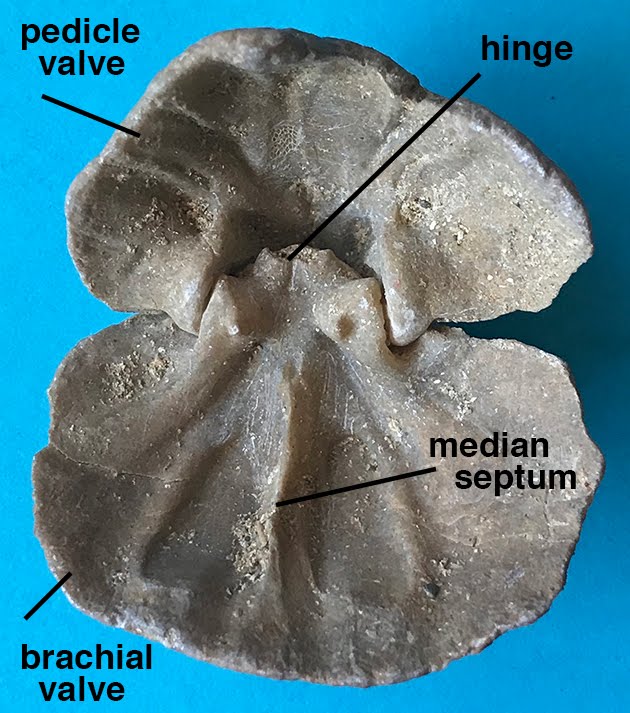
The next image is a another T. hemphilli from the same locality as the previous specimen and shows the partial interior views of both valves (a rare sight!). The maximum width of this partial specimen is 4.2 cm. Its hinge still works. Its two valves move back-and-forth and have no tendency to separate.


It is important to mention, at this point, that although brachiopods are "bivalved" (= consists of two valves) and can resemble some clams (bivalves), brachiopods and clams are NOT the same phylum! There are numerous soft-bodied differences (e.g., brachiopods have a lophophore, whereas clams do not) and there are numerous differences in shell characteristics (e.g., there hinges are different, the interiors of their valves are different, and brachiopod valves have a pedicle opening (foramen), although the foramen might not be obvious on some brachiopods.

Articulate brachiopods were extremely abundant in shallow-marine faunas during Ordovician through Permian times. After the Late Permian mass extinction, they declined in diversity and never returned to the "glory days." Today, they are minor constituents in marine faunas, and some have seeked deeper waters as a refuge. Below are some examples of commonly found Paleozoic articulate brachiopods.


Ordovician, two views of same specimen, 33 mm width.


A Late Paleozoic articulate referred to as a spiriferid (has elongate "wings").


Two views of a Late Paleozoic articulate brachiopod referred to as a productid. This group is characterized by having one of its valves  convex, and the corresponding valve is concave.


Wednesday, June 24, 2020

Inarticulate Brachiopods

Phylum Brachiopoda is comprised of three groups: the inarticulates, the articulates, and a group intermediate between the two. The classification of this phylum is currently in a state of flux, and for more details, "Google" the paper: Brachiopods: origins and early history---by Harper et al., 2017---for reading purposes or for a free pdf download.

Brachiopods have bivalved shells (valves) that can superficially resemble clams.

This post is the first of two parts and concerns the inarticulates and the aforementioned intermediate group. 

Inarticulate brachiopods have a long geologic history of approximately 520 million years, ranging from the Early Paleozoic (early Cambrian Period) to modern day. Their two valves are held together by muscles. Most inarticulate brachiopods lived/live as burrowers (infaunal), and their shells consist of chitinophosphatic composition. 
The burrows of inarticulate brachiopods can be as deep as 30 cm. A pedicle, which serves as an anchor to the floor of a vertical burrow is flexible, thus the brachiopod can extend itself upward or downward. The shell is very thin but is "supported" by the surrounding mud.


Lingula anatina, a modern-day inarticulate brachiopod, which lives in black mudflats (intertidal zone) in tropical and subtropical waters of Japan. The specimen shown above is embedded in epoxy for the purpose of scientific study. The exterior of both valves (height 33 mm) are shown, as well as a portion of the long, fleshy pedicle. 


Lingula hians is a modern-day inarticulate brachiopod from Queensland, Australia. Both valves (height 38 mm) are shown, exterior and interior views. Their interior has a sheen to it because of the chitinophosphatic composition. You can see that modern-day lingulid inarticulates (i.e., those belonging to family Lingulidae) look very similar. I surmise that the similarly is because that they have lived in the same type of stressful environment (mudflats, coastal lagoons) throughout their entire geologic history; thus, providing an example of how the environment can influence strongly the morphology of a shell. Said another way: once an animal has adapted to a stressful environment, it has great endurance potential.

Side view of the two valves (combined thickness 5 mm) of specimen of L. hians, shown above. The valves are paper thin and fragile.

An example of a Cambrian inarticulate brachiopod (height 20 mm), in black siltstone.


The intermediate group, mentioned above, is relatively uncommon in the fossil record, although this group ranges from the late Cambrian to modern day. The intermediate group has calcareous shells that attach themselves to other shells found on the ocean floor. Thus, the intermediate group consists of epifaunal dwellers (i.e., living on a hard substrate). 


exterior
interior

Craniscus wilsoni Squires, 1994, is an example of an intermediate- group brachiopod, whose shell would have consisted of two calcareous valves. When I collected this specimen, I could find only its substrate-free valve, shown above (exterior and interior views, shell 7 mm wide). It is of early Eocene age (about 45 million years old) epifaunal brachiopod from the southern Olympic Mountains, Washington State. The other valve (an attached one) was not found; it was most likely attached (epifaunally) to a shell of a mollusk or some other hard ground (pebble, coral, etc.).

Tuesday, June 9, 2020

A clam for the ages

Venericardia is a widely distributed genus of shallow-marine bivalves (clams) in the family Carditidae. This genus was abundant during the Paleocene and Eocene epochs (a cumulative range of 66 to 34 million years ago). The highest biodiversity of Venericardia was in the Eocene. The genus needs detailed classification studies of all its various subgenera found throughout the world. Detailed studies are much needed to evaluate the likely possibly of over naming of species/subspecies found on the west coast of North America. The genus is now extinct, with the last survivors of this genus dying out apparently in the early Miocene.

Lamarck (1801) first described the genus Venericardia based on well preserved shells of this bivalve in the Paris Basin, France. The aragonite shells of this genus are commonly large and very sturdy, with wide radial ribs crossed by concentric growth lines on the exterior. The interior of the shells are characterized by long posterior teeth, much shorter anterior teeth, and two prominent elliptical-shaped muscle scars connected ventrally by a continuous line. Some species have prominent nodes along the inner margins of the shell.


These two images show the plaster replicas of the exterior and interior surfaces of a left-hand valve (6.5 cm high and 7 cm wide) of Venericardia planicosta Lamarck, 1801 from an Eocene shell bed at Grignon, Paris Basin, France. 


Venericardia (Pacificor) lutmani Turner, 1938, lower Eocene (Ypresian Stage), southwestern Oregon; plaster replicas. Left image is the exterior of a left valve, and the right image is the exterior of the right valve of a single specimen (9.25 cm high and 10 cm wide) which, upon burial, became separated from one another. 


These two images are the corresponding interior views of the same plaster replica shown immediately above.


Venericardia (Pacificor) hornii calafia Stewart, 1930, middle Eocene (Lutetian Stage), southern California. Exteriors of left-hand and corresponding right-hand valves of the same specimen (whose valves [9 cm high and 9 cm wide] are closed very tightly).


Dorsal (hinge) view of same specimen of V. (P.) h. calafia shown immediately above. Left valve is on the left side of image, and right valve is on the right side of image

Venericardia was an infaunal (burrowing) suspension feeder that lived buried just beneath the surface-water interface. Its optimum habitat was in relatively deep, shallow-marine (shelfal) environments, but its shells are commonly found as transported remains in coastal-storm beds.

Friday, May 22, 2020

WHITE SANDS, NEW MEXICO

White Sands is in southern New Mexico, 16 mi west of the town of Alamogordo. White Sands, which covers 275 square miles, was established as a National Monument in 1933. It recently became a National Park. The elevation of the park is 4,235 feet.


White Sands is geologically situated between the San Andres Mountains to the west and the Sacramento Mountains, just east of Alamogordo, to the east. [Google Earth photo, 2018].


Aerial view, looking northwest. White Sands is in the distance, below a cloud layer on the horizon and "between" the two 
pointed-metal objects on the airplane wing.


White Sands consists of white gypsum sand dunes, the largest of their kind on Earth. 

During the Late Permian Period, about 250 million years ago, shallow seas covered the area. Evaporating seas left behind deposits of white gypsum crystals, consisting of hydrous calcium sulfate. Gypsum is very soft: 2 on the Moh's Hardness Scale. Fingernails can scratch gypsum. See my previous post on "Some Varieties of Gypsum" (Sept. 30, 2017).

Subsequent tectonism uplifted the San Andreas and Sacramento Mountains, and, over time, rain dissolved the gypsum deposits, and rivers transported the dissolved material to the nearby Tularosa Basin, which had no outlet the sea. The trapped water evaporated and gypsum was deposited (once again). Over time, weathering and erosion broke down the gypsum crystals into sand-size grains. In the last million years or so, prevailing winds from the southwest transported these crystals and dunes formed. There are transverse, parabolic, and barchan dunes present. 

It is quite a wonderful experience to visit White Sands. You can walk barefoot and not get burned by the sand, and you can roll around in the gypsum sands without getting abraded, like you would if the dunes were made of quartz grains (hardness 7).

Photography is a challenge because of the glare. It is like photographing a snow field.


Friday, May 8, 2020

Maclurites, an early gastropod with a confusing shell

The gastropod genus Maclurites Le Sueur, 1818 is characterized by large flat-spiral shells. It lived in shallow, subtidal, warm-marine waters and was widespread where carbonates were deposited. Locally, it can be abundant and associated with algal fossils.   
Maclurites is restricted to Ordovician time, thus it is a guide [or index] fossil for the Ordovician Period. This genus belongs to family Macluritidae, which includes 10 genera.

Maclurites has a type of shell coiling called hyperstrophic, in which the animal is anatomically dextral (its genitalia are on right), but its shell is falsely sinistral, being actually ultradextral. If there is an associated operculum (the lid-like, partial or complete covering of the aperture), the operculum exhibits counter-clockwise coiling.  

Most gastropods have dextral (right hand) clockwise coiling of the shell, and any associated operculum exhibits counter-clockwise coiling (see image immediately below). A few gastropods are mirror opposites and have sinistral (left hand) counter-clockwise coiling of the shell, and any associated operculum exhibits clockwise coiling.


In my Nov. 20, 2014 post, entitled "Gastropod operculum," I provided views of the dextrally coiled, gastropod shell Megastrea undosa. In this present post, I provide another view of the exterior side of its operculum (38.7 mm hight), which shows counter-clockwise coiling.


Although hyperstrophy is best determined using soft parts for anatomical study, in the case of extinct gastropods, like Macluritesmolluscan paleontologists have to rely on the coiling direction of its calcareous operculum. As shown below, the operculum of Maclurites is coiled counter-clockwise, thus it cannot be a sinistral gastropod.


The above image is a sketch of the apertural view of a complete specimen of Maclurites logani [86 mm diameter], of Middle Ordovician age from Quebec, Canada. [Fascimile of fig. 105 in The Treatise on Invertebrate Paleontology, Part 1, Mollusca (1964), p. I188].

The following four views are of a specimen of Maclurites sp. [68.4 mm diameter, 21 mm height] from the Lower Ordovician Lebanon Limestone, near Nolensville, Tennessee. 

   front or apertural view, aperture (poorly preserved) is to the right


                                  back or abapertural view


                                            basal view


                            dorsal view (the "tip" is missing)

The shell rested on its very flat base, which provided great stability for the shell, thereby resisting being flipped over by waves or currents. The flatness of one side of the shell is inferred to be related to its sessile (unmoving), filter-feeding mode of life.