Sunday, October 18, 2015

Miocene fish scales


Macrofossils are not common in deep-marine mudstones of the Miocene Modelo Formation in southern California. A lucky find would be a partial or complete bony fish skeleton, but these are  rare. Fish scales, however, can be locally common, but a collector needs to know what they look like. Before enrolling in my paleontology class, most of my students would find a fish scale and not even know what they were looking at.

The fish scales shown below are of late Miocene age and from the Modelo Formation (commonly referred to as the Monterey Formation). Each scale is about 10- to 15-mm-wide and represents a paper-thin imprint on bedding planes of mudstone. Identification as to the family or genus of fish is not a trivial process and requires very specialized knowledge. At the very least, however, their presence indicates an aquatic environment.

Two late Miocene fish scales belonging to the same genus. There might be a third fish scale in
 the lower right-hand corner.

Another late Miocene fish scale, genus different from the two shown in the photo above. 
There have been only a few paleontologists that have published on Miocene fish scales from southern California. The principal workers were: D. S. Jordan (published between 1900 and 1920), Lore Rose David (published during the 1940s), and Richard Pierce (published during the 1950s). 

Sunday, October 4, 2015

Fossil dolphin ear bones

Fossil-dolphin ear bones, which can somewhat resemble small pebbles, consist of very hard, dense bone that can be readily fossilized. Most examples of these fossils that are illustrated online these days are from rocks of Miocene to Pleistocene age from the Atlantic coast of the United States (e.g., Miocene rocks in Calvert Cliffs, Maryland; and Pliocene rocks at the Lee Creek Mine, North Carolina.

During life, the earbones were located in a cavity in the middle-ear area, located near the back of the dolphin skull. This cavity is filled with a dense foam that, along with ligaments, to support the ear bones. The bones consist of the tympanic and the periotic bones, and the entire structure is referred to as the “tympano-periotic complex.” The two bones are partially fused together with flanges, grooves, small holes, and a large bulbous (i.e., bowl-shaped area) region, called the bulla. The inner ear is located within the tympano-periotic complex.

Examples of fossil tympano-periotic complexes are shown below. They are from the shallow-marine Miocene Temblor Formation found at Sharktooth Hill in southern-central California.
Miocene tympano-perdiotic complex, greatest dimension 42 mm (approximately 1.75 inches).

Opposite side of same specimen shown above.
A different specimen, greatest dimension 43.5 mm.

Note: In one of my previous posts (8/15/2014) entitled “Fossil whale ear bone,” I illustrated a whale tympanic bulla.


Sunday, September 20, 2015

Fossil yucca? plant

One of the rarest fossils I have collected from the Pico Formation south of Newhall, southern California is what I believe is a small base (trunk) of a yucca plant. It is from the upper part of this formation and is of late Pliocene age (about 3 million years old). 

The Pico Formation in this area was deposited in a marine-delta environment, and, as I mentioned in one of my earlier posts (8/15/2014), fossil pine cones can be found (rarely) in these beds. The pine cones were derived from pine trees that grew in the adjacent, ancient San Gabriel Mountains east of the delta. Some of the pine cones eventually floated down a braided river (full of coarse debris consisting of pebbles and cobbles) and were deposited in fine-grained sandstone near an ancient shoreline, and mixed with shallow-marine fossils (e.g., seashells and shark teeth). It seems likely that presumed yucca remains could have also floated into this marine-environment setting.

When I first saw the presumed yucca fossil, I thought it was a pine cone. Upon closer inspection, however, I realized the yucca? fossil is not like the pine cones from this formation. As I walked back to my car, I came across a modern yucca plant (see photo and comments below). I was immediately struck by the fact that the vertical-striations on some of the woody part of the trunk of both the modern and presumed fossil yucca are very similar. If you have knowledge of the bases of fossil yucca plants, please let me know if you think my identification is correct or not.


Late Pliocene yucca? base (trunk), height 12 cm (4.75 in.), width 7 cm (3 in.), from the upper Pico Formation near Newhall, California. The white fossil sticking out along the upper left side is a shallow-marine clam. Notice the cross-section of the high-spired, shallow-marine gastropod shell
of Turritella cooperi near the bottom. 

Modern-day base (trunk) and a few green leaves of a yucca [probably Hesperoyucca whipplei] height 24 cm (9.5 in.), width 15 cm (5 in.), from near Newhall, California. The non-green, hard, woody trunk is 14 cm height. Hesperoyucca whipplei is one of the most common yuccas of the chaparral and coastal-sage scrub plant communities living below 4000 feet in elevation in southern California. The leaves of this yucca are stiff and dagger like.


Monday, September 7, 2015

Dinosaur gastroliths

Gastroliths are literally “stomach stones.” It has long been postulated that they were swallowed voluntarily by giant sauropods (herbivorous dinosaurs) for the purpose of aiding digestion by grinding food material. 

Gastroliths look just like highly polished river gravel, and this fact has helped convince some paleontologists that gastroliths are nothing more than sedimentary gravel and never used by dinosaurs to aid their digestion process. It would follow, therefore, that if you believe you have found "stomach stones," it would strengthen your hypothesis if you could show that they came from inside of a dinosaur skeleton in the stomach area.

Many years ago, a reputable vertebrate paleontologist gave me a stomach stone (see the red stone shown below), which he said that he had collected from the stomach area of a large sauropod of Late Jurassic age in the San Rafael Swell area of Utah.

A gastrolith 9 cm long (= a small cobble) from Utah. The rock, which is heavy, is an iron-bearing (reddish) quartzite.

The other picture (shown below) is of two other gastroliths, also from Utah. These specimens were part of a private collection that was sold.

Two gastroliths (small one is 1.8 cm long = large pebble; large one is 3.8 cm long = very large pebble) from Utah. The rock type, which is lightweight, is a hard but highly polished detrital sedimentary rock (probably coarse-grained sandstone).

Tuesday, August 25, 2015

Petoskey stones

Petoskey stone (4 cm in length) from Michigan.
A fossil commonly part of personal collections is a Petoskey stone, which is a fragment of a species of colonial rugose coral of Middle Devonian age (about 390 million years old) from lower Michigan. These fragments, which can be found along the shore of Lake Michigan, are commonly cut and polished (using lapidary techniques) into pebble- or small cobble-sized pieces with flat bottoms. Some are used in making designer jewelry.

The specimens show tightly packed, polygonal-shaped individual corals called corallites. The dark center of each corallite was the mouth area, surrounded by tentacles loaded with stinging cells used for catching prey. Radiating out from the center are distinct “lines” called septa, which were used for attachment of the soft parts of the coral. The name "Petoskey stone" comes from Ottawan Indian lore and means “rays of the rising sun.” It seems likely that this name was inspired by the presence of the septa. The Latin name for these Michigan specimens is Hexagonaria percarinata.

The Petoskey stones found in Michigan underwent transport and abrasion during the Pleistocene “Ice Age” by glaciers and running water, thus their colonial-coral structures have been worn down. When these specimens are polished by lapidary techniques, the colonial structures become even more worn.

For comparison, I include a photograph of a specimen of colonial-rugose coral that I collected from western Nevada. This specimen, which is of Mississippian age (about 350 million years old), is an  unworn example of Lithostrotionella jasperensis. The central area of each is corallite is raised and occupied by the columella, and the septa radiate from it.
Lithostrotionella jasperensis (4 cm length) from Nevada.
By the way, colonial-rugose corals went extinct at or near the end of the Permian Period (about 255 million years ago).


Tuesday, August 11, 2015

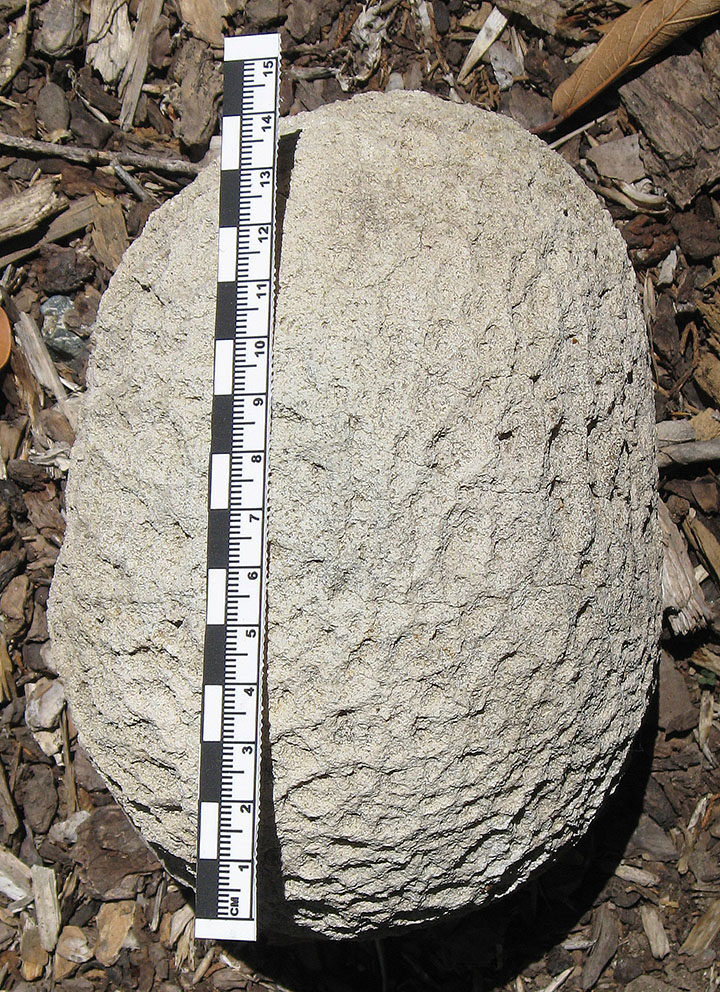
"Cantaloupe" concretions

A few years ago, while doing field work just west of Simi Valley, Ventura County, southern California, I collected some spherical concretions that are quite interesting. They are mostly five to six inches in diameter and have a distinctive pitted appearance that strongly resembles cantaloupes, thus I have dubbed them the name “cantaloupe concretions.” They are fun to collect, and other members of my field party fell victim of trying to find perfect ones (like the one shown below).  


A spherical concretion (approximately 11 cm = 4.5 inches) that looks like a cantaloupe.
 The black-and-white rectangles of the scale are in centimeters.

Some of the concretions are elliptical shape, as shown below.


An elliptical concretion (approximately 14.5 cm = 6 inches).
The concretions occur in sandstones in the nonmarine Sespe Formation and are approximately Oligocene (30 million years) in age. These concretions were first noted in 1924 by W. S. W. Kew, who did some of the earliest geologic work in the area. He also reported that they have a pitted appearance.

Concretions form around some nucleus (an impurity, possibly a shell or plant fragment) when groundwater flows through sands.  The sand subsequently becomes strongly cemented. Differences in the strength of cementation of the sand grains in these Sespe Formation concretions were made apparent by weathering of the surface, thereby producing the pitted appearance. Some of the concretions were broken open, but there was nothing organic nor unusual in the central (core) area.

In one of my earlier posts dealing with "Pseudofossils," in July, 2014, I briefly discussed what concretions are and illustrated a common shape.