Friday, May 14, 2021


THE MIDDLE CAMBRIAN Burgess Shale

In the early 1900’s, a sharp-eyed paleontologist named Walcott was doing field work in British Columbia, and he found a Lagerstätte from the Middle Cambrian Burgess Shale Member of the Stephen Formation. 


The Cambrian Period began 541 million years ago. The Burgess Shale is of Middle Cambrian age in the earliest part of the Paleozoic.

A “Lagerstätte” is a German word used to designate any exceptionally well preserved fossil fauna or flora. Walcott and subsequent researchers collected and described more fossils. They stored them in established museums so that other paleontologists could access them for detailed study. Eventually, researchers began to realize that the Burgess Shale Lagerstätte represented soft-bodied animals that existed near the beginning of complex animal life on Earth. The research process took many years, and the findings were, in some cases, quite controversial about the exact type of organism that each different fossil represented. Research continues to the present day. The Burgess Shale fossil area is now a World Heritage Site. The localities are protected and require authorization to visit. Unauthorized collecting is prohibited.


The modes of preservation of the Burgess Shale Lagerstätte are either impressions (as shown above in the example of a an early “velvet worm” type of animal) in brown mudstone, or, more spectacularly, as  paper-thin carbonized (whitish to gray) imprints in very fine-grained black to gray siliceous mudstone. 


One popular interpretation about their burial environment is that the animals lived in shallow-marine waters at the edge of an underwater cliff. They were transported a short distance by currents over the cliff and down into deep-quiet waters, where they were rapidly buried by muds. Like most interpretations, this one was recently challenged, and some workers maintain that the animals actually lived at the bottom of the cliff and were not transported there. 


The next five posts highlight examples of fossils found in the Burgess Shale strata. These examples show some rather strange-looking animals, including (the last of the examples) of possibly the first back-boned animal.

Saturday, May 1, 2021

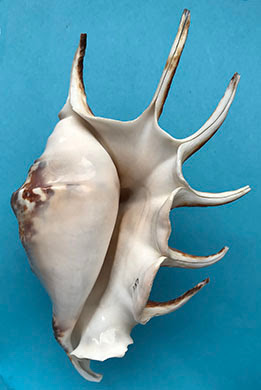
Lambis, the "Scorpion" Conch

The shallow-marine gastropod genus Lambis Röding, 1758 belongs to family Strombidae, which makes up the “true conchs” of the world. 

Three of the 10 living species (not including 14 hyrbrid “species”) of Lambis are illustrated in this post. They all live in very shallow waters in the Indo-Pacific, and, in much less common cases, the Red Sea. Their shells are large and thick, with many long, hollow digitations along the side of the shell, and knobs or protuberances can be present on the dorsum (top) of the shells. In addition, they all have a “peep-hole” notch (called the strombid notch) for the right eye. Their anterior end has a short or long anterior canal.


Lambis scorpius (Linnaeus, 1758), height 11.3 cm, width 5.5 cm, thickness 3 cm; three views: ventral, dorsal, and right side, in that order. This moderately common species lives in coral-reef areas in the Indian Ocean and Western Pacific regions. Its knobby digitations help this gastropod “blend in” with the rubble it lives in.

---------------


Lambis lambis (Linnaeus, 1758), height 15 cm, width 8.5 cm, thickness 5.5 cm. Three views: ventral, dorsal, and right side, in that order. This Indo-Pacific species lives in mangroves or on reef flats from low tide to 5 m depths.

-----------------------


Lambis millepeda (Linnaeus, 1758), height 14.5 cm, width 5.5 cm, thickness 3 cm. Three views of one specimen: dorsal, ventral, and right side, in that order. An internal view (cut section) of another specimen. This Indo-Pacific species lives on sand and rubble in shallow waters. This specimen is from Marshall Islands, Jaluit Atoll.

---------------------


Lambis is known with certainty only from the Recent record. This geologic range of this genus has been reported in some online databases as being Paleocene to Recent, but these reports are taxonomically out-of-date and incorrect. The current consensus among most experts is that these Paleocene and Eocene reports pertain to the gastropod Sulcogladius goniophora (Bellardi, 1852) of Eocene age from Western Europe and Pakistan. That species belongs to family Rostellariidae. A few experts have put forth the concept that Sulcogladius belongs in the Rostellariidae genus Rimellopsis Lambiotte, 1974.   


Monday, April 19, 2021

The Only Cowrie Living On The West Coast of the United States

Neobernaya spadicea (Swainson, 1823) (the “chestnut” cowrie), a member of family Cypraeidae, lives today only from Monterey Bay, Monterey County, California to southern Baja California Sur, Mexico. Cowries are marine gastropods found most commonly throughout the world in warm to tropical, shallow-marine waters. There are approximately 260 living species and many extinct species. Living cowries are among the favorites of sea-sea collectors because the cowrie shell is glazed (highly polished) and can have an array of beautiful colors and patterns. The geologic record of cowries is from the Jurassic to Recent. There are many Cenozoic cowries in the fossil record of the west coast, and most of them lived during times that were much warmer than today in this area.

The cowrie now known as Neobernaya spadicea (Swainson, 1823) was misidentified as to genus [e.g., Cypraea], until 2000, when it was recognized as actually belonging to genus Neobernaya. The fossil record of N. spadicea is Pliocene to Recent.


The following four  images are of a specimen of N. spadices (49 mm length [distance between the posterior and anterior]; 29 mm width; and 24 mm height [distance between the base/bottom and the dorsum/top]. This specimen was collected in beach drift from a beach in Santa Barbara County, Southern California.


                                                         dorsal (dorsal)  view


                                                  ventral (base/bottom) view


                                right-side view (outer lip side)


                                  left-side view (inner lip side)


The name “spadicea” refers to the chestnut-brown color although there is a variation of the color of the top surface of the shell of this species: from chestnut brown to rust to red. The base (lower surface) and lower parts of its sides of the shell, however, is white.


This species lives in moderately cool waters, from intertidal to 50 m depth, especially the sublittoral zone near ledges and rocky areas. It lives in the near vicinity of forests of the giant kelp Macrocystis pyrifera, where this gastropod preys on bryozoans, hydroids, sponges, anemones, tunicates, and molluscan eggs. At least one of octopus apparently feeds on N. spadicea.


After hatching from eggs, the young of N. spadicea transition into a free swimming stage (veliger), but they are slow swimmers and many settle quickly to the ocean floor and begin to grow into adults. The juvenile stage of this species, like all cowries, is called the “bulla” stage. Its shell is very thin and elongate. Eventually, this stage will transition into the glazed over, strong shell of an adult. The maximum, full adult shell size is about 80 mm length.


Interior of a N. spadicea specimen showing the juvenile bulla stage. The entire specimen (length 46 mm, width 27 mm) was collected also as beach drift from a beach in Santa Barbara County, Southern California.


Much of the information used in this post is from the following very useful and up-to-date reference:


Groves, L.T. 2019. The family Cypraeidae Rafinesque, 1815, in the northeast Pacific: One spectacular species. Zoosymposia 13:131–138 (James H. McLean Memorial Volume).   


Monday, April 5, 2021

Septarian Nodules

 The name “septarian nodules” is derived from the Latin word “septum,” meaning seven, in reference to partitions dividing cavities. More specifically, the name refers to carbonate-rich nodules having an internal structure comprised of a series of carbonate-filled cracks or cavities, which separate polygonal blocks of hardened sedimentary material, such as mudstone.


The exterior of a septarian nodule, 13 cm tall and 11 cm wide. Utah.
Septarian nodules on the outside are not exactly eye-catching.


The interior of the same nodule, shown above. The interior of a septarian nodule can be, however, very interesting and eye-catching.


The nodules usually form early in the burial history of the muddy sediment before the rest of the sediment hardens into rock. Afterward, compaction causes cracks/cavities to form, and groundwater with dissolved minerals infills the cracks/cavities. Upon evaporation, the minerals crystallize out of the water. 


Septarian nodules, more accurately referred to as septarian concretions, have a smooth rounded exterior, which is normally gray. The mineral-filled cracks in the interior are typically yellow (calcite), but some also can be partially brown (aragonite = another carbonate mineral).


This septarian nodule (12 cm wide and 15 cm tall) was cut (slabbed) in order to show the intricacy of the infilled cavities.


Lastly, I included this slabbed (cut) septarian nodule because it is a nice specimen and one that was used in one of my previous posts (July 17, 2014) entitled "Pseudofossils."
The rounded and smooth exterior of most of the septarian nodules have been mistakenly by some collectors as “dinosaur eggs,” which they are NOT! Pseudofossils are inorganic objects.


Rock hounds commonly cut the septarian nodules in half and polish them. They can sell for low to high prices, depending on the complexity of the radiating crack pattern and the variety of the coloration.


Sunday, March 21, 2021

Chama (The Jewel Box Clam)

The bivalve (clam) genus Chama Linnaeus, 1758 belongs to family Chamidae Lamarck, 1809. The geologic record of the genus is Paleocene to Recent. Extant (living) species are found mostly in shallow-tropical waters (intertidal to 100 m depth). There are a few species, however, that live in cool waters (e.g., in Oregon and California). The common name of this bivalve is the “Jewel Box.” 

Chama is a small to medium-size heterodont bivalve, which means it has only a few teeth, and they are subdued and somewhat degenerate. This is because Chama normally cements itself to the substrate (e.g., in crevices within coral-reef rock), therefore, large teeth are not needed.


Chama lazarus Linnaeus, 1758 is a moderately common species of Chama found in water depths ranging from 1 to 20 m, in the Indo-Pacific region. The specimen shown below is from the Philipine Islands.


This first image shows both valves closed together (articulated). The shell is 75 mm height (including projections of the spines) and 55 mm width (including projections of the spines). The right valve is on the left side of this image. During life, the right valve would be facing upward, so as to discourage a predator from biting down on the sharp spines. 


This second image shows the exterior of the right valve, whose sharp bladed spines are encrusted by some patches of calcareous red algae, small worm tubes, and bryozoan colonies (nearly microscopic).


This third image shows the exterior of the left valve, which is attached to a piece of colonial coral. The left valve, which is the "lower" valve, also has some bladed spines, but they are absent where the valve makes contact with the substrate. Thus, this bivalve always has its sharp spines present on any vulnerable part of its shell.


This last image shows the interiors of both of the valves (left valve on the left and right valve on the right). The brown material just above the teeth is the thin ligament, which helps hold the valves together.


Sunday, March 7, 2021

A Dolomite Ventifact

A ventifact is a stone that has been shaped by the erosive action of windblown sand (rarely ice crystals), bouncing along (saltating) only a few feet above the ground. The abrading grains of sand “file” (pit, etch, striate, groove, rill, and/or polish) away at the rock surface, which acts as a windbreak, and as result a sharp edge (facet) forms. Ventifacts form in arid environments (deserts) where there is a strong wind and a steady (but not overpowering) supply of sand or ice crystals. Windblow processes are referred also to as aeolian processes.  


Ventifact rock type (lithology) is commonly a very hard material like quartzite, chert, obsidian, or some basalts. Less common is dolomite, whose chemical formula is CaMg(C03)2. Dolomite reacts only weakly with cold, dilute hydrochloric acid (HCl). Limestone (CaCO3), which is another carbonate rock, is much softer than dolomite and, unlike dolomite, reacts vigorously with cold, dilute hydrochloric acid.


The ventifact shown below is a stone of dolomite (22 cm width and weighing about 2.5 pounds). Where it was found is unknown, but it was probably found in a desert in southern California.


The first view shown below is the top view of the stone. Most of the grooves are on the left side, but, if you look closely, you can see a smaller set of grooves on the lower right-hand area. Although this smaller set is in parallel alignment with the other set, the smaller set is at a sharp angle relative to the larger set. The only way to explain this phenomenon is that there had to been a change, over time, of 180° in wind direction. The facet (a sharp edge of demarcation between the two different-angled sides of the upper surface of the rock) is readily visible. 


For your information, the planet Mars has been modified by aeolian processes more than another other solid planet in our Solar System. One half of the rocks found at the Mars Path Finder Vallis Landing site in 1996 are ventifacts, and they were formed by northeast to southwest winds. For more information about that site, see the following article (free for reading):


Bridges, N.T., et al. 1999. Ventifacts at the Pathfinder landing site. Journal of Geophysical Research v. 104, no. E4, pp. 8595–8615.


Saturday, February 20, 2021


Terrestrial Pulmonate Gastropods Found At A Locality In Southern California 

Terrestrial-pulmonate gastropods have the ability to breathe air. They represent an informal taxonomic group that includes terrestrial (land) and freshwater families, and even a few marine families.


Over many years, I have found several different kinds of terrestrial pulmonates (those with shells and some without) in my yard, in northern Los Angeles County, southern California. Even though these kinds of gastropods are not in my field of expertise, I tried to identify them, with considerable help from my friends at the Malacology Department of the Natural History Museum of Los Angeles County. 


The result of my efforts, after many years of “collecting” right in own yard, is that they are four families present: four genera, and four species. Also, I was surprised to learn that these taxa originated in Europe and were later introduced into the USA. Also, they were all named between 1758 and 1822.


Shelled Pulmonates


Rumina decollata (Linnaeus, 1758)


Common name: decollate snail

Family: Achtinidae

Distribution: native to Europe and the Mediterranean region; introduced to the USA (California, Arizona, Florida, Georgia, No. Carolina, So. Carolina, and Texas) and to Cuba, Mexico, and Bermuda.

Remarks: They remain hidden in debris unless it rains, then they crawl about over sidewalks and driveways. They are voracious predators and eat any other snails they encounter, especially Cornu aspersum.

Images: (in order of appearance): Juvenile specimen (one view) with its non-truncated shell (9.5 mm height). Adult specimen (four views) with its truncated shell 31.5 mm height; front view, back view, tilted side view, and top view.


---------------

Cornu apserum (O.F. Müller, 1774)


Common name: brown garden snail

Family: Helicidae

Distribution: native to Europe, North Africa; introduced to many parts of the USA  (including California) and to South America.

Remarks: These snails are vegetarians and can be very destructive if they find their way into your garden. This species is the most common terrestrial snail in Los Angeles County, southern California. They were common in my garden, until Rumina decollata showed up; now, Cornu aspersum is very rare there. 

Images: Adult specimen, 27.9 mm height (3 views): front, back, and right side, showing outer lip edge.


---------


Oxychilus sp. 


Common name: glass snail

Family: Oxychilidae

Distribution: native to Europe, North Africa, and parts of the Middle East; introduced to many parts of the USA (including California). 

Remarks: The common name refers to being able to see “through” their somewhat transparent shell. These snails prefer humid places under leaves and stones. This snail is one of two similar species; it is probably O. draparnaldi (Beck, 1837). Positive identification would need anatomical studies.

Images: Adult specimen, 4.2 mm height, 11.5 mm width, 3 views: front, top, and bottom.


------------


Slug Pulmonate


Ambioglolimax valentianus (Férussac, 1822) or Ambiogloimax nyctelin (Bourguignat, 1861)

Common name: Three-band garden snail 

Family: Limacidae

Distribution: native to Europe (Spain and Portugal); introduced to China, Japan, and USA (including California, Oregon, and Washington).

Remarks: One of two very similar species. Positive identification requires internal anatomical studies. This genus has an internal shell (small and flat).

Image: Largest individual approximately 35 mm length.


ADDITIONAL REMARKS:

Europe is the origin for the majority of the many of the non-native terrestrial gastropods found in the world. Their distributions are constantly changing and basically becoming more widespread. If you are interested in the details, please see the following (free) pdf:


Gladstone et al. (2020). Spatiotemporal patterns of non-native terrestrial gastropods in the contiguous United States. NeoBiota 57:133–152.


In my study, I found the following reference useful:


Cōcke, J. 1995. Common land snails of Los Angeles County. Privately published.