Saturday, October 23, 2021

Whale Shark


The modern-day whale shark Rhinocodon typus (family Rhinocodontidae) is dark gray in color with white spots and stripes. Its body has a very wide and squarish head (up to 5 feet wide) with many (about 300), rather small, single-cusped teeth. The whale shark is commonly referred to as a whale because of its large size, but Rhinocodon typus is a shark, not a whale. A whale is a mammal, and the whale shark is a giant filter- feeding elasmobranch (shark = a fish). The whale shark is the largest known shark today, thus it is the  largest known living fish. It can up to about 40 feet in length. The first three images show the left side, top, and front (mouth) views of a model of R. typus.


The whale shark is a slow-moving fish that is found globally today, except in the Mediterranean Sea. It likes tropical waters, and is known to seasonally congregate in the following areas: California to Chile, especially in the Gulf of California (=”Sea of Cortez”) in Baja California (Mexico); Yucutan (Mexico); Belize; Western Australia (especially lagoons and coral atolls) to Japan; Maldives Island (Indian Ocean); and New York to central Brazil.


Whale sharks feed on microscopic zooplankton (copepods) and, to a lesser degree, on small fish, fish eggs, and small squids. They are filter feeders: they have modified pads (gill rakers) along their gills and can screen the water for food as it moves through the gills. For their larger prey, they use suction feeding (sucking in large quantities of water containing the food). Whale sharks are harmless to humans. Their teeth are small.  


As shown in the diagram above, the earliest known “whale” sharks lived approximately 56 million years old (late Paleocene or early Eocene in age) and belong to the genus Palaeorhinodon. Their teeth, which are small and single cusped, have been found in Africa, central Asia, Europe, and eastern North America (e.g., South Carolina and Virginia). Their geographic distribution coincides with the ancient Tethys Sea, which stretched from Java and India and westward through southern Europe. These warm waters affected, as well, the east coast of the United States. To my knowledge, they did not live along the west coast of the United States during this time even though the climate was warm there. 


Also, as shown in the diagram above, the first known whale shark belonging to genus Rhinocodon appeared during the middle Oligocene, about 28 million years ago. Their teeth, which are also small and single cusped, have been found along the east coast of North America, where warm warms lingered. They did not occur along the west coast of the United States because of continued climate cooling in this area. The fossil record of Rhinocodon ranges from the middle Oligocene to modern times.


In the modern oceans, in addition to whale sharks, there are two other similar looking, giant filter-feeding elasomobranchs: megamouth sharks, and basking sharks. Their geologic time ranges are younger than that for whale sharks (see diagram below).


Megamouth (family Megachasmidae, genus/species Megachasma pelagios) is another large shark that eats plankton. This shark ranges from the late Oligocene/early Miocene, about 23 million years ago, to today. Recent individuals can reach 12–15 feet long. This fish was
unknown to science until 1976, when a specimen was found entangled in a parachute anchor of a U.S. oceanographic vessel off of Oahu, Hawaii. This shark is named for its enormously distensible mouth and protrusible jaws containing overly 100 rows of small hooked teeth. It has a poorly calcified skeleton, therefore, it is a weak swimmer. A drawing of it is shown below:


Furthermore, “Megachasma pelagios was discovered in 1976 off the coast of the Hawaiian Islands. The specimen shown below is the second megamouth ever found. It was caught by commercial fishermen in 1984 near Catalina Island, southern California. it is a 14.7-foot make, weighing approximately 1,540 pounds. In 1990, a live megamouth shark was caught off the coast of Dana Point, southern California. It was fitted with sonic transmitters and released. The transmitters revealed that the shark spends most of its time well below the surface, spending the night 50 feet below the surface, diving to 490 feet at dawn, and returing to shallower waters at dusk. Many marine animals display this vertical migration pattern as they follow plankton in the water.” (From signs displayed at the megamouth exhibit at the Los Angeles County Museum of Natural History, 2021). A head shot of this actual specimen is shown below:


The basking shark genus/species Cetorhinus maximus) is shown below. It is the world’s second largest fish (36 feet long). Like the whale shark and megamouth, the basking shark is a surface-feeder that eats plankton. It prefers temperate waters and shuns polar and equatorial waters. The geologic range of C. maximus is middle Miocene (15 million years ago) to today.


Sunday, October 10, 2021

BIOMINERAL VS. MINERAL

 According to mineralogy textbooks, a mineral is a solid INORGANIC substance of natural occurrence. That definition rules out human-made simulants (e.g., cubic zirconia and nearly all mossanite --- see one of my recent previous posts). That definition also rules out organic substances secreted by organisms, even though these organic compounds have the same (or nearly same) chemical composition as “true” minerals. What to do? The answer is to use the terms biomineral, organic mineral, or biogenic mineral when dealing with organically secreted shells, teeth, bones, kidney stones, etc.

All five kingdoms and 55 phyla of organisms contain members that create biominerals. At last count, there are at least 60 known biominerals, but new ones are being discovered all the time. Most (80%) are crystalline, and some (20%) are amorphous. Many of these biominerals can be in the following groups (with examples given below): carbonates (calcite, aragonite), phosphates (dahllite, francolite), sulfates (gypsum, barite), silica (opal), iron-oxides (magnetite, goethite, ferrihydrite), iron sulfides (pyrite), halides (fluorite), and oxalates (weddelite).


Three comparisons of a biomineral versus its mineral counterpart are given below: 


FIRST COMPARISON: The biomineral that makes up vertebrate (including humans) bones and teeth is called dahllite [= hydroxylapatite (or also spelled hydroxyapatite)] consisting of Ca5(PO4)3(OH), which is = 45% calcium-rich phosphate, 33% organic matrix material (mainly collagen), and 22% water.


The following image is of an Eocene mammal tooth (5.3 cm length) consisting of generally well preserved dahllite:


The mineral apatite Ca5(PO4)3(F, Cl, OH) is an inorganic substance consisting of calcium phosphate combined, in varying amounts, with fluorine, chlorine, and hydroxyl ions. The mineral apatite, furthermore, is an end member of the complex apatite group, or series, of minerals with varying amounts of F, Cl, and OH. The mineral apatite has been long been known as a calcium-phosphate series of minerals found in igneous rocks (especially in hydrothermal veins) and in phosphate-rich sedimentary rocks. In summary, the biomineral dahllite [= hydroxylapatite] and the mineral apatite are chemically quite similar, and the difference is based on the content of the elements fluorine and/or chlorine, which are both subject to variation depending on the surrounding environment.

The following image is of a crystal (2 cm height) of inorganic apatite, with a hardness of 5 on the “Moh’s Scale of Hardness” (0 to 10, with 10 being the hardest = diamond).


SECOND COMPARSION: The biomineral aragonite (calcium carbonate [CaCO3 + organic matrix material]) versus the mineral aragonite (calcium carbonate [CaCO3]). Biomineral aragonite, common in some invertebrates, especially certain gastropods, bivalves, and, cephalopods (nautiloids and ammonites) can have iridescent “mother-of-pearl” luster, which I have mentioned in several of my previous posts. This luster indicates that there has been no alteration of the original composition of the shell material. The mineral aragonite never has iridescent luster, as is obvious in the image below of inorganic aragonite.


The following image is of the inside of a modern-day abalone shell (18.7 cm long) showing its “mother-of-pearl” biomineral aragonite luster. See my previous post July 28, 2020 for more details.


The next image is of the interior of a modern-day Nautilus shell (16 cm wide) showing its “mother-of-pearl” biomineral aragonite luster. See my previous post August 1, 2016 for more details.


The next image is of radiating crystal clusters of two specimens of aragonite of inorganic origin. Small cluster 2 cm wide, larger cluster 4 cm long. Impurities cause the reddish color.


THIRD COMPARISON:
The biomineral opal (SiO2-xH2O) versus the mineral opal (SiO2-xH2O). Biomineral opal (transparent) is present in the test [microscopic shell] of single-cell, micro-organisms like diatoms [plant kingdom] and radiolarians [animal kingdom], as well as in glass sponges. The mineral opal, which can have an amazing array of colors but not transparency, is present in some sedimentary deposits.

The following two images are of the biomineral (opal), which forms the tests of a modern-day, microscopic radiolarians from deep-ocean sediment.


                                          single radiolarian

                             six more examples of radiolarians

The following image is of the biomineral (opal), which forms the exoskeleton (21 cm long) of Euplectella, a modern-day glass sponge. See my March 15, 2020 post for more details.


The last image is of a fragment (1 cm) of the mineral (opal) of precious opal. See my post Dec. 14, 2018 for more details.


Monday, September 27, 2021

The Elegant Lavender Interior of the Gastropod Drupa forum


The gastropod
Drupa Röding, 1798 is a Pleistocene to Recent genus, with about eight species and several possible subspecies. The type species [the original species used to define this genus] is Drupa morum Röding, 1798, commonly known as the “Purple Drupa, the Purple Pacific Drupa, or the Mulberry drupe snail.” The word “drupa” is Latin for ripen, in the sense of ripening of fruit. The Drupa shell does resemble a small berry (e.g., Mulberry).


Drupa morum Röding, 1798 from the Indo-Pacific area. The first image above is of the dorsal (back) side of the shell. The second image is of the ventral (front) side of the shell. The characteristic lavender color of this species is on present on one side of the aperture. The number "2" at the top refers to a later slide, which shows this same specimen in a series of other specimens.

Genus Drupa belongs to family Muricidae, and some specialists place the genus in the subfamily Thaidinae. Drupa is a predatory gastropod that prefers to eat worms, as well as some gastropods. The modern-day geographic distribution of Drupa is essentially restricted to between 35°N and 35°S (the area in "red," shown in the map below), in the Indo-Pacific (tropical) shallow-marine waters among coral reefs or rocky areas. Many of the species of Drupa are widespread within this region.


The species of Drupa are determined by several main morphologic features: the number of spiral rows of knobs on the last whorl (largest whorl), the shape of the knobs, the number and position of the labral teeth on the outer lip, the number and position of the columellar teeth along one side of the aperture (the main opening of the shell), and the color of the aperture. The labral teeth and the columellar teeth (both the oblique and straight ones) are labelled on the immediately following image.


The next two "strip images" show a growth series of six specimens of D. morum. The first one shows the dorsal side of each shell (numbered in increasing size), and the following strip shows the corresponding ventral side of each shell.


 Height range is 27.3 to 35 mm.


If you look carefully, you will see that the number of labral teeth and the number of columellar teeth, as well as their spacing, are not all the same on every specimen, even though the sizes of the specimens are similar. Nevertheless, all six specimens are Drupa morum. If the identification were based on only two specimens (numbers 1 and 6---see image below), however, it would seem that there are two species. That is why one needs to study as many specimens as possible. The outer lip of D. morum is especially prone to reabsorption of the calcium carbonate making up the shell, thus the details of the outer lip are not constant.


In the following image, specimen no.1 had reabsorbed some of the shell material making up its labral teeth along the outer lip of its shell. Specimen no. 6, which has all of its labral teeth, is shown for comparison.


Tuesday, September 14, 2021

Turquoise, an exquisite blue/green gemstone

 The word “turquoise” is an old French adjective, used to describe objects taken from the region of Turkey. One of these objects includes beautiful sky blue to green stones, which were originally mined in the Sinai Peninsula or over 5,000 years, thereby making turquoise one of the first gemstones to be mined. 

Today, turquoise is most commonly found in the southwestern United States, Mexico, China, Chile, Egypt, and Iran.  


Turquoise is a hydrated copper aluminum phosphate mineral. Its chemical composition is CuAl6(PO4)4(OH08)-4H20. Its composition can be variable, and even turquoise deposits in the same general area can have slightly different chemical compositions.


It is a secondary mineral that forms in arid or semi-arid regions, when rainfall leaches copper, aluminum, and phosphorus out of host rocks (plutonic and volcanic igneous rocks, or sedimentary phosphate beds). The leached material can also include impurities (strontium, lead, etc.). When the requisite elements are in the right combination, they get re-precipitated as nodules, encrustations, in veins, or in massive form. 


Two views of a nugget (5 cm width) of turquoise with “spiderweb” cracks:


Lastly, a view of a thin crust (2.5 cm length) of turquoise:  


At certain locales in the southwestern United States, turquoise can be found as the result of weathering of hydrothermal porphyry-copper deposits (PCDs). For more information about PCDs, see my previous Post.


Also, in the southwestern United States, turquoise typically forms within 100 feet of the ground surface. The shallow depth allowed Indigeous Americans to mine mineral in areas now known as Arizona and New Mexico. 

Wednesday, September 1, 2021

 Porphyry Copper Deposits

The word “porphyry” is a textural term [not a compositional one] referring to large-grained crystals (called phenocrysts) dispersed in a fine-grained (aphanitic) crystal groundmass. There is commonly a large difference in size between the tiny (can be microscopic) matrix material and the much larger crystals (>2mm). 


The above image is an example of a rock with porphyry texture: a rhyolite (volcanic igneous rock), 12 cm in high. This rock came from a river deposit of Mio-Pliocene age in southern California. This rock does not contain copper.


The next image is an example of pure native copper (50 mm maximum dimension). It was extracted from a porphyry copper rock at a copper mine near Morenci, Greenlee County, Arizona. 


Porphyry copper deposits (PCDs) account for the world’s largest source (about 60%) of copper. These deposits consist of disseminated copper (low to moderate grade [0.3 to 2 percent] copper and copper minerals in vein systems and in fractured rocks (breccias) with porphyry texture and containing copper formed from hydrothermal (heated) fluids that emanated from plug-like magma chambers in the upper crust (less than 5 to 10 km depth). These veins invade host rock, which can range from granitoid  porphyry intrusions (granites to diorites) and from adjacent volcanic wall rocks (rhyolites to basalts). Along with copper, other ores can be associated, like gold, silver, iron, molybdenum, lead, zinc, and tungsten.


The above two views are of the same hand-specimen sample of a copper porphyry from the Keweenaw Peninsula, Michigan, near Lake Superior. The native copper is disseminated in a conglomeratic sandstone/shale interbedded with rift-zone basalt (a volcanic rock). The maximum dimension of this hand specimen is 60 mm.


Porphyry copper deposits have formed throughout most of Earth’s history, but 90 percent of the known ones are Cenozoic or Mesozoic in age. They form mainly in dynamic tectonic areas: under big volcanoes and over suduction zones. They can form, furthermore, in continental magmatic areas along convergent tectonic plate margins or in island-arc environments. PCDs are found predominantly along the west coast of North America (from Alaska to Mexico), the Andes in South America, the Alps region in southern Europe, central Asia, the southwestern Pacific, and the east coast of Australia. 


An example of a continental magmatic area in southwestern North America is the one extending from Nevada to Mexico. An example of an island-arc environment is in Papua (province)  (shown below) is in the southwestern Pacific Ocean area. 


Porphyry copper deposits are currently the largest source of copper ores. Because the content of copper is very low, in many cases the ores are mined via huge open-pit from which massive amounts of rock are excavated and processed. One of the world’s largest and richest PCDs-mines is at Grasberg, Papau, southwest Pacific Ocean. The images below, which are from Google Earth (2020) show the location of this mine, at increasing magnification. In the second image, you can see a road spirally descending into the very large open-pit mine.


The main source of the information I used about PCDs is the very thorough paper by John, D.A., et al. 2010. Porphyry copper deposit model. United States Geological Survey Scientific Investigations Report 2010-5070-B. Chapter B. 169 pp. The pdf is available online for free. 


Thursday, August 19, 2021

Jadeite and Nephrite: the differences

 The purpose of this blog post is to provide some background concerning the generalized word “jade.” It is actually a group name, which “lumps” two different minerals: jadeite and nephrite. Although their chemical properties are different, their physical properties (e.g., hardness, specific gravity [=density], texture, color range, etc.), as well as their geologic origin and setting, can be similar and can overlap. Distinguishing between them is not a trivial matter, especially if you rely on just an “eyeball” identification.” Positive identification requires quantitative mineralogical examination(s). These could include an x-ray diffractometer, infra-red spectrometer, Raman spectrometer, and/or a petrographic microscope study of very thinly cut-and-ground sections of small pieces of the material.

Jadeite and nephrite have a moderate hardness between 6 and 7 on the Mohs Hardness Scale. Yet, they make good ring stones. This is because their aggregate structure makes them extremely tough.


JADEITE


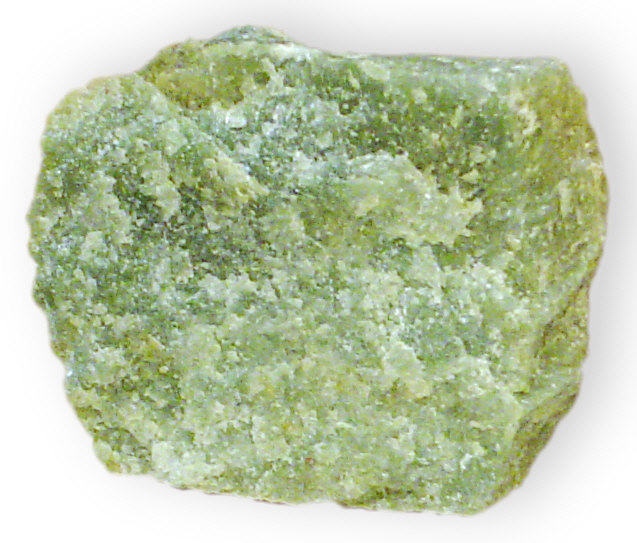
Jadeite is a sodium-aluminium silicate [NaAlSi2O6]. It is a non-hydrous sodic pyroxene mineral. It has monoclinic crystals, a density (specific gravity) of 3.3, and greasy to pearly luster. It is very durable (tough) and difficult to break, but is not all that hard. It has a wide range of colors: apple green to deep green [the most valuable, including the “Imperial jade,” carved in China], shades of blue green, shades of pink and lavender, white (yes! even white) and also black (the rarest). Jadeite is used for making high-end jewelry and artisan pieces. Commercially important original deposits are found in Myanmar (formerly known as Burma), Cuba, Guatemala, Japan, Kazakhstan, Russia, and Turkey.


This is an image of raw jadeite that has not been cut nor polished.

(from Wikipedia 2021).


Jadeite is predominantly found in geologically complex areas called subduction zones, where convergent tectonic plate boundaries, of both modern and ancient continents, collide and where associated high pressures and relatively low temperatures occur inside the Earth’s crust to form metamorphic rocks. These rocks are commonly associated with chemically rich fluids that can partially replace some of the chemical components of jadeite; thus jadeite is rarely pure.


This is a carved piece of jadeite. Image from Wikipedia (2021).


NEPHRITE


Nephrite (Greek, meaning kidney) is a hydrous calcic amphibole silicate mineral with a formula of [Ca(Mg,Fe5Si8O22(OH)2]. It is one of the amphibole silicates. It has monoclinic crystals, a density of 2.96, and greasy to pearly luster. The crystals of nephrite are fibrous and interlock in a very strong matted texture, which is somewhat softer (thus better for carving) than jadeite. Nephrite is closely related to the tremolite-actinolite mineral group and is actually a variant of that group, whose members can be asbestos-like.


This is an ear ring with polished nephrite (7 mm height) in the center. 


Nephrite is more common than jadeite. Nephrite has also a narrower range of colors (mainly green to whitish), and it is used for less expensive jewelry and artisan pieces. Its green color is commonly more subdued and darker than jadeite’s green color. It is found in South Australia, northern British Columbia, China (Xinjiang), Italy, New Zealand, New Zealand, Switzerland, Taiwan, and California.


The image above is a two-ton boulder (slabbed and polished) of nephrite from a placer deposit in south-central Wyoming. The nephrite from this locality ranges from bright green olive and black. This boulder is on display in a stairwell at the Los Angeles County Museum of Natural History.


The aforementioned metamorphic rock/suduction zone geologic setting of jadeite is similar to that of nephrite, except that nephrite forms at lower pressure than does jadeite. Nephrite is known also in placer deposits, which formed by erosion and transport from a host rock and followed by deposition elsewhere in river bottoms, along ocean beaches (California), or in glacial moraines (British Columbia). 


Shown above are two abraded pebbles (largest one with a maximum length of 3 cm) of nephrite from an ocean-beach placer deposit at Jade Cove in Monterey County, California. They have a greasy feel to them.   


NATURAL LOOK-ALIKES


There are many other green minerals that look like jadeite or nephrite. Some are naturally occurring (e.g., emeralds, aventurine, serpentine, olivine, smithsonite, amazonite, green varieties of garnets, etc.).


The image above is a cut-and-polished stone (28 mm height) of aventurine, which is a green microcrystalline form of quartz called chalcedony (see, via the “Search” option at the top of each one of my blogs, for my previous post on “varieties of quartz-part 1”). Although similar in color to jadeite or nephrite, aventurine is very distinctive because it has very tiny, platy mineral inclusions that occur as black dots and streaks.


IMITATIONS OR TREATMENTS 


There is also the possibility that the “jade” you are thinking about buying might be is an imitation (simulant). For example, it might be a piece of green-colored plastic or resin. In some cases, pieces of nephrite have been bleached in acid to remove any unwanted brownish hue, and then stabilized with a polymer. Another possibility is that someone is trying to scam you with dyed-green calcite (= a soft mineral, easily scratched by a knife). 


To protect yourself from fraud, always buy from an absolutely trusted and reputable dealer. If you are still hesitant, you can always consult a gemological association (like the Gemological Association of America or The International Gemological Institution). They use density and/or other definitive mineralogical/petrological tests, and provide you with a copy of the results; just like they do for identification of diamonds versus imitations (see one of my previous posts).

MORE INFORMATION


If you wish to obtain detailed information about jadeite or nephrite, or, for that matter, any other mineral, go to either one or both of the following websites: [note: I consulted them when writing up this blog].


www.gemdat.org


 www.mindat.org


Saturday, August 7, 2021

Crassadoma gigantea: The North American Pacific Coast "Purple-Hinged Rock Scallop"

Scallop bivalves (clams) belong to family Pectinidae, a worldwide group consisting of several hundred species, including some large northern kinds fished commercially for their edible adductor muscle. This muscle, which is used for holding the two valves together, is considered to be a delicacy by many people (Abbott, 1985).

Crassadoma gigantea (J.E. Gray, 1825) is a large scallop living in shallow waters from the Aleutian Islands, Alaska to Bahia Magdalena in Baja California Sur, Mexico. In cooler waters, it reaches its largest size: up to 23 cm in diameter and up to 20 pounds in weight). The name is derived from crassus (Latin: thick) and domus (Latin: house). The common name for this clam is the “purple-hinged rock scallop.” The internal ligament of scallops occupies a triangular pit at the center of the hinge. Crassadoma gigantea is the only species of this genus, which is endemic (confined) to this region. No records of it are known from the Bering Sea, Kamchatka, Japan, or elsewhere.


Crassadoma gigantea has as a fossil record of Miocene to Pleistocene age but only in northern California and Baja California Sur. One of its synonyms of this bivalve is Hinnites giganteus, a name no longer used because it is taxonomically out-of-date.


All of the images shown below are of same specimen (9 cm height and 9 cm width) of C. gigantea from Leo Cabrillo Beach, Los Angeles County, southern California.


                                     Exterior of right valve.


      End view of right valve showing the juvenile-growth region.


The juvenile part of a valve is called the “chlamys” growth stage. A juvenile lives “free” by attaching its strong byssal threads to the substrate. These threads occur on one side of the hinge, and this area (byssal notch) is usually not preserved in the adult stage. The juvenile shell, furthermore, is commonly preserved on both valves. Eventually, the bivalve becomes an adult and becomes permanently cemented to the substrate. Adult Crassadoma gigantea can attach to rock faces or pilings, as well as inside crevices and under boulders. It ranges in depth from intertidal to 80 m.


                                   Interior of right valve.


Exterior of left valve. The white encrustations are of tiny serpulid worm tubes.


                                      Interior of left valve.


Side view of both valves together (articulated), with the right valve (strongly convex) overlying the left valve (nearly flat).


The attached strongly convex right valve, is referred to as the “lower valve,” and the less convex (can be nearly flat) left valve is the “upper valve.” The terms “lower and upper,” however, are relative terms for specimens that commonly attach to vertical surfaces, like steep rock faces or harbor pilings. Permanent attachment to the substrate is rare in pectinids.


Other examples of extant-scallop genera in the world are the pectinids: Pecten, Chlamys, Aequipecten, Amussium, Crytopecten, and Lyropecten. “Wild” scallops have traditionally been harvested using scallop dredges or bottom trawls. In some areas, divers collect the scallops by hand, but this is an expensive process.


On a world-wide basis, in the last few years, there has been a decline in the numbers of “wild” scallop productivity. One reason might be the significant decline in the sharks that prey upon the scallop-eating cownose sting rays. The main diet of these rays is scallops, and without the control offered by the sharks, the sting-ray population is increasing (Milius, 2007; Schmid, 2007).


The simultaneous reduction in sea grasses is another contributing concern. Juvenile scallops (referred to as “spat”) attach themselves to sea grasses before seeking their adult mode of life. Sea grasses provide a sanctuary for the juveniles (Milius, 2007; Schmid, 2007).


Another reason for the decline of “wild” scallop productivity might be the rising acidity of the world’s oceans. At the root of this change is the rising carbon-dioxide levels released into the atmosphere by human activities (pollution) and forest fires. The carbon dioxide is absorbed the oceans, which are showing increasingly higher pH levels. This acidity deprives baby scallops the calcium carbonate they need to grow strong shells. Commercial shell-fishing activities all over the world are at risk, but the Pacific Northwest (especially Washington, British Columbia, and Alaska) are unusually vulnerable because winds that gust south in the summer whip deep water to the surface. These upwellings are even more prone to being acidic, because carbon dioxide tends to be trapped in colder depths (Guilford, 2014).


For more details about C. gigantea, SEE:


Coan, E.V., et al. 2000. Bivalve seashells of western North America. Marine bivalve mollusks from Arctic Alaska to Baja California. Santa Barbara Museum of Natural History Monographs Number 2 Studies in Biodiversity Number 2. 764 pp.


References Cited:


Abbott, R.T. 1985. Seashells of the world. A guide to the better known species. Golden Press, New York. 160 pp.


Guilford, G. 2014. From Our Obsession The Sea. https://qz.com/311345/the-worlds-scallops-and-oysters-are mysteriorly-dying-out/


Milius, S. 2007. Too few jaws: sharks decline let rays overgraze scallops. Science News 171(13):197.


Schmid, R.F. 2007. Shark deaths upset rest of food chain: Shark overfishing may be endangering scallop populations, say scientists. Associated Press/ABC New, May, 29, 2007.