Saturday, April 13, 2024

SAND DOLLARS

NOTE: I have three previous posts about echinoderms:

Jan. 7, 2017-the spatangoid Schizaster diabloensis

Feb. 12, 2019- a two-part series: The first part is about regular echinoids (e.g., spiny sea urchins). The second part is a brief review about the infaunalization of irregular echinoids (sand dollars and some other infaunal groups).


This present post deals ONLY with clypeasteorids (= a main component of the echinoids) and provides much more information, as well as some taxa not mentioned in my 2019 posting. 


CLASS ECHINOIDEA

There are two main groups of this class: echinoids = 1) regular (sea urchins) and 2) irregular (sand dollars and other infaunal groups). The mode of life for each of these two groups is shown in the following figure.  
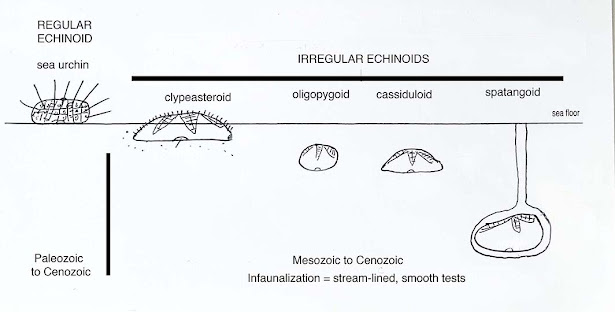
Geologic time and life zones of regular and irregular echinoids. 


Irregular echinoids range from Mesozoic to modern day. Although some irregular echinoids (sand dollars = clypeasteroids) crawl around (epifaunal animals) on the ocean floor, most of them are shallow-depth burrowers (infaunal animals), in either shallow or slightly deeper waters. Becoming burrowers protected them from predators (fish, crabs, etc.). Other infaunal groups that could burrow even deeper,” namely oligopygoids, cassiduloids, and spantagoids will be discussed and illustrated in my next post.


Clypeasteroids  = SAND DOLLARS (Epifaunal or Shallow-Infaunal Burrowers)


                                    Encope grandis (top view)

     Order Echinolampadacea

     Family Mellitidae

Common Name: Giant Keyhole sand dollar (it has a large hole (keyhole). 

Range: Subtropical, Gulf of California, (e.g., Bahia de Los Angeles, Baja California, Mexico). 

Habitat: Sandy beaches commonly about 2 m depth (intertidal) but can live to 20 m (394 feet) deep.

Shell: Its keyhole (or lunule = a large opening) allows faster movement of the shell as the animal plow through sand.

Sources of Information: WoRMS (online: World Register of Marine Species), and mexican-fish.com

Figured Specimen: length 7 cm, width 7 cm.


                     Mellita quinquiesperforata (Leske) (top view)

     Order Clypeasteroida

     Family Mellitdae

Common Name: The “five-slotted” sand dollar.

Range: Endemic to the western Atlantic Ocean, from Virginia to Florida (e.g., especially common in Naples area, Florida), Gulf of Mexico to Texas, south to Mexico, and also Bermuda, Jamaica, Puerto Rico, and Brazil. 

Habitat: A temperate to tropical sand dollar that lives in shallow waters below tide lines in sandy bottoms; especially in bays. The five “slots” (openings = lunules) allow for passage of sand during shallow burrowing by the animal.

Source of Information: animaldiversity.org

Figured Specimen: length 7 cm, width 7.2 cm.


                   Rotuloidea fimbriata Etheridge, 1872 (top view)

     Order Clypeasteroida

     Family Rotulidae (consists of two extant genera and one extinct genus)

Range: Safi, Morocco, West Sahara [North Africa],

Fossil: Pliocene (approx. 2.5 million years ago).

Habitat: Probably lived in lagoons and estuaries.

Dimensions of Figured Specimen: Length 3.3 cm, width 3 cm.


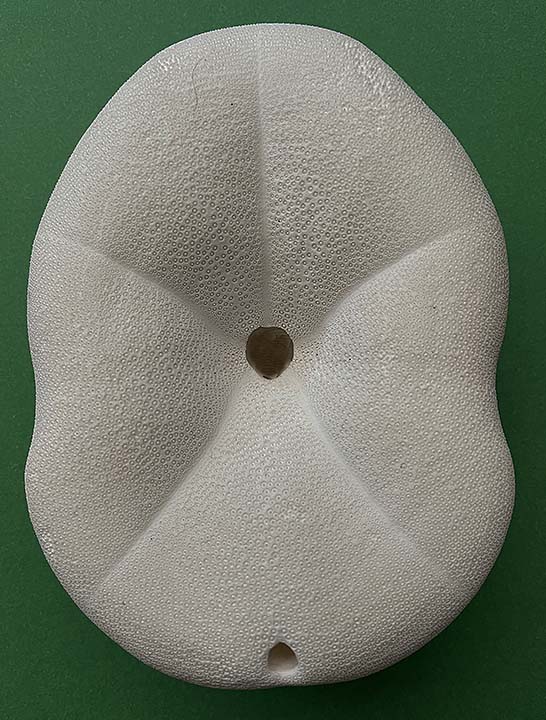
              Astrodapsis bajasurensis Squires and Demetrion, 1993

                                (two views: top and bottom)

     Order Clypeasteroida

     Family Echinarachiidae

Range: Baja California Sur, Mexico.

Fossil: Late middle Miocene (Isidro Formation) (approx. 13 million years ago).

Habitat: Subtropical.

Source of Information: Squires and Demetrion, 1993.

Dimensions of Figured Specimen: Length 2.9 cm, width 2.65 cm

Other Comments: The clypeasteroid genus Astrodapsis is endemic to California (Hall, 1962) and Baja California, Mexico (Squires and Demetrion, 1993). It is an index fossil used for relative age-dating of Miocene and Pliocene sedimentary deposits in these areas. Specimens are usually abundant and easily identified to the genus level, at least, based their inflated petals (petaloids), which are food grooves on the top surface of their shell. Species identification of Astrodapsis can be “tricky” however, because of gradational morphology caused by subtle paleoenvironmental differences (note: many nearshore fossils [e.g., oysters] have suffered the same fate). It is extremely likely that there has been considerable over-naming of the California species.


                      Dendraster excentricus (Eschscholtz, 1831)

                                   (two views top and bottom)

     Order Clypeasteroida

     Family Dendrasteridae

Range: Alaska to Baja California Sur, Mexico.

Habitat: Tidal channels and protected areas with moderate water movement (e.g., lagoons).

Source of Information: Wikipedia and gbif.org/species/2279084.

Figure 5: Dimensions of Figured Specimen: Length 5.8 cm, width 6.2 cm; this specimen was collected from by the author from beach drift on San Quintin Beach, Baja California Norte.

Note: The food-channeling, very narrow grooves on the bottom of this shell have been stained black by natural causes. 


                                    ?Dendraster excentricus 

This sand dollar population inside the "plastic bubble" has a vertical-feeding position. This image was taken of an exhibit at the Cabrillo Beach Museum, southern California. These sand dollars are in their feeding position; namely, they periodically they align their shells vertically and orient their ventral sides (that is where their mouth is located) facing the current caused by an incoming tide, so as to catch any available suspended food. Typical diameter of this  sand dollar is about 8 cm.


                           Clypeaster rosaceus (Linnaeus, 1758).

                              (three views top, bottom, and side)

     Order Clypeasteroida

     Family Clypeasteridae

Common Name: The “flat” sea biscuit.

Range: Western Atlantic Ocean, South Carolina to Barbados, Caribbean, and Panama.

Habitat: Turtle grass and sand fields bordering turtle grass.

Shell: Its variation in shape is great.

Source of Information: Wikipedia.

Dimensions of Figured Specimen: Length 11.4 cm, width 8.6 cm, height 3.5 cm.

Other Comments: The clypeasteroid genus Clypeaster (illustrated above) has considerable variation in the shape of its species. This variation can be in one or more of the following: its petals  can be low or inflated; overall shape can be low conical to highly conical. Such variation has undoubtedly resulted in overnaming of species.  


                                             Clypeaster sp.

                             (three views: top, bottom, and side)     

     Order Clypeasteroida

     Family Clypeasteridae

Range: THIS IS A FOSSIL SPECIES. MIOCENE, ITALY

Shell: This highly conical shell shape is quite a contrast to the previous example of a species of this genus; namely, Clypeaster rosaceus = a flat-shell species of this genus.

Dimensions of Figured Specimen: length 12.5 cm, width 11.5 cm, height 6 cm.


References Cited:

Hall, C.A. Jr. 1962. Evolution of the echinoid genus Astrodapsis. University of California Publications in Geological Sciences 40(2):47–180.


Squires, R.L. and R.A. Demetrion. 1993. A new species of the clypeasteroid echinoid Astrodapsis from the Miocene Isidro Formation, Baja California Sur, Mexico. Journal of Paleontology 67(2):258–263. 

Friday, April 12, 2024

THE "KILLER" CLAM TRIDACNA

The so-called "killer clams" are classified as:


Subclass Heterodonta

Order Cardiida

Family Cardiidae: 7 genera and 3 subgenera

Genus Tridacna Brugiuère, 1797 (the most common genus)


Geologic Range:

Late Cretaceous?, Eocene to Recent, with occurrences in Europe, India, Africa, So. Pacific; commonly associated with corals reefs.


Tridacna clams (bivalves) are generally large to massive in shell size, with ribs few in number but strong, and lacking anterior lateral teeth .

Some species attach themselves via byssal threads to a coral reef, and, in so doing provides stability for themselves. The byssal threads extend through an opening (along a dorsal area located posteriorly) called the byssal notch. The notch can be narrow or very wide. Some individuals use their weight to hold them in place rather than rely on byssal threads. Some individuals can also be nestled among corals. Tridacna bivalves can close their valves for protection, but the closure is rather slow, especially among the large individuals. Their shells do not shut fast like a mousetrap. I think that was the basis for the misconception that these bivalves could trap divers.


Tridacna gigas is the largest of all living bivalves, reaching lengths of more than four feet. Their mature adults can live for nearly a century, and their shells are very heavy.


The edges of their shells are fluted, there by allowing for the flexible mantle to extend upward out of the shell in order to catch sunlight. The mantle contains algae (zooanthellae), which via photosynthesis provides photosynthetic “food” for the bivalve. 

View into a tank of ocean water containing living Tridacna specimens for the public to see at the California Academy of Sciences in San Francisco. The large dark-green to black individuals of Tridacna are aligned in parallel rows. If you visit this facility, be sure to see this aquarium with live Tridacna in crystal-clear water.


Close-up of a living Tridacna specimen with its blue mantle tissue exposed. This specimen was in the same tank of water mentioned above. The mantle contains symbiotic algae which the bivalve eats.


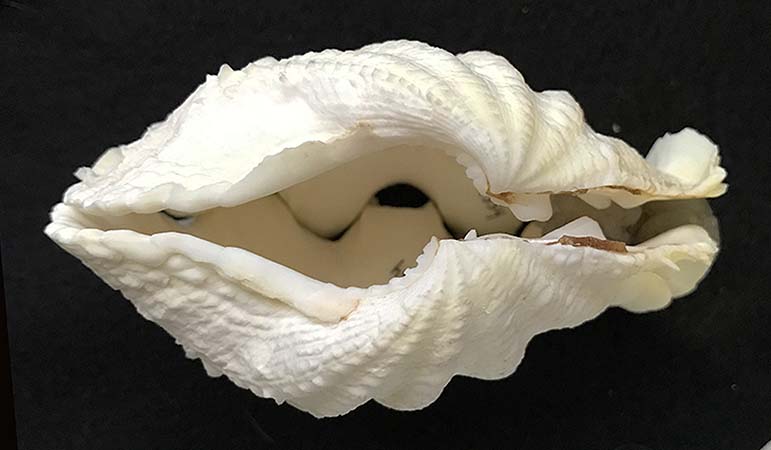
Hippopus hippopus (Linnaeus, 1758). Three views: exterior and interior of left valve, dorsal view of both valves. Length 7.2 cm, height 5 cm.


Tridacna maxima (Roding, 1798), Indo Pacific, shallow coral reefs

Three views: exterior and interior of left valve; dorsal view of both valves. Length 9 cm, height 6 cm.


Tridacna (Chametrachea) squamosa Lamarck, 1819. SW Pacific, common. Three views: exterior and interior of left valve; dorsal view of both valves. Length 8.5 cm, height 6.5 cm. 


References Used:

Reefkeeping.com (this is a very informative website for the marine aquarist)


Wednesday, April 3, 2024

GEOLOGIC RECORD OF CAMELS

Camels are artiodactyl (even-toed) mammals belonging to family Camlidae. Some other examples of artiodactyls are giraffes, deer, buffalo, cows, pigs, and even whales!


The oldest known camel is Protylopus. It is of approximately middle Eocene age (40 to 50 m.y.a. [million years ago]), and it lived in what is now South Dakota. This camel was 4 feet tall, 2.6 ft. long, and weighed 57 pounds). It lived in open woodlands and fed on soft leaves. Its front legs were shorter than its hind legs, and its feet were four-toed.

Protylopus, the earliest known camel. Sketch by author and based on image in animaladay.blogspot.com


During the latest Eocene/earliest Oligocene in western U.S.A., two other camel genera evolved in North America: Poebrotherium and  Stenomylus, both of which started to look more like modern camels.


Poebrotherium. Sketch by author based on image in ideas.fandom.

com/wiki


Stenomylus. Sketch by author based on image in Wikipedia. This camel walked "tip-toed," like a modern gazelle.


Aepyecamelus is of late Miocene age. Sketch by author based on image in Wikipedia.org Aepycamelus lived when there was increased cooling going on, and the dry savannah was replaced by steppe lands. 


Note: Other camelid genera that lived during the Miocene were Alticamelus, which was 19 feet tall, and Ocydatylus, which had a neck as long as a giraffe. 


Paracamelus migrated from North American to Eurasia via Beringia #2 (see one of my previous posts about Beringia = a land bridge between North America and Asia. This camel was the first to enter the North American arctic region. During the time of Paracmelus, which was latest Miocene through early Pleistocene, camels grew larger (up to 9 feet (2.7 m tall), with longer necks. Their teeth got longer and had higher crowns than before. Also, their feet obtained pads. Sketch by author based on image in Wikipedia.


Paracamelus also migrated into South America during Pliocene/Pleistocene = GABI time (see one of my previous posts about GABI = the Great American Biotic Interchange. In South America, Paracamelus evolved into llamas, alpaca, guanacos, and vicuñas.


Camelops hesternus, which was native to North America, was the last camelid to live during the late Pleistocene [13,000 to 11,000 years] in North America. The remains of this extinct camelid have also been found in the La Brea Tar Pits in Los Angeles, California. Sketch by author based on image in Wikipedia. According to Heintzman et al. (2015), Camelops is a “sister group” to African and Asian Bactrian and dromedary camels but not similar to South American camelids.


Modern-day camelids are represented by three species: 1) Camelus dromodarius [the dromedary camel-- has one hump], 2) Camelus bactriannus [the Bactrain camel (has two humps), and 3) Camelus ferus [the “wild” Bactrain camel (also has two humps). 

The humps are used to stored fat.


The dromedary camel Camelus dromodarius, also known as the “Arabian camel,” lives in the Middle East, Sahara Desert, and south Asia. This camel is the smallest in size (6 feet high and usually about 600 pounds) of the three living species of camels. Sketch by author is based on image from Wikipedia.


Two specimens Camelus dromodarius at the “Living Desert Zoo and Gardens,” in Palm Desert, Riverside County, southern California [December, 2023]. Image courtesy of C. S.


The Bactrain camel, which is also known as the “Mongolian camel,” lives in central Asia. This camel can be up 1200 pounds. Sketch by author is based on image from Wikipedia.


The “wild” Bactain camel lives in China and southwestern Mongolia. This camel is critically endangered. Sketch by author is based on image from Wikipedia.


References Consulted:


Heintzman, P.D. and five others. 2015. Genomic data from extinct North American Camelops revise camel evolutionary history. Molecular Biology and Evolution 32(9):pp. 2433–2440. (free pdf)


en.Wikipedia.org


Tuesday, April 2, 2024

CYRTULUS UNDATUS [The Wavy- Spindle Shell]

According to Vermeij and Synder (2018: p. 61)) and WoRMS (2023), the extant (living) marine gastropod Cyrtulus undatus (Gmelin, 1791) is now classified in the family Fasciolariidae, a very diverse group (approx.. 500 spp., made up of such shells commonly known as the “spindles,” “tulip shells,” “horse conchs,” etc. Fasiolariids are predatory neogastropods. Many of the fasciolariid genera have complex taxonomic histories that have recently and are continuing to be much better understood via the use DNA molecular studies, in combination with other anatomical features (radular teeth, etc.) (Couto, 2016). Scientific literature published even 10 years ago on fasciolariid identification/classification is now very out-of-date, with on-going studies that will undoubtedly produce new findings. 

Cyrtulus undatus, which used to be classified in family Fusinidae and in genus Fusinus, has a shell that can be up to 25.3 cm long. Its shell has a fusiform shape, with rounded knobs and low spiral ribs. The shell color is white, but the periostratum, a protective outer layer during life, is brown.


This species is benthic (lives on the ocean floor) in tropical waters, mainly in the southwest Pacific (southern Japan, Malaysia, and northern Australia). It occurs also in Hawaii, where it has been identified as Fusinus sandvicensis (Sowerby, 1880), according to Kay (1979, p. 278) and found via dredge hauls at depths of from 50 to 150 m.  It is a “non-broadcast spawner,” that is to say that its life cycle does not include a trochophore stage.


The common name of this shell is the “wavy spindle shell” and also “Legrand’s wavy spindle.” The “wavy” designation is apparently because the tip of spire, as well as the long anterior canal, can be slightly curved (or “wavy), like the shell illustrated below.


Three views (apertural, abapertural, and right side) of the fasciolariid gastropod Cyrtulus undatus (Gmelin, 1791), height 19 cm, width 6 cm [side width 5.3 cm], Philippines.


References Cited:


Couto, D.R. de. 2016. A phylogenetic analysis of Fasciolariidae (Gastropoda: Buccinoidea). 273 pp. Dissertation, Museu da Universidade de Sa Paulo, Brazil. Available as a free pdf. (internet download.)


Kay, E. A. 1979. Hawaiian marine shells. Reef and Shore Fauna of Hawaii: Section 4. Mollusca. 653 pp.


Vermeij, G.J. and M.A. Synder. 2018. Proposed genus-level classification of large species of Fusininae (Gastropoda, Fasiolariidae). Basteria 82(4-6), pp. 57-82.


WoRMS, 2023. http://marinespecies.org


Wednesday, March 27, 2024

SECTIONED GASTROPOD SHELLS: MORE THAN MEETS THE EY

SECTIONED GASTROPOD SHELLS: MORE THAN MEETS THE EYE

Many years ago, while at a commercial-shell dealer in southern California, I came across some marine gastropod shells that had been sectioned (= cut/sliced”) vertically. I bought a few, put them in a picture frame, and hung the frame in my office. Sectioned shells have their own beauty. Some can be easy to recognize as to what the original genus and species are, but some are more challenging and require some knowledge of shell morphology vs. families/genera. 


I decided to post an image of my frame containing the sections (identified for your benefit) and also decided to include another image, showing what the original shells looked like.


Sectioned Shells: Starting at the top left, "moving" in a clockwise position:


Pleuroploca trapezium (Linnaeus, 1758)


   Family Fasciolariidae

   Indo-Pacific region, shallow marine, lives under corals.

   This specimen is 14.5 cm in height.


   Tibia delicutaula? (Nevill, 1881)

   Family Strombidae

   Arabian Sea. Deep water, moderately rare.

   This specimen is 9.5 cm in height.


    Lambis scorpius (Linnaeus, 1758)

   Western Pacific, lives in coral-reef areas.

   This specimen is 14.5 cm in height.


    Turritella cerebra

   Family Turritellidae

   Indo-Pacific region, shallow marine.

   This specimen is 10.5 cm in height.


What The Non-sectioned Shells [of the same species illustrated above] Look Like:


These figures are also arranged clockwise (starting in the upper left corner), as in the preceding figure.


When I recently checked online, I found the following site where sectioned shells (very affordable) are for sale:


Seashell Supply and Emporium:  seashellsupply.com

(located in Camarillo, southern California) 


You can purchase sectioned shells (as well as complete shells) at other locations near you (check the internet). 


Wednesday, March 6, 2024

THE BLUE CORAL SNAKE


While researching my last post about “Blue Coral,” I came across the topic “Blue Coral Snake.” The latter has nothing to do with "Blue Coral," but this snake does belong to the family that includes the strikingly banded and venomous "coral snakes" that live around and in coral reefs. The Blue Coral Snake, which lives in jungles, has electric blue stripes and a neon-red head. Its slender body, which can be up to 5 feet long, is blue/black with cobalt blue scales. Its tail and belly can be orange. All of this vibrant coloration serves as a warning to predators.


The "Blue Coral Snake."

The Latinized name of this snake is Calliophis bivirgatus. It lives in dense rainforests at 300 to 3,600 feet elevation, in southeast Asia (Malaysia, Burma, Thailand, Indonesia, and other neighboring regions). This snake is venomous, and its venom is extremely potent. It can cause paralysis and respiratory failure. Calliophis bivirgatus belongs to the family Elapidae, which includes cobras and sea snakes. The blue coral snake can prey on young king cobras. 


The blue coral snake is timid and primarily nocturnal. It eats other snakes, as well as small lizards. Its has specialized teeth that curve backward, thereby holding onto its prey. It venom glands, which are located behind its eyes, are the biggest venom glands in the world. Its venom can be fatal to humans, and there is currently no anti-venom. This venom is like that of most other deadly snakes, it that it  can cause its prey to instantly freeze with muscle spasms (cramps). Its venom is similar to that of some spiders and scorpions, as well as to cone snails (e.g., Conus geographus---see my April 22, 2019 blog post on “Cone shells Past and Present.”


This snake has a defensive position that mimics cobras, i.e. its flattens the neck and raises its forebody off the ground. Females are larger than the male. This snake can live up to 20 years.


References Consulted


facts.net/nauture/animals


businessinsider.com/blue-coral-snake-venom


Monday, March 4, 2024

“THE BLUE CORAL”

This animal, known scientifically as Heliopora coerulea (Pallas, 1766), is an extant octocoral with a massive skeleton (up to a meter in diameter that can be columnar, plate-like, or branched). The blue color of its skeleton is often obscured by the brownish to gray-brown color of its living tissues. The skeleton itself contains iron salts that produce its unique blue color. Furthermore, the skeleton consists of fibrocrystalline aragonite (a type of calcium carbonate). It is a hermatypic zooanthellaete species with polyps in the skeleton. Each polyp has eight tentacles.


Heliopora colonies are variable in their shape, ranging from branching forms (with blunt ends) to encrusting forms.


Heliopora coerulea: 8.5 inches [21 cm] wide and 6 inches [15.2 cm tall], from the Philippines. 


Close-up of a part of the specimen of H. coerulea shown above.


The surface of the skeleton is smooth and perforated by cylindrical pits of two sizes: 1) widely-spaced “tiny black holes” up to 0.25 mm diameter and encircled by a stellate margin and 2) much smaller tubular-shaped openings used by the autozooids (part of the internal canal system that contains the zooanthellae = the symbiotic algae).


An even more close-up of the same specimen of H. coerulea shown above. Notice the two different sizes of openings in the skeleton: the autozooids = black holes (each one up to 0.25 mm diameter and encircled by a stellate margin) and the much smaller (near microscopic size) tubular openings that, according to Wood (1983) enclosed extensions of the internal-canal system that contained the zooxanthellae.


Heliopora coerulea is a species that can tolerate thermal changes. It has a fossil record since the Cretaceous. The morphology of this octocoral has changed little since then.


The geographic occurrence today of H. coerulea is confined to the tropics: Indian Ocean and western Pacific Ocean, including the Japan and the Great Barrier Reef of Australia. It lives nearshore on reefs, in depths below two meters. It is a vulnerable species.


Its classification is: 

Phylum Cnidaria

Subphylum Anthozoa

*Class Octocorallia (lack true septa)

Order Helioporacea (includes only one genus: Heliopora)

Family Helioporidae

Genus Heliopora

Species H. coerulea

**Species H. hiberniana


In addition to the “Blue Coral,” octocorals include soft corals (such as Tubipora = the red-colored organ-pipe coral), sea pens, and gorgonians (sea fans and sea whips). There are about 3,000 known species of octocorals. They have colonial polyps with eight-fold symmetry (note: true corals have hexa-radial symmetry).


Zoe et al. (2018) reported a new species of living Heliopora, namely H. hiberniana, from offshore areas in north Western Australia. It differs from the “Blue Coral” by having a white skeleton, more slender branches, and some differences in skeletal morphology.

References Cited or Used:


en.wikipedia.org/wiki/Blue_coral


gbif.org/occurrence/1039258522

   [this online site is via the Invertebrate Zoology Division, Yale Peabody Museum]


Wood, E. M. 1983. Corals of the world. T.F.H. Publications. Neptune City, New Jersey, 256 pp.


Zoe, T.R., and seven others. 2018. Integrated evidence reveals a new species in the ancient blue coral genus Heliopora (Octocorallia). Scientific Reports 8, article no. 15875.