 |
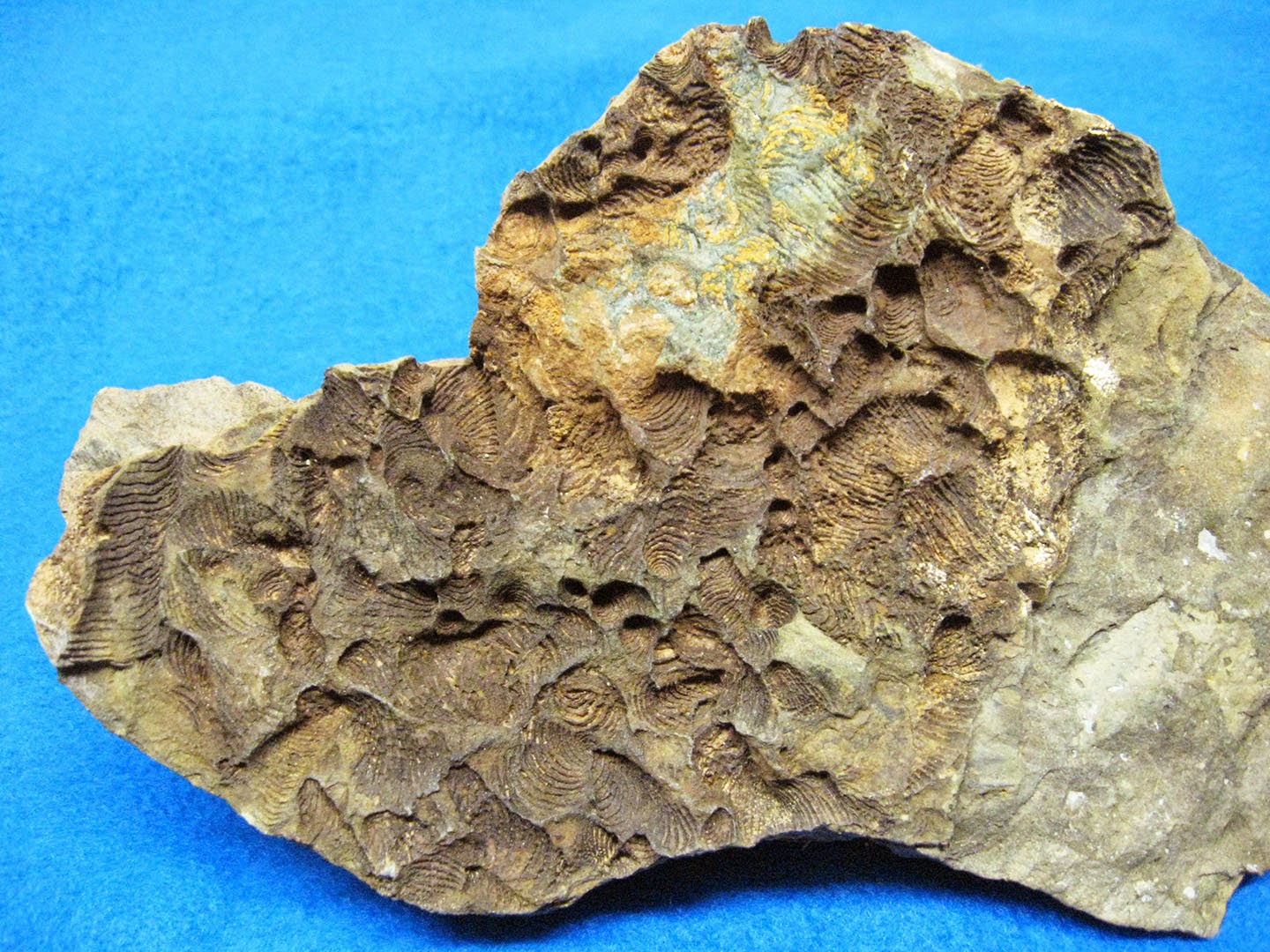
| Inoperna bellarugosa Popenoe, 1937 (length 7.3 cm = 73 mm).
The bivalve genus Inoperna, which belongs to the mytilid family (includes mussels), lived during the Triassic (latest part), and the Jurassic to Cretaceous (a total geologic time range of just over 60 million years). It was globally widespread in warm seas, and it had its widest distribution during the Jurassic. It showed up on California during the Cretaceous.
The genus is characterized by a narrow elongate shell, with nearly parallel dorsal and ventral margins. Its surface is divided by a diagonal ridge, with numerous strong ribs above the ridge and smooth shell beneath the ridge. The shape and ribbing of this genus resembles that of a feather and is very memorable. Individuals of this genus apparently lived on the sea floor and were stationary.
The species shown above is from Turonian strata of Late Cretaceous age in the Santa Ana Mountains, Orange County. As you might remember from my last post, the Turonian (93.5–93 million years ago) was the warmest time of the Cretaceous Period.
The etymology (name derivation) of I. bellarugosa is from bella, Latin for beautiful, and rugosa, Latin for wrinkles. I think that you will agree that it is aptly named.
|
Thursday, February 26, 2015
A Cretaceous bivalve that looks like a feather

Sunday, February 15, 2015
An even more unusual gastropod
 |
In my last post, I showed pictures of an unusual Cretaceous gastropod belonging to genus Trochactaeon, which belongs to the actaeonellid family. It is unusual because of the structure of the interior of its shell. In this post, I deal with yet another "unusual" gastropod, and its internal-shell structure is even more "unusual," some might say "bizarre." This "bizarre" snail belongs to a group known as the nerineids. This group lived during the Jurassic and Cretaceous (see diagram above). Like Trochactaeon, nerineid gastropods are indicative of tropical to subtropical conditions and were confined to an area roughly parallel to the equatorial region.
|
 |
The above photograph is the exterior of the shell of one of several species of nerineids found in the Alisitos Formation of Albian age. The Albian correlates to a specific interval of the Early Cretaceous (see above diagram). The exterior of this shell (height 4.5 cm, width 2.7 cm) of Eunerinea sp. is very poorly preserved.
|
 |
| This photograph shows the interior of the same specimen shown above. As in most nerineids, the body cavity has the development of spiral folds (reason[s] unknown). This specimen helps prove the old saying (i.e., changed slightly, herein): you cannot judge a shell by its exterior. |
Tuesday, February 3, 2015
An unusual Late Cretaceous gastropod from California
 |
This post concerns an interesting gastropod (snail) that belonged to the extinct actaeonellid family. Actaeonellids lived only during the Cretaceous, and during this time, they were one of the most common members of shallow-marine communities that were widely distributed in a belt of tropical (and to a lesser degree subtropical) waters that paralleled the equator. Common associates are rudistid bivalves (see one of my previous posts for October, 2014). Rudistids and actaeonellids went extinct at the end of the Cretaceous. |
 |
| Like many actaeonellids, Trochactaeon packardi is characterized by a cylindrical shell with a low spire at the top. The specimen shown above is 4.6 cm in height and 2 cm in diameter. This view (front) is of its aperture, where the soft-bodied part of the gastropod would have been able to extend itself somewhat out of its shell. |
 |
| This is the abapertural (back) view of the same specimen shown above. The shell is smooth, which would have allowed to shell to be streamlined (perhaps for burrowing); a useful feature for a carnivorous animal. |
 |
| This is a second specimen (height 6 cm, diameter 3 cm). Its anterior end is well exposed and shows two prominent plicae = spiral features near the anterior end (a third one, positioned nearer the anterior end, is much weaker). These plicae are very important in the identification of this gastropod. |
 |
| This third specimen (height 5 cm, diameter 2.8 cm) was cut in half (from top to bottom) in order to expose its very characteristic internal structure. There has been some crushing of some of the thinner internal shell walls. |
 |
| This last view is of a specimen (3.7 cm in diameter) that was cut in half (from side to side). Actaeonellids have more revolutions of the shell wall than are normally found inside of most gastropod shells. |
Friday, January 23, 2015
Early Cretaceous belemnite from California
 |
Some well preserved specimens have been found that show that belemnites had 10 arms (tentacles). Belemnites were fast-moving nektonic (swimmers) carnivores (meat eaters) that resembled squids. The largest belemnites had a total length of approximately 18 cm. Although some hypothetical reconstructions show flattened "hands" at the end of two of their tentacles (as shown above), some well preserved specimens that actually have impressions of the arms (click HERE) show no "hands" (as shown in the commercially available model below).   |
 |
| Most belemnite specimens are like the one shown above; only the posterior part (rostrum) of the shell is present. This is an incomplete rostrum (length 9.3 cm, diameter 2.7 cm) of the belemnite Acroteuthis kernensis Anderson, 1938 from the Hex Formation in the Devils Den District of central California. This formation is of late Early Cretaceous age (i.e., approximately 128 million years old and corresponding to what geologists refer to as the late Barremian Stage of the Early Cretaceous). The rostrum consists of solid, dense calcite (calcium carbonate). It acted as a counterbalance for the heavy head and tentacle areas of the belemnite shell; otherwise, the animal would have swam head down (not a desirable trait for an otherwise streamlined creature). |
 |
This is the ventral view of the specimen shown above. The ventral groove (function unknown) is well developed. Not all belemnites shells have a ventral groove.
|
 |
This sketch shows the alveole, which is where the phragmocone (the chambered part of the shell) fits into the rostrum.
|
 |
Alveoles are rare at the Devils Den District locale, but I was able to find this interesting specimen (3.9 cm in total length) that shows the interior of the rostrum with an impression (a negative feature that can hold water) of the alveoli.
|
 |
This is a cross-section view of the specimen shown above in the first two pictures of Acroteuthis kernensis. You can readily see how the calcite that comprises the rostrum was secreted in successive concentric layers (like tree rings) by the animal. The genus Acroteuthis is restricted to the Early Cretaceous between 140 and 125 million years ago. It has been found mostly in Canada (British Columbia, Yukon, and Northwest Territories), as well as in Greenland, Germany, and Russia.
|
Thursday, January 8, 2015
Helicoplacus, an Early Cambrian echinoderm
 |
| Helicoplacus gilberti Durham & Caster, 1963
This post concerns a group of very rare fossils called helicoplacoids. They belong to the phylum Echinodermata (i.e., includes starfish, sea urchins, sand dollars, sea cucumbers, etc.). Helicoplacoids, however, do not remotely look like echinoderms. Instead of having fivefold symmetry (= pentaradial or pentameral), they all look like the above-sketched specimen of Helicoplacus gilberti. They are characterized by an oblong body (most are about 3 cm long). Near one end of the body is the spiral food groove that acted like a mouth. Their "skin" was covered in spirals of overlapping calcareous plates, which were not sutured together tightly like on most echinoderms. Many "specimens," therefore, consist of small concentrations of easily disarticulated (scattered) calcareous plates.
Helicoplacoids are the earliest well-studied fossil echinoderm. They are only known from Lower Cambrian strata, around 525 million years ago, and they apparently lasted for 15 m. y.
|
 |
| A nearly complete specimen of Helicoplacus gilberti, 2.8 cm long, from Lower Cambrian strata, White Mountains, California. The food groove area is poorly preserved.
It is currently believed that Helicoplacus was a suspension feeder that lived in burrows in muddy substrate of shallow-marine waters. They might have extended their flexible bodies outward to feed. All the specimens found in the White Mountains of California are in siltstone that has been slightly metamorphosed. Their calcareous plates have been either weathered away or dissolved because only molds of the plates are now present.
Although some fragmental specimens of Helicoplacus are found in a few areas other than the White Mountains of California, the only complete specimens of this genus are found in these mountains.

The above picture shows a small cluster of H. gilberti from Lower Cambrian strata, White Mountains, California. The length of this slab is 8 cm.
|
Sunday, December 28, 2014
Cryptochiton stelleri
 |
| Dorsal view of a modern Cryptochiton stelleri, length 24.5 cm. This post is the second part of the subject of chitons. The previous post dealt with what is a chiton and how it lives. This second part concerns the chiton Cryptochiton stelleri Middendorff, 1847. This species, which is also known as the "Giant Pacific" chiton or the "Giant Gumboat" chiton, is the world's largest chiton and can grow to 36 cm in length and weigh over 2 kilograms. Today, it is a cool-water mollusks that is found in Japan, Kamchatka, and Alaska to northern California. It lives in the low intertidal zone, where it feeds mostly on algae that it scrapes off of rocks. |
 |
| Ventral view of same specimen shown above. |
 |
| Side view of same specimen shown above. |
Cryptochiton stelleri also has a fossil record that extends as far back as, at least, 120,000 years. For over 35 years, I and my paleontology students have been visiting a 47,000 year-old, emergent marine-terrace locality near Goleta, west of Santa Barbara, southern California. During that time, we have found only three plates of C. stelleri. To my knowledge, no one has reported before that this chiton occurs in these particular marine-terrace deposits. One of the best preserved valves (width 5.3 cm) is shown below.
 |
The marine terrace near Goleta formed during the Wisconsin Glacial Stage, which was the fourth and last stage of the Pleistocene Ice Age. Relative to the present, sea level was lower during the Wisconsin Glacial Stage. The ocean temperature was cooler, and is the reason why C. stelleri occurred as far south as southern California during that time.
|
Saturday, December 13, 2014
Chitons, bioerosion
 | |||||
Top side of limestone (19 cm long) found in intertidal waters.
The above picture and the one following it show how effective chitons can scrape a rock-hard surface. The pictures show two sides of the same chunk of rock. The unscraped side never had a chiton living on it, whereas the scraped side shows how effective the grazing of a chiton can be. This is an excellent example of bioerosion. This chunk of rock came from Palau, in the South Pacific, and the scrape marks were made by another genus of chiton (chitons?), other than Cryptochiton.
|


Subscribe to:
Posts (Atom)