Thursday, July 21, 2016

Pyrgulifera humerosa, a Late Cretaceous freshwater snail from Wyoming

For many years, I have been intrigued by a fossil freshwater gastropod (snail) belonging to the genus Pyrgulifera, whose geologic range is Late Cretaceous to Eocene (i.e., from about 95 to 40 million years). In addition to its occurrence in North America (Wyoming, Idaho, and Utah), it is also found in Europe (e.g., Austria and France), Asia, and India. The morphology (shape) of Pyrgulifera reminds me of some shallow-marine gastropod genera although the resemblance is coincidental, rather than evolutionary.

One of the best examples of this genus is Pyrgulifera humerosa (Meek, 1860), of Late Cretaceous age (Cenomanian Stage). It is an extremely common species, especially in the Bear River Formation near Evanston, Wyoming, in the extreme southwest corner of this state. Many varieties of this species are known.  
Back-side view of same specimen.

height 25 mm; incomplete (tip is missing)


Specimens of P. humerosa are generally well preserved although the margins of the aperture are usually crushed or broken off. The shell has a short-fusiform shape with several well defined whorls, concave ramp, angulate shoulder bearing several short spinose projections, and rather wide spiral ribs, especially on the last whorl. 

Species of Pyrgulifera lived in freshwater or fresh-brackish (<5% salinity) waters in coastal plain estuaries or lower courses of rivers.


Wednesday, July 6, 2016

Sandia Mountains orbicular granite

The Sandia Mountains, which are immediately northeast of Albuquerque, New Mexico, consist mostly of Precambrian "granite" [technically speaking it is a granodiorite/quartz monzonite], as well as some adjacent metamorphic rocks. Overyling the granite is the Madera Formation, a fossiliferous limestone of Pennsylvanian age. There is a profound erosion surface (unconformity) between the granite and the basal part of this limestone.

West face of Sandia Mountains, northeast of Albuquerque, New Mexico. Nearly 95 % of the face is granite.
 At the top of picture you can see the well-bedded Pennsylvanian fossiliferous limestone.
 The highest elevation area is called the Sandia Crest and is 10,678 feet (3,255 m). 
A very unusual and interesting rock, called a orbicular granite, is locally well known from about mid-way up the west face of the Sandia Mountains. It occurs in a somewhat dike-like (parallel sides) exposure, about 30 feet wide and perhaps several hundred feet long. The orbicular granite has very distinctive black-and-white orbicules. Most of them are about 2 inches in length and 1 inch wide. The longest ones are up to 5.5 inches, and the widest ones are 2.75 inches (note: not the same orbicule). The typical orbicule consists of a core rock of granite or feldspar, surrounded by a shell of black biotite, which is, in turn, surrounded by a shell of white oligoclase. The latter consists of radiating crystals. Some of the core rock appears to be biotite, but this is most likely just a function of the angle of the exposed surface.


A large piece of orbicular granite from the Sandia Mountains. Some of the centers
 of the orbicules are granite, others are feldspar, and many others appear to be biotite.
The scale (in centimeters) is 15 cm (6 inches) in length.

A hand specimen of the orbicular granite. The oligoclase crystals in the white shell are
 arranged perpendicular to the crystals in the underlying biotite shell.

The Sandia granite is one of the most age-dated granites in North America. Based on K/Ar and Rb/Sr age-dating, the orbicules and surrounding granite are approximately 1,300 to 1,350 million years old. Many researchers have done work on the orbicular rock, and the overwhelming majority of them suggested an igneous (magma) origin. Only a very few researchers have suggested a metamorphic (metasomatic origin) that involved reactions between xenoliths (hand-sized inclusions) and water-rich or vapor-rich magmatic fluids. The conditions of the orbicule formation have not been determined completely.

Monday, June 27, 2016

A link to the La Brea Tar Pits

There is an informative website dealing with the famous La Brea Tar Pits, at http://www.tarpits.org/blog

I highly recommend checking it out. Their latest news shows many excellent pictures of activities going on at La Brea. Just go the link given above and start scrolling down. The picture that involves the "drifting" mammoth replica is particularly interesting.

Also, click on the "You Tube" link at the bottom right side of the main page. Then click on the video featuring Will Ferrell at the Page Museum. He was upstaged somewhat by a  life-size, three-dimensional, moving replica of Smilodon, with fur and camouflage markings. It really makes it clear how the back of Smilodon was sloped (i.e., its front legs were longer than its rear legs).

In sum, checking out this website will be a valuable use of your time. Enjoy. 

Tuesday, June 14, 2016

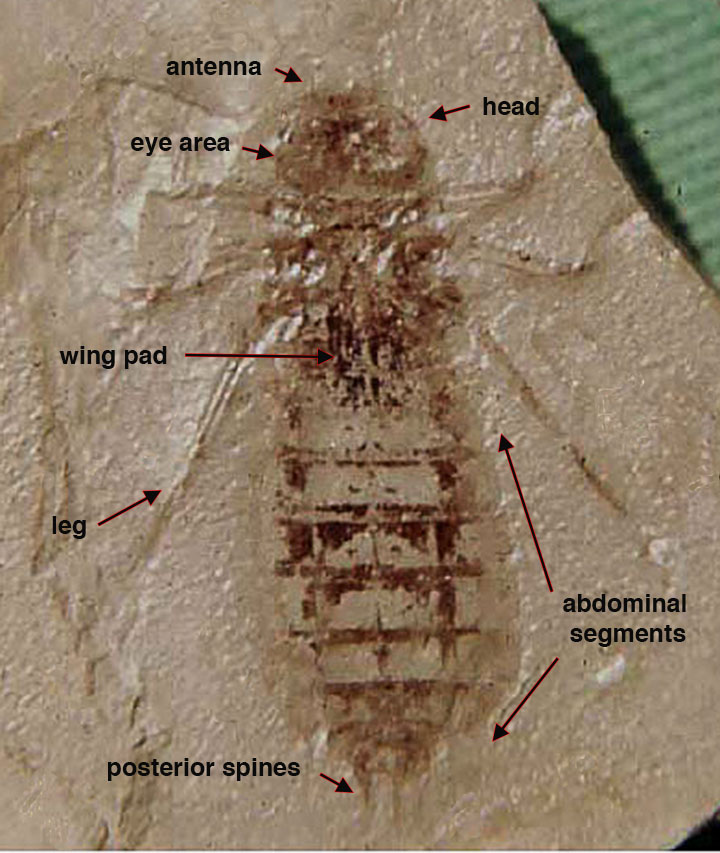
Fossil dragonfly nymph from California


Dragonfly nymphs have an aquatic existence for a short time before morphing into winged adults. Nymphs live in lakes and streams and are voracious carnivores. Although it would seem that the muddy and quiet burial environment on the bottom an ancient lake would have resulted in nymphs being commonly preserved, their remains in the fossil record are uncommon.

The specimen shown below is a carbonized impression of dragonfly nymph of Pliocene age (approx. 4 million years old) from an ancient lake just north of Los Angeles in southern California.


The specimen is the dorsal view of a carbonized impression of a dragonfly nymph (nearly 35 mm long = nearly 1.5 inches) belonging to family Libelluidae? (genus cannot be determined). It has its antennae (barely visible), left-eye area, both wing pads (probably broken), legs, and posterior spines preserved.


Burial of this specimen must have been rapid, otherwise scavengers would have obliterated the remains.

The specimen was found in a shale bed with associated fish and plant remains (aquatic reedlike plants and nodules of presumably seed-pod origin). 

Tuesday, May 31, 2016

Why is massive rose quartz pink?

I have always enjoyed collecting quartz, and massive rose quartz is one of my favorites. There are some interesting new findings about what causes its coloration, and this post with help inform you about some of them. You might note that researchers use the adjective “massive” to describe rose quartz. This is done in order to differentiate it from euhedral (nice, angular crystals) of rose quartz.


A polished specimen of massive rose quartz, 3.75 inches high.

Massive rose quartz is one of the common colored varieties of quartz and found at numerous localities worldwide. A few of the areas where multiple localities are known include: Brazil, California (Riverside County), Montana, South Dakota, Norway, and Madagasgar. Massive rose quartz is commonly found in granitic pegmatities. It is less commonly found in hydrothermal veins.

Unpolished massive rose quartz (about 6.5 inches long), from Minas Gerais mine in Brazil.

So, what causes the pink color of massive rose quartz? Over the years, there have been various explanations, but the one that has been meticulously researched by Caltech mineralogists in recent years has proven the presence of pink nanofiber inclusions, which are related to the pink mineral dumortierite, a boron-bearing silicate. These pink nanofibers are 0.1 to 0.5 micro meters in width [about 0.00002 inches], and they resemble wavy bundles of hair-like fibers.

Massive rose quartz is always slightly to highly cloudy (turbid) and never clear. Its color can range from pale to pink to lavender (even in the same hand specimen, see third picture), and, in some cases, entirely lavender (see fourth picture), or, reportedly, orange.

From left to right: massive rose quartz showing transition from pale pink to pinker to lavender.
Hand specimen is 5 inches in length.

Lavender variety of massive rose quartz.
Hand specimen is 4 inches high.

I obtained much of the above information from the very informative article:  Goreva, J., C. Ma, and G. R. Rossman, 2001. Fibrous nanoinclusions in massive rose quartz: The origin of rose coloration. American Mineralogist vol. 86, pp. 466–472.


Just copy the article title, paste it in the Google Search box, and you can get your own free pdf.

Wednesday, May 18, 2016

New mud volcano in Pakistan

This post concerns a mud-volcano island created by a 7.8M earthquake in southern Pakistan on September 24, 2013. The island, called Zaizala Jazeera (or “Earthquake Mountain”) formed 1 km (0.6 mi.) offshore from the coastline in shallow-marine waters, in the Paddi Zirr (West Bay) area near Gwadar, Pakistan (25°N, 62°E).


The island was originally circular with a diameter of 250 m. The original height was 15 to 20 m (60 to 70 ft.). It is currently sinking, and has already sunken 10 ft. into the sea since first appearance. Geologists believe that the island was caused by the earthquake-related, emission of methane gas on the seabed. Corals have inhabited the slopes of the island.

For additional close-up pictures of the mud volcano,
click HERE