Friday, May 26, 2023

RECENT SEA SHELLS OF ICELAND

Iceland is a North Atlantic oceanic island located between Greenland and northwestern Europe:


Google Earth Satellite image (2015) showing location of Iceland in the North Atlantic Sea.

Iceland has a relatively young geologic origin. It originated about 16 to 3 million years old, when volcanic eruptions began atop a “hot spot” on the Mid-Atlantic Ridge, as shown in the figure below.


Ocean-floor topography in relation to Iceland. This map is from The National Geographic Society (1968), Atlantic Ocean Floor Map.
 

Eruptions continue to present day in Iceland, as the island continues to enlarge. The northern edge of Iceland is situated on the Arctic Circle (60º N). Its waters are classified as boreal (cold) and are located between colder waters to the north and warmer (temperate) waters to the south. It is also important to mention (as is evident from the above figure) that Iceland “sits” on a volcanic plateau that was created by the volcanic flows associated with the Mid-Atlantic Ridge. This plateau causes Iceland to have a different physiography than that of the surrounding ocean floor. In turn, this plateau could be a “barrier” to the dispersal of the mollusks that crawl about on the adjacent (deeper) ocean floor.


The modern-day seashell fauna of Iceland is generally known but not in great detail. The composition of this fauna is the result of Iceland's transitional-zone geographic and climatic conditions. For example, some of the species found in Iceland also live in Great Britain, France, Norway, and Sweden, whereas other species found in Iceland also live in the arctic circumboreal waters that occur in Greenland, northeast Canada, as well as further south into Maine, Virginia, and North Carolina. Furthermore, some of Iceland’s molluscan species also live in Alaska, and even as far south as northern Japan. It is pertinent (if not alarming) to mention that the arctic circumpolar waters are currently warming at a rate twice that of the global mean temperature (Overland et al., 2017). 


Iceland is actually a southern “outpost” of arctic fauna with many arctic species present. Some other arctic species, however, do not reach Iceland. This arctic influence is most apparent along the eastern and northeastern coasts of Iceland.


For most marine bivalves, their dispersal is via free-floating and long-lived planktonic (feeding) veligers. This is the reason why most bivalves can be so widespread, with the main limiting factor controlling their distribution being temperature. Some marine gastropods also have free-swimming veligers—either feeding or nonfeeding---with either a short or long larval life. Some gastropods, especially the carnivorous neogastropods, however have no free-swimming larvae. These factors, taken as a whole, could help explain why some Arctic gastropods are not as widespread as the bivalves. 


I was able to obtain a generally good understanding of the taxonomic composition of Iceland’s marine molluscan species, but doing so was not that easy. It took me several days of searching online, as well as looking through a lot of literature, to find even rudimentary data. Seashell books (for seashell collectors) about Iceland’s marine mollusks are essentially confined to a single one: Skeldyrafana Islands, by Oskarsson, I. 1962 [reprinted in 1982] (see image, below). His identifications, which are written in the Icelandic language, however, need considerable revision. He reported approximately 190 species of bivalves and 130 species of gastropods. In addition, he reported numerous “subspecies;” many of which might not even be valid, taxonomically speaking. The book is not available online, but it can be purchased for a reasonable price from online-book dealers.


Cover page of Oskarsson's (1962) book.


My following treatment of Iceland’s marine mollusks is very incomplete and consists of a few commonly occurring species. Nevertheless, the ecologic data that I present here are up-to-date.


A FEW EXAMPLES OF RECENT MARINE MOLLUSKS OF ICELAND


Color images of most of the following species were kindly provided by Lindsey T. Groves, Collections Manager, Los Angeles Museum of Natural History. He obtained these images while on a vacation there in 2016. Exception are a black-and-white image from Oskarsson (1982).  and color images of Buccinum undatum. Geographic distribution, environmental data, and depth data are mainly from Coan et al. (2000) or from WoRMS (2023).


                                                BIVALVES

Mytilus eludes

      Family Mytilidae

      Widespread in the northern Atlantic


A cobble beach, near Hvaines, Iceland, with numerous disarticulated valves of M. edulis.      


Two valves of M. edulis collected from the beach fauna near Hvaines.


Chlamys islandica (O.F. Müller, 1776)

     Family Pectinidae

     Iceland, Greenland, Norway, North Atlantic, Faros British Isles,         North Carolina.

     Not in Canada nor in Alaska. This is an Atlantic Ocean species.

     Note: Early Iceland workers commonly mistakenly assigned this    species to genus Pecten.


Chlamys islandica, right-valve exterior. 


Arctica islandica (Linnaeus, 1767)

Family Arcticidae

Firm sand, mud, or clay, intertidal to deep (4-480 m)

Iceland, Ireland, Britain, France (Bay of Biscay), Denmark (Faroes Islands), northwestern Russia (Onega Bay, White Sea), Labrador to North Carolina.


                               Arctica islandica, right-valve.


Spisula solida (Linnaeus, 1758)

     Family Mactridae

     A burrowing bivalve in sand, uncommonly at low water but mostly sublittoral. Fa

     Eastern Atlantic from Iceland, Norway, and south to Portugal and Spain.

                                           Spisula solida.


Serripes groenlandicus (Mohr, 1786)

Family Sardine

Intertidal to about 80 m.

Panarctic and circumboreal = cosmopolitan in arctic and boreal waters:

Iceland, North Atlantic from Greenland to New England; northern Pacific-throughout  Bering Sea shelf to Amchitka Island, Aleutian Islands in Alaska, and south to Puget Sound, Washington.


        Image of Serripes groenlandicus from Oskarsson (1982).


Mya truncata Linnaeus, 1758

Family Media

Intertidal to 100 m, in mud and sand of protected bays and foreshores.

Circumboreal and panarctic

Iceland, Beaufort Sea to Point Barrow, Alaska, south to Hood Canal and Neah Bay, Washington, and in western Pacific south to northern Japan. Note: this species has a fossil record stemming from Miocene rocks in California (Coan et al., 2021, p. 473).


                                    Mya truncata, left valve.


                             GASTROPODS


Buccinum undatum Linnaeus, 1758 [has many synonyms]

      Family Buccinidae

      Predator. Its lavae do not have a planktonic stage; therefore this snail is somewhat restricted in its distributon.

      Subtidal dweller. Native to the North Atlantic. It is fished commercially. Specimens are up to 15 cm height. 

      Iceland and Svalband. West Greenland. Europe (Norway to Spain). Canada: Baffin Island, Queen Elizabeth Islands, Labrador, Newfoundland, Quebec, New Brunswick; USA: Maine, Massachusetts, Connecticut, New York, New Jersey, Delaware, Maryland, and Virgina (WoRMS, 2023).


Buccinum undatum Linnaeus, 1758, apertural and abapertural views.


Nucella lapillus (Linnaeus, 1758)

Family Muricidae

Intertidal predator on barnacles (WoRMS, 2023)

Iceland; west Greenland; Canada: Labrador, Quebec, Nova Soctia, New Brunswick; USA: Maine, Massachusetts, Connecticut, and New York (WoRMS, 2023).

             Nucella lapillus (Linnaeus, 1758), apertural view.


References Cited:

Coan, E.V., P.V. Scott, and F.R. Bernard. 2000. Bivalve seashells of western North America: marine bivalve mollusks from Arctic Alaska to Baja California. Santa Barbara Museum of Natural History Monographs Number 2, Studies in Biodiversity Number 2, 784 pp.


marinespecies.org [=WoRMS.org] 2023


Oskarsson, I. 1982. Skeldyrafana Islands. 351 pp. (in the Icelandic language).


Overland, J.E. et al. 2017. Surface air temperatures. In Arctic Report Card. http://www.artic.noaa.gov/Report Card


Sunday, May 21, 2023


 ARÊTES AND MOUNTAIN GLACIERS

When I was researching my recent blog on “High Mountains Peaks,” I knew that such mountains are inherently associated with arêtes (pronounced “ah-rets), however, that glacial-geomorphic term is inexplicably seldom mentioned in any “on-line” remarks or literature.


The word arête (pleural arêtes) is a French term, meaning “fish bone,” in order to describe the sharp angular ridges with crests and divides in glaciated or formerly glaciated mountain areas. These crests and divides are jagged and look like serrations in a “saw blade.” In some cases, the crests can be spines (e.g., like the spectacular examples found in the glaciated areas of the Patagonia region in southern South America or in the Trango area of Pakistan). Arêtes are formed by the processes of erosion and freeze-thaw weathering, and they are especially evident in high-mountain glaciated areas and result from the continued backward growth of the walls of adjacent eroded valleys.


 An area that has been eroded by four coalescing mountain glaciers. All the sharp, jagged ridge lines (arêtes) associated with the glacier were caused by erosion. One of these arêtes is indicated on the figure above, which is based on (but modified) from fig. 14.11, on page 354, of  Hamblin, W.K. and E.H. Christiansen 1998. Earth’s dynamic systems. 8th ed. Prenctice Hall, New Jersey, 740 pp.


Monday, May 15, 2023

THOR PEAK: THE WORLD'S LONGEST VERTICAL DROP

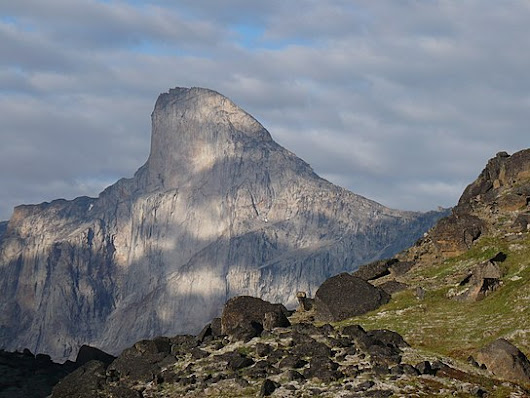
 While researching my recent blog on the world’s “Highest Mountain Peaks,” I came across mention of Thor Peak in Canada. Although, it is not one of the highest mountains in the world, its west face does lay claim to having the longest drop in the world: 4,100 ft. (1,250 m). 


Location of Thor Peak, Baffin Island, eastern Canada (from Google Earth, 2023).


Thor Peak (from Wikipedia.org). 


Thor Peak, also called Mount Thor, is in the Auyuittuq National Park, in the Oikigtaaly Region of Northwest Canada. The elevation of this peak is 5,495 ft. (1,675 m). This area is within the Baffin Mountains, which forms part of the Arctic Cordillera Mountain Range. Thor Peak, consists of solid granite. This rock, which is of Precambrian age, is among some of the oldest rocks known on Earth. During the Pleistocene ice age, Thor Peak was carved by massive glaciation.


The first ascent of Thor Peak was in 1985 and it took a team of climbers 33 days to make the climb. A solo ascent of the west face was in 1998. The first free climb was in 2012. It should be added that people have died trying to climb Thor Peak.


A free fall by someone (traveling at terminal-velocity speed) off Mt. Thor would last about 26 seconds before hitting the ground. Note: It is illegal to base jump off Thor Peak. 


In shape, Thor Peak resembles the peaks of El Capitan and Half Dome in Yosemite Valley, central California. El Captian has a vertical drop of about 3,300 feet: from base to summit. Like Thor Peak, both El Captian and Half Dome consist of granite and were glaciated during the last Ice Age.


For an interesting article about Thor Peak, I encourage you to read the following blog:


Dunhill, J. 2023. Mount Thor is the world’s largest vertical drop an “it is terrifying.” <iflscience.com/mount-thor-is-the-worlds-largest-vertical-drop-and-it-is-terrifing>


Monday, May 8, 2023

NACRE IN SHELLS PART 2 (GASTROPODS AND CEPHALOPODS)

THIS PART 2 IS A CONTINUATION OF THE IMMEDIATELY PRECEEDING POST DEALING WITH NACRE IN BIVALVES

GASTROPODS

(Both the lateral and apertural views of each specimen are illustrated below--or in the case of Haliotis, the dorsal and ventral views). The caption for each set of images precedes those images.


a) Mikadotrochus hirasei [83 mm wide, 115 mm high]. This “slit shell” is rare and found in deep waters (>100 m) of the coasts of Japan, Taiwan, and China. It belongs to family Pleurotomariidae.  For more details, see my previous post for July 28, 2020.

                                                         a)


b) Trochus niloticus [40 mm wide, 40 mm high]. This species is common and found in Hawaii. It belongs to family Trochidae.


                                                       b)

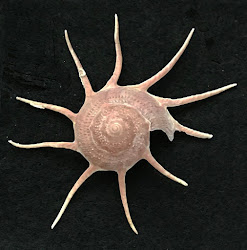
c) Guildfordia triumphans [including the spines: 48 mm wide, 35 mm high]. This species (a.k.a., “the star shell” or also the “triumphant star turben” is common and found (caught in nets) in deep waters of East Africa. It belongs to family Turbinidae.


                                                       c)


d) Astraea undosa [80 mm wide, 60 mm high]. This species is common and found in southern California and Baja California. It belongs to family Turbinidae.


                                                     d)

e) Haliotis refuscens [187 mm wide, 130 mm high]. This species (a.k.a., “red abalone”) is moderately common and found on rocks mainly along the coast of central California. It belongs to family Haliotidae. For more information about this shell, see my previous post July 28, 2020.


                                                     e)

CEPHALOPODS


NAUTILOID

(both the exterior and interior views of the specimen are illustrated below)


f) Nautilus pompilius [16 cm wide], an Indo-Pacific modern-day specimen showing its interior layer of “mother-of-pearl” biomineral aragonite luster. See my previous post August 1, 2016 for more details.


 f)                                       


AMMONITE

g) Placenticeras sp. [110 mm wide, 125 mm high], interior layer, with weathered remnants (the white patches overlying the sutures) showing faint pearly luster. This South Dakoka specimen is of Late Cretaceous age. See my previous post April 27, 2022 for more details.


                                                      g)

SEPIID

 (both the side and frontal views of the specimen are illustrated below)


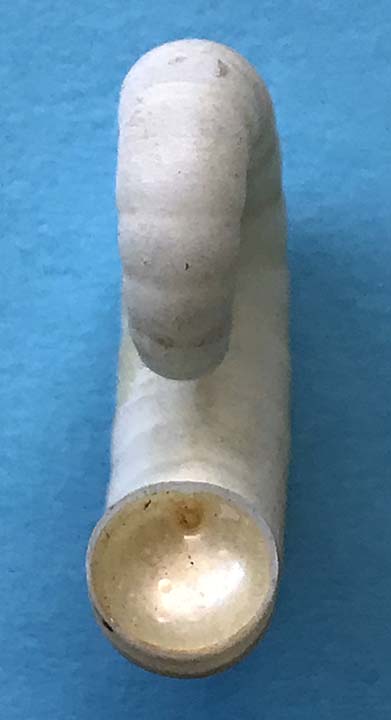
h) Spirula spirula [23 mm wide, 6 mm diameter]. This species is the only living member of this genus. The specimen is from Florida. The frontal view of the shell shows the  perforation for the siphuncle, which connects all the chambers inside the shell. For more information, see my previous post August 8, 2019.


h)


Thursday, May 4, 2023

NACRE IN SHELLS: PART 1 (BIVALVES)

In the classification and identification of mollusk shells (clams, snails, nautiloids, ammonites, etc.), the presence of “mother-of-pearl” luster [also referred to as nacre = the material responsible for iridescent shells with rainbow colors] is very important and fundamentally useful. This beautiful aspect of some shells is related to the presence of the organic biomineral aragonite (calcium carbonate [CaCO3 + organic matrix material]). I discussed this phenomenon in one of my earlier posts dealing with biominerals, which are minerals secreted by organisms. Two of the most popularly known examples of shell nacre occur in the pearl oyster and the abalone. [Note: In one of my earlier posts I discussed and illustrated also the topic of  inorganic aragonite.]


Only certain families/genera of mollusks secrete nacre, which always occurs as an inner lining, usually protected by an organic layer covering the outside surface of a shell. These families comprise the generally least derived (least evolved) groups of bivalves and gastropods. Also, many families of freshwater clams have nacre in the interior their shells. A few slugs have internal shells, but they consist of calcite. Other mollusks having with nacre in their shells are nautiloids (straight and coiled), ammonites, sepiids, and monoplacophora.


Organic aragonite makes the strongest shells. The microstructure of organic aragonite is like stacked bricks interlayered with conchiolin. Upon death of the shell, the decomposition of the conchiolin causes the shell to deteriorate, unless the entire shell is encased in protective material like asphalt or extremely fine-grained shale. The main thing is to keep out corrosive water. Organic aragonite has been reported from rocks as old as Ordovician, but other Paleozoic locales where the aragonite has been well preserved are rare. The earliest undisputed nacre occurs in the Lower Ordovician cephalopod Isorthoceras from Cincinnatic, Ohio. Inferred nacre occurs in two Cambrian bivalves (e.g. Pojetaia), but these shells underwent replacement of the original shell material by phosphate minerals.


The fossil record shows a nearly unbroken sequence of nacre-forming mollusks from the Early Ordovician to Recent time. In my last post, I focused on the presence of nacre in Middle Pennsylvanian shells from the Buckhorn Asphalt Quarry in Oklahoma.


Because the subject matter of nacre is considerable, I decided to treat it in two separate posts. This first part shows common examples of some bivalves (marine and freshwater) that have nacre. 


NACRE IN BIVALVES


Both the exterior and interior views of each specimen are illustrated below and in that order of appearance. The caption for each pair of images precedes the images:


1) Pteria sterna [75 mm wide, 70 mm high], with a pearl blister. This species is common and found in southern California to Peru. It belongs to family Pteriidae. Collected by the author:


1)


2) Isognomon isognomum [130 mm wide, 65 mm high]. This species is common and found in the intertidal zone in the Philippines. It belongs to family Isognomonidae:


                                                     2)

3) Atrina vexillum? [90 mm wide, 100 mm high]. This species is common and found in the Indian Ocean. It belongs to family Pinnidae:


3)

4) Pinna rugosa [350 mm high] is commonly found in the Bahia Concepcion area near Loreto, Gulf of California, Baja California, Mexico. It belongs to family Pinnidae. Collected by the author.


                                                       4)

5) Proptera alata [150 mm wide, 97 mm high]. This bivalve is found in freshwaters of eastern and central North America. It belongs to family Unionidae (the freshwater bivalves):


                                                      5)

Thursday, April 27, 2023

BUCKHORN ASPHALT QUARRY

The Buckhorn Asphalt Quarry (BAQ) in southern Oklahoma, USA, is a very rare occurrence of one of the oldest known mineralogically and chemically unaltered mollusk shells in the world. The rocks are Middle Pennsylvanian in age (about 310 million years old).


Aragonite is a common constituent of fossil and Recent mollusk shell. This biomineral is metastable and eventually recrystallizes into coarse-grained calcite, thereby destroying the original microstructures. There has been very little to no  recrystallization of these kind of shells in the BAQ shells. The inner shell layers of many cephalopods (nautiloids and ammonoids), gastropods, and bivalves from the BAQ contain textures and microstructures identical to pristine, unaltered nacre of modern mollusks. Many shells have also their original Sr, Mg, and stable oxygen-isotope contents. Orthocone nautiloids have their original cameral deposits and conchiolin. Also, some gastropods have their original color patterns.  


This exceptional preservation (also referred to as a “Lagerstatten”) occurred because either during or shortly after deposition, oil migration occurred along nearby wrench faults. This early incursion of oil prevented any diagenetic alteration to the BAQ shells and allowed for only pin-point cementation of the shell and sediment. Conversion of the oil to asphalt occurred later. When the asphalt is extracted via a Soxyhlet extractor (using dichlormethane) from the “rock,” the material crumbles under finger pressure.


The 10-m thick BAQ section of strata are mostly limestone (foraminifera-mollusk grainstones) in the lower part and a foraminifer-cephalopod coquina in the upper part. The strata overall consist of broken and abraded skeletal debris, scattered whole gastropod shells (some minute in size), scattered plant remains, and scattered micro-scour channels and cross beds. Many of the plant fragments and the orthocone nautiloids show preferred orientations. The shells were most likely winnowed by waves/currents in localized areas in a shelf environment affected by fluctuating depths.


The way the BAQ quarry looked in 1970 when I started my field work.

The quarry is within the historic Buckhorn asphaltic region, which was heavily mined in the early 1900's. The quarry was originally dug out by hand in order to obtain asphalt to be used in Oklahoma City. The BAQ, which was originally called the Gilsonite Paving and Roofing Company, No. 2 quarry, was initially mined for its hard, shiny asphalt (gilsonite), and periodically thereafter, until the 1940s, for its natural asphalt. I first visited the BAQ in spring 1970, when I started my doctoral dissertation there. I found only weathered asphalt, and much of it was as displaced pieces of "float," and the old quarry was filled with thick brush (including poison ivy), ticks, and some snakes. Before the 1970s, fossil dealers and weekend collectors had trespassed onto the private property in order to take fossils without asking permission from the land owner. They had picked over the rocks pretty thoroughly in their search for weathered-out orthocone *straight-shelled” nautiloids with some remnant shiny luster.


My doctorate dissertation research at the California Institute of Technology concerned the first integrated geologic, paleontologic, and geochemical study of theBAQ. With the financial assistance of the Oklahoma Geological Survey, I arranged for the old (historic) BAQ to be reopened by means of two bulldozers, a back-hoe tractor, and two days of dynamiting. As a result, foliage and debris were removed, fresh bedrock was exposed, and the quarry proved to be approximately 168 m long, 25 m wide, and with an average depth of 7 m. A continuous 10-m-thick stratigraphic section was exposed near the west end of the quarry. The richest fossil bed of cephalopod remains was exposed for a distance of 38 m by means of the heavy machinery and precision dynamiting. This bed is richly asphaltic with dark black color and odor, and the abundant fossils had undergone no weathering whatsoever. In comparison, weathered rock (especially float) in the bottom of and along the south side of the quarry had a bluish-gray to gray color. Weathering became evident on freshly exposed asphalt even after a single rainstorm. The majority of the fresh bulk material I had uncovered during this excavation was either shipped or taken by me to southern California. A few years ago, I donated this material to the Invertebrate Paleontology Department of the Natural History Museum of Los Angeles County (LACMIP). Other material that I collected and gave to Caltech was later given to LACMIP. In order to facilitate future researchers visiting LACMIP to view all these samples, I recently donated to LACMIP my extensive collection of research papers concerning the paleontology and geology of the BAQ.


The way the quarry looked just after the dynamite process and bull-dozing were finished in 1970.


In addition to the mollusks, other fossils that I found in the BAQ strata are remains of land plants, foraminifera, chaetetid sponges, rugose corals, bryozoans, brachiopods, rare scaphopods and chitons, ostracods, and echinoderms.


Asphalt-impregnated coiled cephalopod shell.


Asphalt-impregnated straight (orthocone) nautiloid shell.


Orthocone nautiloid with asphalt removed, thereby revealing the original iridescence (the play of lustrous, changing colors) of the original organic aragonite layer.

Two views (A, side) and (B, oblique of top) of a Naticopsis gastropod showing color banding after the asphalt was removed.

[For more details, see the reference: Squires, R.L. 1976. Color pattern of Naticopsis (Naticopsis) wortheniana, Buckhorn Asphalt Deposit, Oklahoma. Journal of Paleontology 50(2):349–350].


Since my reopening of the quarry back in 1970, many paleontologists, some from other nations, have visited the site and collected from the available material. Their studies have have revealed some new discoveries: algae, a rugose coral (rare), and isolated fish teeth and fish scales.


In a paper by Vendrasco et al. (2018) (cited below), I wrote a comprehensive summary of the geology of the BAQ and included pertinent references.


Vendrasco, M.J., A.G. Checa, R.L. Squires, and C.M. Pina. 2018. Unaltered nacre from the Pennsylvanian Buckhorn Asphalt, and implications for the arms race between mollusks and their predators. Palaios 33(16(:451-463).