Saturday, December 28, 2024

AMARYLLIS (the plant), not the amphipod!

There are only two known species of plant with its beautiful flowers. The plant is native to the western Cape region of South Africa, in the rocky area betwwen the Oligants River and Knysna. Amaryllis has been introduced into California (see images below), Great Britain, Australia, and New Zealand.


Its classification is:


  Kingdom Plantae

  Order Asparagales 

  Family Amaryllidacea

  Genus Amaryllis Linnaeus, 1753

  Species: only two species are known.


The common names of this plant are “belladonna lily,” “Jersey lily,” “armarillo,” “Easter lily” (in southern Australia), and the “March lily” (in South Africa). These plants, however, are only distantly related to the true lily, Lilium. 


The name “Amaryllis” symbolizes “love, beauty, and determination.” The plant is up to 3 feet tall, with long leaves. Its flowers are large and funnel shape, and have long stems. The flowers can be white, pink, apricot, rose, or deep burgundy. The images shown below are from plants grown in my garden in northern Los Angels County, Southern California.

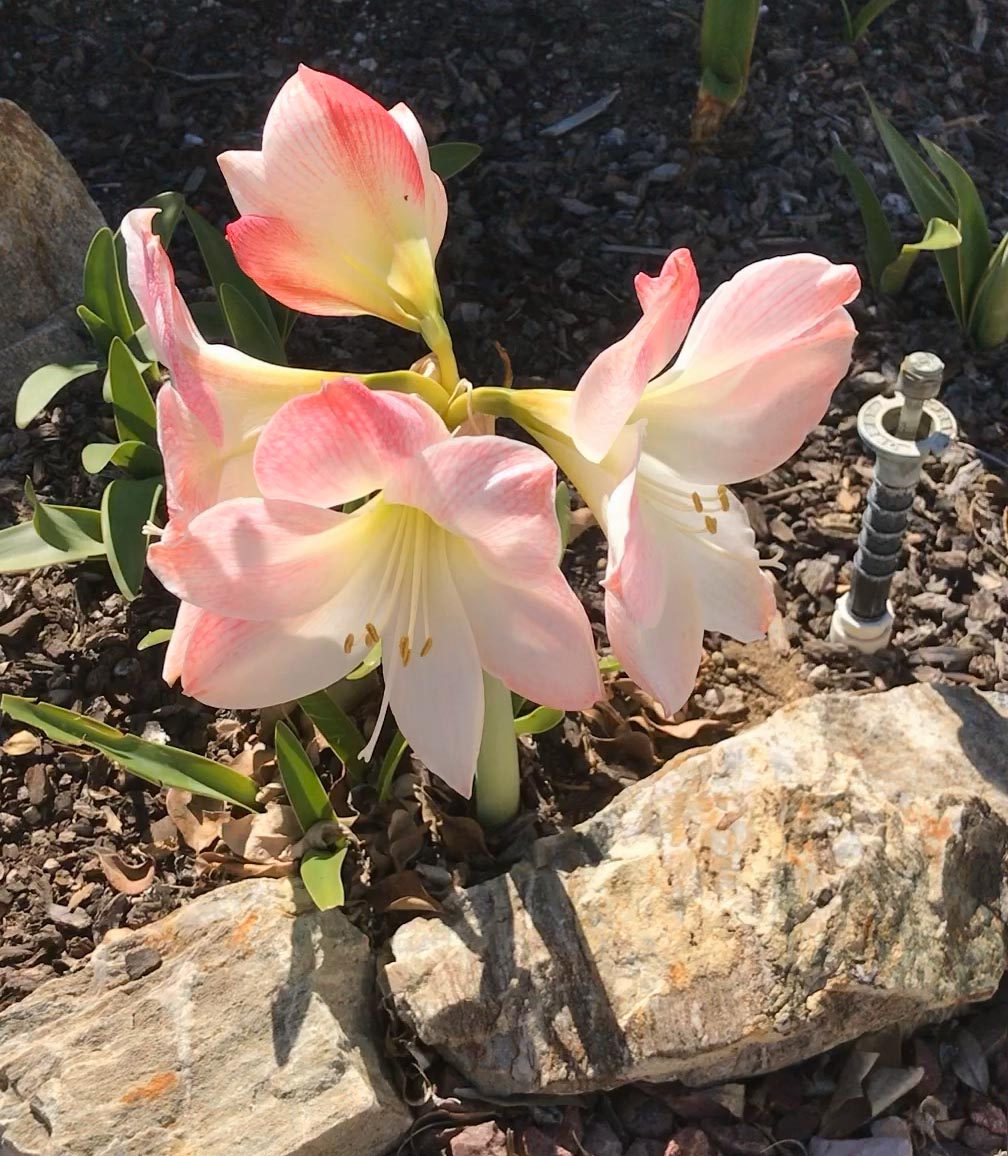


This plant normally flowers in late summer. It is NOT frost tolerant, but it does not like tropical environments. It likes considerable shade (but not total shade) and does not like to “sit” in water.  It does well is the Los Angeles area.


While researching this flower, I was surprised to learn that the genus name “Amaryllis” is used also for a group of marine crustaceans (amphipods) that live in shallow oceans (depth from shoreline to 50 m) in the western Indian Ocean! This is allowed in the long-standing rules of taxonomy (= the naming of organisms) because the name “Amaryllis” applies to both plants and marine animals; otherwise, one name or the other would have to be changed.

Reference consulted: Wikipedia

Sunday, December 22, 2024

MEDITERRANEAN CYPRESS: A TREE WITH MANY NAMES

This evergreen-conifer tree has many synonyms. Examples are the following:  Cupressus sempervirens = [“Mediterranean cypress” a.k.a  "Italian cypress"], "Tuscan cypress," "Persian cypress," “pencil pine," “tiny towers,” and/or “green spine.” 


This kind of tree tapers quickly (thus it is pencil shaped). It is a very narrow (4 to 5 feet wide) tree, but it can be very tall (commonly reported as up to 115 feet tall (= 35 m). These kind of trees rapidly increase their height (about 2 to 3 feet per year), but eventually their growth rate slows down. Their roots are primarily vertical and usually not disruptive to nearby walls. In my neighborhood in southern California (northern Los Angeles Count), there are quite a few localized stands of the "Mediterranean Cypress." The tallest ones are about 80+ feet tall (estimated height) or more, as they have been growing for many decades.

A cluster of this cypress in Southern California, with a telephone pole, for scale. I estimate this cluster to be at least 70 feet tall.

The foliage of this type of tree consists of clusters of short needles on upright branches. Shown is a cluster, 7 inches long, 5.5 inches wide.

A view showing only the uppermost 10 feet of a cluster of these trees. Their seed cones are located only in the uppermost part of each plant.


This plant does not flower, but in the late summer and fall, it produces small, roundish, green to brown (can be copper color) seed cones, which are initially closed--but open up somewhat later. Shown here are representative seed cones from the upper part of the tree. The cones are about 1.5 inches in height and ¾ inch in diameter.


Shown above is a dried-up and cracked seed cone, ¾ inch height and by ¾ inch in diameter. Dried cones are used for crafts and decorations. The cones are tightly held together at first, but eventually, they fall apart.

The fossil record of this genus is poorly known. The geologically earliest known occurrence of Cupressus in the rock record is Oligocene in age (very approximately 30 million years old) in South China (Shi, G. et al., 2011). A Paleocene fossil of Cupressoconus from Britain is probably an earlier representative of genus Cupressus (Shi et al, 2011).


References Cited or consulted


Belger, T.J. 1984. Roadside plants of southern California. Mountain Press Publishing Co., Missoula. 157 pp.


Shi, G. and others, 2011. Cupressus foliage shoots and associated seed cones from the Oligocne Ningming Formation of Cuangzi, south China. Review of Palaeobotany and Palynology 166(3):325-334. (free pdf available online)


Watts, T. Desert tree finder. Natural Study Guild. 61 pp. [note: an inexpensive “pocket

book” for hikers].

Wednesday, December 11, 2024

WINGS? ON A GASTROPOD SHELL

Can wings can be present on a snail snail? The answer is, of course not!  But, this post concerns the so-called “winged triton” seashell, more formerly known a Gyrineum perca. In scientific description, these so-called “wings” are more properly referred to as varices. They are aligned  along the sides of the shell, and they probably provide stability on the ocean floor for the shell. The growth of varices on shells is referred to as “episodic,” growth; that is to say, it is intermittent but fast. Initially, a thin-flexible expansion of the shell is built, and as this material is secreted, it is mineralized and gradually thickened, over a period of several days. The gastropod otherwise remains inactive and concealed until the new shell material is hardened (Vermeij, 1993). 

For you “old timers,” this particular seashell was colloquially known as the “winged triton” or “maple-leaf triton.” For awhile, it was previously referred to in the scientific literature as Apollon perca or Biplex perca, but if you regularly read my posts, you will be fully aware that the names of sea-shells are commonly in a state of flux these days; mainly, because of new DNA data about these animals.

A

B


C

Gyrineum (Biplex) perca, length 55 mm, width 45 mm, thickness 16 mm.apertural view. A) apertural view. B) abapertural (back) view. C. Right-side view. No Locality data available.


Another specimen of Gyrineum perca: length 52 mm, width 40 mm, thickness 15 mm. This second specimen has an operculum [used to close off the aperture from predators]; the operculum consists of horny [=organic material which is not calcified]. Locality data not known.


According to WoRMS [World Register of Marine Species], the current classification of this seashell is:


Class Gastropoda

Order Littorinimorpha

Family Cymatiidae

Genus Gyrineum

Subgenus Biplex

Species perca (Perry, 1811)


The shell of Gyrineum (Biplex) perca ranges from 31 to 100 mm (1.2 to 3.9 inches) in length. The shell, which is white, yellowish, or pale brown, is quite flattened, with a large flange (“so-called wings”) along its two sides.


The modern-day distribution of Gyrineum (Biplex) perca is eastern Africa to Japan. It is essentially  confined to warm (tropical) waters (Wikipedia, 2024). 


Gyrineum is one of the 24 known genera of family Cymatidae Link, 1807. To view some of the species of Gyrineum that resemble Gyrineum perca (there are at least four other such species)—the differences being in the shape of the wings (flanges); for more information, see the following website: https://www.jaxshells.org/gryrineum.htm 


References Cited:


Beu, A.G. 1998. Family Ranellidae. In Mollusca The Southern Synthesis, Part B. Fauna of Australia Volume 5. Pp. 799-802. CSIRO Publishing, Melbourne, Australia 


Vermeij, G.J. 1993. A natural history of shells. Princeton Science Library. 207 pp.


Wikipedia. 2004.


WoRMS. 2024. World Register of Marine Species [https://marinespecies.org]


Tuesday, December 3, 2024

AN UNUSUAL SOUTHERN CALIFORNIA ORB-WEAVER SPIDER

Spiders, like other arthropods, have six legs. This blog post concerns a species of spider belonging to the order Araneae, family Araneidae, and genus Argiope (the orb-weaver spiders).


Orb-weaver spiders are the most common group of spiders in the world. Some of them can be bizarre-looking and very brightly colored. I recently found two specimens in my garden. Compared to other orb-web spiders found in southern California, they are unusual. Their bodies (carapaces) have a yellowish-brown color pattern. The exteriors have several rows of prominent bumps that protrude out over the ventral surface.


I checked what literature I have in my natural-history library, as well as online, and I determined that these spiders represent an unusual variety of Argiope argentata, a species that typically lives in New World tropical and temperate regions, especial in of Central America and South America. The specimens in my garden, however, have a less spectacular color pattern than most other Argiope argentata species, which can have patches of silver, black, red, yellow, green, orange and/or brown.


A


Dorsal view of specimen (A): length of spider approximately 2 inches long). Next, below, is the ventral view (B) of this same specimen (slightly out of focus). The prominent white, “zig-zag thread” = the stabilmentum, which was secreted by the spider. See the text for a discussion of the function of the stablimentum. [Note: this kind of spider positions itself upside down on its web. The wind was blowing when I took this picture, and I could not get a sharp-focus image of ventral (bottom side) of this spider].

B 


The last and third image (C), see below, is a ventral view of another, but smaller, specimen (length only1.25 inches). Its stabilmentum is also present (on the left side of this view). The web of this specimen was more complete than the other specimen. Both specimens were found in my garden, in northern Los Angeles County, southern California. 


C
                               

Orb spiders typically have very large and complex orbicular (circular) webs. The web of the first spider photographed above (images A and B), was only a very partial one (i.e., a small lenticular-shaped remnant of its recently damaged web). I returned the next day to view the spider, again and it and the web were gone, except for a few filaments. Orb-weaver spiders are known to routinely destroy their own webs and create new ones. That is most likely the best  explanation for the sudden disappearance of its web. The web of the second specimen was a more complete (but still small) classic orb-spider web. 


Like other orb-web spiders, the ones found in my garden positioned themselves upside down in their web where they wait for their prey (e.g., mosquitoes) to get trapped.


note: a comment on the purpose of the stabilmentum. Some experts speculate that it is to make the web visible to birds that might otherwise fly into the web and, thereby, destroy it. This type of structure is commonly made by orb spiders.


Sources of Information:


Conrad, J. 2014. A blog site. Naturalist Newsletter. https://backyardnature.net. 


Levi, H.W. and Levi L.R. 1968. A guide to spiders and their kin. A Golden Nature Guide, New York, 160 pp.


Nicky Bay. Orb-weavers (Araneidae checklist)-Macro photography of many species, some with unbelievable shapes and colors). An online website. 

Tuesday, November 26, 2024

A GIANT-SIZED MIOCENE FOSSIL BARNACLE FROM CALIFORNIA

On the west side of the San Joaquin Valley, central California, near the town of Coalinga, outcrops of the shallow-marine Santa Margarita Formation contain locally abundant, giant-sized (several inches tall and wide) barnacle fossils. Identifications as to their genus and species have been inconsistent (Cote, 1991:p.158). Detailed study is needed to resolve their exact generic identification. In one of my previous blog posts (Nov. 11, 2017), I briefly mentioned these large barnacles and photographed the same cluster of specimens that is also used in this current blog post. 

Some specimens of this large (several inches tall and wide) barnacle genus/species have, in a few cases, been misidentified as fragments of mammoth bone or even as rudistid bivalves (note: these particular bivalves went extinct at the end of the Cretaceous). 


Top view of an individual specimen of Tamiosoma gregaria Conrad, from the Santa Margarita Formation, Coalinga area.


Side view of the same specimen.


Basal view of the same specimen.


Top view of a cluster of T. gregaria (7 inches wide and 6 inches tall) from the same locality as the specimens shown above. 


REFERENCE CITED


Cote, Russel. 1991. Paleontology of the Santa Margarita Formation. California State University, Northridge. This master’s thesis is available for free online. 


Friday, November 22, 2024

PONDEROSA LEMON (BIGGEST LEMONS EVER)

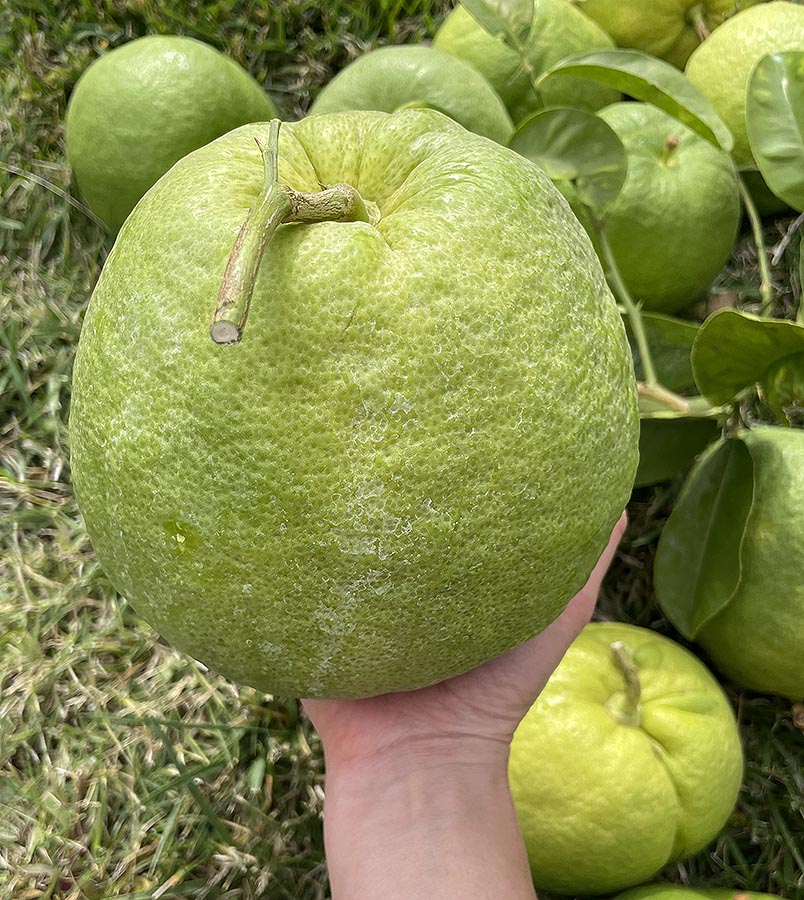
The gigantic fruit of the ponderosa “lemon,” or Citrus x pyriformis, is the biggest citrus in the world. It is a hybrid of a pomelo and a citron, thus it is not a true lemon. It was probably derived from a cross between a wild citrus and a domesticated citrus, such as a variety of a bitter orange. It can weight as much as 5 pounds and is often the size of grapefruits. Furthermore, like other citrus, lemons are actually a berry. 

The example shown above is from northern Los Angeles County, southern California. Such plants are not native to this area; they have to be purchased from plant nurseries.


The tree from whence the giant fruit came from (i.e. after it was picked). You can see some regular sized fruit still on the tree.


Some other big "lemons" from the same tree (shown above). Although, these are large, they are not as big as the giant one shown above. These big "lemons" are in the process of growing into giants.


The fossil record of citrus fruit is is poor! The earliest fossils of citrus plants (in general) are of late Miocene age (8 million years ago) and  are found in southwestern China.


Reference Consulted: A blog by Jerry James Stone (2023).


Wednesday, November 20, 2024

WESTERN SPADEFOOT TOAD, TRANSVERSE RANGES, SOUTHERN CALIFORNIA

While doing geologic field work in the Transverse Ranges, just north of the San Fernando Valley in southern California, one day a few years ago, I came across something I had never encountered before or since. I was way off the “beaten track,” in a “wild” area, when I saw three toads sitting on a rock, next to a small stream–in a shady area. This particular area is not easily accessible to hikers, and that is undoubtedly the reason these toads were present. It is common knowledge that unspoiled “wild areas”) are becoming fewer and fewer these days (and sightings are rare–because of human encroachment. Furthermore, this toads is now considered to be an endangered species in this area, and I was fortunate to be able to see them. In addition, it was rare event because, I spotted them during the day, even though they are primarily nocturnal.


Phylum Vertebrata

Class Amphibia

Family Pelobatidae

Genus Spea [spea is Greek, meaning warty skin]

Species hammondii


Spea hammondii is a small (1.5 to 2.5 inches long) stout-bodied toad with short legs and warty skin. Their eyes are wide-set, with no bone buildup (boss) in between them. Their adult body often has four irregular light stripes and black blotches on their back. Their backs can be all brown or all gray. Their abdomens are white. A juvenile specimen I saw [illustrated here] was all green.


Three species of Spea are found in California: hammondii has the greatest geographic range as it occurs throughout California, as well as in northwest Baja California, Mexico. Another species occurs only in northeastern California (east of the Sierra Mountains) and another species occurs only in southeastern California.

                                          A


                                           B

A western spadefoot toad [A and B, two views of adults, both about 2 inches long; and C, view of a juvenile, about ¾ of an inch long] alongside a small creek, in the Transverse Ranges just north of San Fernando Valley, northern Los Angeles County, southern California. I did not measure exact dimensions because I did not want to disturb the animals in any way.