Thursday, June 30, 2022

SOME COMMON MINERALS CONTAINING COPPER

Copper (Cu) is one of the first metals used by humans. Copper is one of the few metallic elements to occur in native (pure) form. The white mineral in the example below is probably quartz. Native copper has a Mohs Hardness of 2.5–3.
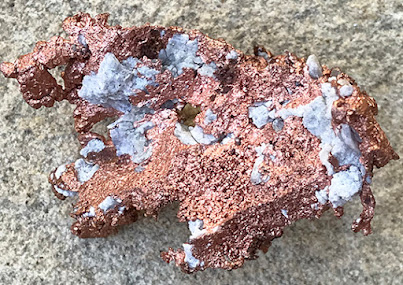
Specimens of arborescent massive native copper like the hand specimen shown above (5 cm in length) are moderately common in the Moreno area of Greenland County, Arizona.


Malachite Cu2(CO3)(OH)2 and azurite Cu3(CO3)(OH)2 are very similar minerals containing copper (Cu). Malachite is a rich shade of green, and azurite is a dark shade of blue. Both are secondary copper minerals, and they occur worldwide commonly in the upper oxidized zone of copper deposits, especially where limestone is present. Both minerals are almost always associated with each other, and they are found commonly in open-pit mines of copper. Malachite is used in making jewelry. 
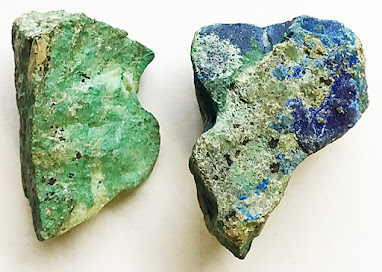


Hand specimens of malachite (on the left) and azurite (both as massive forms). Each specimen is about 40 mm in height. 


Additional comments about malachite: this mineral has been extensively mined, dating back at least 3,000 years, at Tima, southern Israel. Extensive archaeological research has shown this locality to most likely be the so-called “King Solomon Mines” locality, which has been inaccurately depicted in several movies as a non-descript locality “deep in the jungles of Africa.” Perhaps the most famous of these movies is the 1950 one, starring Stewart Granger. There is a classic scene where there is a pile of riches: “rubies, emeralds, diamonds, and gold,” but, alas, malachite and azurite were not included. 


Chrysocolla (CuSiO2-2H20) (pronounced “cris-o-cola”) is a copper silicate mineral with a high copper content. Its color is blue-green (cyan), or brown to black. It is a “secondary” mineral that forms in the oxidation zone of copper deposits when free silica (Si) is available. One of the distinguishing characters of chalcopyrite is that it will readily “stick” to a wet finger. That is how many beginning-geology students, taking a class in mineralogy, identify this mineral. Chrysocolla is commonly found associated with malachite and azurite. Like malachite, chrysocolla has been used in making jewelry. Chrysocolla has a wide range (2.5 to 7) of hardness on the Mohs Scale (see one of my previous blog posts).


The hand specimen of chrysocolla (massive form) shown above is 13 cm in longest dimension.


 A HETEROMORPH AMMONITE WITH AN UNUSUAL “TWIST”

This post is an addendum to my previous post on heteromorph ammonites that I provided a few weeks ago. This new post focuses on a single hetermorph: Pravitoceras sigmoidale Yabe, 1902, which is a nostoceratid ammonite belonging to family Diplomoceratidae. 


This hand-colored plastic model of Pravitoceras sigmoidale is 8 cm height and 5 cm wide. The color scheme is fictional. A former graduate student of mine recently discovered that this unusual ammonite is now available for purchase online, and he sent me one. I thank him for his astuteness and generosity.  


This species is known only from a few formations of Late Cretaceous age (latest Campanian Stage) in southwestern Japan. Most specimens are found in nodules within dark gray, massive mudstone. It has been found with the following other ammonites:

Hypophylloceras sp., Pachydiscus sp., Patagoiosites alaskensis, and Baculites sp.


Pravitoceras sigmoidale is unusual because it has an unprecedented bend in its living chamber (= the “body chamber”. That is to say, its living chamber, where the bulk of the soft parts of the animal resided, is uncoiled and turned 180 degrees in the opposite direction of the rest of this ammonite’s coiled shell. Techincally speaking, the orientation of its living chamber is referred to as a “retroversal U-shape hook.”


Some specimens of P. sigmoidale are also unusual because they can have some anomiid bivalves attached to one or both the sides of the living chamber of this ammonite. The presence of these attached bivalves on both sides of the ammonite shell indicate that this ammonite did lie on the sea floor but did not drag its living chamber. Fully mature individuals of this ammonite lived for a long time after having formed the retroversal hook because several generations of anomiids have been found colonizing the body chamber on some specimens.


The above sketch shows a complete shell of P. sigmoidale with anomiid bivalves (each indicated by the letter "a") attached on the “retroversal U-shape hook.” Arrow shows the position of the last septum = the back of the living chamber.


For more information about this ammonite, see:


Matsunaga et al. 2008. First discovery of Pravitoceras signmoidale…Paleontological Research, v. 12, no. 2, pp. 309–319.

doi:10.2517/prpsi/12.309


Misakei et al. 2014. Hetermorph ammonites with commensal bivalves…Palaeontology 57, pt. 1, pp. 77–95.

doi: 10.1111/pala. 12050


Tuesday, June 21, 2022

A MODERN SHARK WITH EXTREMELY SHARP TEETH

 BIOLOGY AND RECENT DISTRIBUTION

The “snaggletooth shark” is up to about 8 feet (2.4 m) long, with males being about twice the size of females. It has a blunt snout and a torpedo-shaped body. Its scientific name is Hemipristis elongata (Klunzinger, 1871). This shark is known only from the western Pacific (from China to Australia), the Indian Ocean, and the Red Sea area. It prefers coastal waters and does not occur around oceanic islands.


Figure 1. Shape of the body of a mature Hemipristis elongata individual (modified after alamy.com). The “snaggletooth shark” is appropriately named. It's fearsome teeth are superbly designed to grasp and hold prey. Its serrated teeth are extremely sharp pointed, and some are curved inward and even hook-like. Once this shark bites onto something, it is securely snagged. Also, once its prey (bony fish, other sharks, rays, crabs, or cephalopods) enters the jaws of this shark, there is no backing out.  A person has to very careful when handing the jaws of this shark, otherwise painful piercings/hookings can occur.


DENTITION

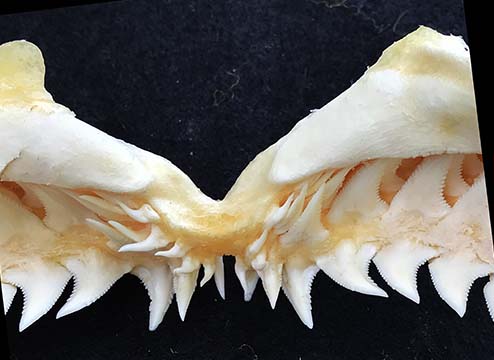
The following images are all taken of a complete jaw (19 cm [7.75 inches] wide, 16 cm (5.5 inches] high) of a five-foot long (estimated) snaggletooth shark (locality unknown). 


Figure 2. Front view of both jaws of a modern specimen of Hemipristis elongata. This upper jaw with biting edge has 28 exposed teeth: 10 left side, 4 left middle area, 4 right middle area, 10 right side). The lower Jaw teeth with biting edge has 28 exposed teeth: 10 left side, 4 left middle area, 4 right middle area, 10 right side. The upper jaw teeth (= the sawing teeth) are curved triangular, except those in the middle part of this jaw, where the teeth are narrower and very pointed (= hook-like gripper teeth). The teeth in the lower jaw are also hook-like gripper teeth.


Figure 3. Back view of both jaws of the same specimen shown in the preceding figure. Notice the numerous rows of stored teeth in the lower jaw waiting to be eventually pushed to the biting edge, as the previous teeth fall out. 


Figure 4: Closeup of a portion of the interior of the upper jaw. This view shows the rows of stored teeth ready to be pushed upward to replace any broken or missing teeth along the biting edge. When the stored teeth are pushed upward, they rotate 90 degrees or more.


Figure 5: Oblique view of left side of both jaws. This spectacular view shows how the action of the upper jaw is functionally very different than that of the lower jaw.


Figure 6. Frontal view of the middle teeth on the upper jaw. The teeth on the middle part of the upper jaw are dagger-like to  hooklike and have no serrations. The rest of the teeth on this jaw are simitar-like with numerous serrations (used for sawing action) on both sides. 


Figure 7. Interior view of the same middle teeth (and laterally adjacent teeth) on the upper jaw. This view is the backside of the part of the jaw shown in Figure 6. 


FOSSIL RECORD

The fossil record of Hemipristis ranges from the Eocene to Recent and consists of three species. The only known Eocene species is H. curvatus. It lived during warm times, but when cooler conditions prevailed during the subsequent Oligocene time, this shark genus nearly disappeared. During the warm times of the Miocene, this genus had a large paleogeographic distribution (Maryland to Florida, Belgium, etc.), but it was represented by only one species. H. serra. During the largely cooler times of the Pliocene and Pleistocene, the geographic distribution of Hemipristis once again greatly declined. The only species today is H. elongata, and it is restricted to tropical waters. It is facing extinction if the overfishing by commercial trawlers continues unchecked. 


MISCELLANEOUS COMMENTS

As you can readily observe from this post, shark teeth can be very different in shape and size between the upper versus the lower jaw in just a single shark. Now, imagine how challenging it would be for you to identify the type of shark if you have only a single tooth found on the beach or in a fossil bed. How do the experts do it? At some museums, I have seen that shark-tooth experts hang hundreds of preserved shark skulls from the ceiling of their laboratories. That way, they can more quickly match a recently found tooth with known teeth. Another strategy is to have a massive library of computer-stored images showing the different shark teeth for each known genus. 


SOURCES OF INFORMATION


www.fossilguy.com


en.wikipedia.org


Saturday, June 11, 2022

DEFINITION OF A DESERT

 This topic sounds simple enough, but you might be surprised by what you learn below. 

Most people would say that a desert is where it is hot and dry. That can be true, but that is NOT the official definition of a desert.


A desert is defined based on the amount of annual rainfall. For a desert to be a desert, there has be less than or equal to 10 inches of rain per year. Furthermore, there can be hot or cold deserts. 


There are many examples of hot deserts: Sahara and Kalahari (Africa); Gobi (China); Mojave (California); Patagonia and Atacama (South America); and the Great Australian Desert (Australia). Most hot deserts are located between 30°N and 30°S of the equator.


The two best examples of cold deserts are: Antarctica and Greenland. The air temperature is so low in these polar places, the atmosphere simply cannot retain much moisture, thereby creating desert conditions.


The map below shows the location of most of the world's present-day deserts:


OSTRICH EGG VS. CHICKEN EGG

The largest eggs laid by a modern bird are those of the ostrich Struthio camelus Linnaeus, a North African species of flightless bird belonging in the ratite order. 

Ostrich eggs are about 2.8x the size of a chicken egg. A typical grocery-store chicken egg of Gallus domesticus is shown below for comparison. 


Left side: ostrich egg 6 inches high [= 15.3 cm], 4.75 inches wide [= 12 cm].


Right side: typical chicken egg 2.2 inches high [= 5.6 cm], 1.6 inches wide [= 4 cm]. 


The ostrich egg shown above is empty, but it probably originally weighed about three pounds. Chicken eggs weigh about 1/20 of an ostrich egg (before being emptied). 


According to Wikipedia, the incubation period for an ostrich is 35 to 45 days, and they can live up to 62 years, making them one of the longest-living bird species.


Also according to Wikipedia, the average incubation period for a typical “laying hen” is 21 days. Chickens belong to order Galliformes.


Tuesday, May 31, 2022

VOLCANIC CURIOSITIES

Volcanic Bombs

These are fragments of liquid and/or plastic state lava, ejected into the air by means of a volcanic explosion (s). As the fragments move through the air, they twist and turn and can form spindle-shaped masses with surface markings. They range in size from a few millimeters to more than a meter in diameter. 


Two volcanic “bombs” from a relatively young volcanic eruption in central Arizona, USA are shown below. This first “bomb,” 6 cm width, is shown in two views, front and back. 


The second "bomb" is 9 cm wide.


Lava Stalactites


These are associated with lava flows. The lava was originally molten liquid matter  (magma). The stalactites shown below formed when the red-hot lava infiltrated cracks in the ceiling of a hollow lava tube and dripped down into the empty space. 

Two stalactites from a young lava-flow tube in central New Mexico, USA are shown.


The first stalactite (front and top views) is 7 cm high and 5 cm wide. The holes visible in the top view of the interior were caused by trapped air bubbles.


The other lava stalactite (front view) shown below is 9.5 high and 7 cm wide. If you look carefully at its side, you can see some green surface staining resulting from deposition of the copper mineral malachite.


Xenolith


The word “xenolith” is Greek, meaning a foreign (stranger) or guest rock. It is an inclusion of an older rock in a younger volcanic rock. The older rock is referred to as “country rock” or “wall rock” by geologists.


The following example of a xenolith is from the Mojave Desert in eastern central California. The xenolith is a small piece of granite, which is a plutonic igneous rock that formed inside the Earth. This xenolith has been incorporated as an inclusion into black volcanic rock (basalt lava, which is a volcanic igneous rock that formed from a lava flow or volcanic neck near the surface of the Earth). The age of the xenolith can be very old and indicative or an entirely different geologic temperature and pressure than the surrounding basalt. The whitish xenolith is 4.5 cm high and 2.5 cm wide. 


There is no indication that the temperature of the basalt lava affected the granite xenolith (inclusion) because there is no alteration of the granite where it made contact with the basalt. I have also included below a close-up image of a portion of this contact.  


SPONDYLUS, The Thorny "Oyster"

The bivalve (clam) Spondylus is a favorite among seashell enthusiasts, who like these clams because of their picturesque shape, potentially vivid colors, and, in some species, long spines. The shells of many specimens, however, can be obscured because of attached corals and other sea life. Spondylus is indicative of warm (tropical to subtropical) seas, and the geologic record of this genus ranges from the Jurassic Period to Recent times. Its distribution today is pantropical, with about 40 or so species. The number is inexact because of the notoriously high degree of variability in the shape and features of the shells.

Spondylus has been referred to as the “thorny oyster” or the “spiny oyster,” but it is not an oyster. Some species can resemble the bivalve Lima. In terms of the development of its hinge morphology, however, Spondylus has some degree of affinity with Pecten clams (scallops). Spondylus can be thorny or spiny, and you have to be very careful when handling it. The spines, whether short or long, can be very sharp. It might be necessary to wear thick leather gloves when handling some of the specimens. 


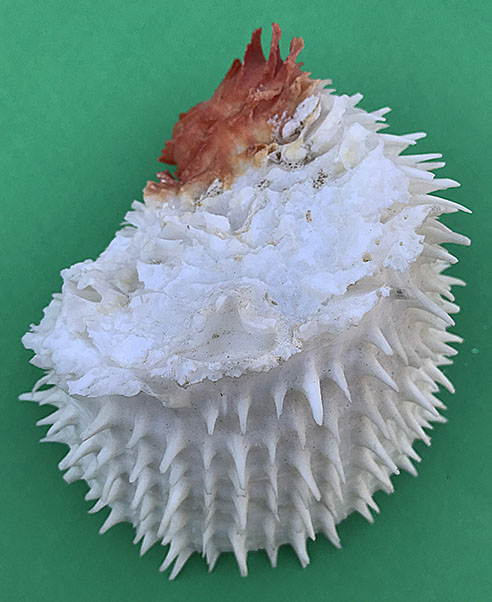
The following images are of a representative Recent species of Spondylus, namely S. varians Sowerby, 1838 from low-energy, tropical shallow waters of Thailand. Like all bivalves, Spondylus consists of two valves. The right valve (so-called "lower" valve) is attached to rocks, corals, or other hard substrate. As a result, the right valve can have an extremely variable shape because it resembles the shape to which it is attached. The left valve (so-called "upper" valve) is free, and its shape can be determined by the degree of water energy (e.g., quiet water versus rough water). Quiet-water Spondylus species have longer spines that the rough-water ones. As seen below, the right valve (lower valve) of a specimen of S. varians extends 120 mm, when viewed from left to right, and the left valve (upper valve) is 80 mm when viewed from top to bottom.

                  both valves (side views): upper valve flat, lower valve cup shaped

both valves (top views): upper valve (with red "dot"); if you look closely, you can see the hinge line between the two valves along the top edge of the "red dot"
  

                                                    upper valve exterior 

                                                    upper valve interior


lower valve exterior


                                                    lower valve interior


Like all specimens of Spondylus, the right (attached) lower valve of S. varians has a thin dark ligament between two stout teeth (crural teeth). The left (free) valve has two corresponding sockets to accommodate these teeth.


In the images shown below are the presently known four species of fossil Spondylus from the west coast of North America, from Late Cretaceous through Eocene age. The diagram shown here is a summary of their geologic history in this area. As you can see, Spondylus occurred only during warm times.


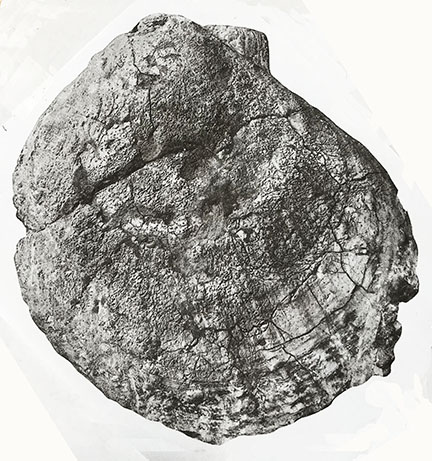
The oldest Cretaceous species from this region is Spondylus rugosus Packard, 1922 from southern California. Preservation is commonly very poor. Specimens can be large, up to 95 mm height. The specimen illustrated here is the left valve of the holotype [= the specimen found by Packard and used by him to name the species], height 95 mm, width 72 mm, Santa Ana Mountains, southern California.


The next geologically younger Late Cretaceous species is Spondylus subnodosa (Packard, 1922) from northern and southern California and possibly Vancouver Island, British Columbia. Preservation is generally good. Specimens can be quite large, up to 150 mm height. \The specimen illustrated here of S. subnodosa is the right valve of the holotype, height 150 mm height, 140 mm width, Santa Sana Mountains, southern California. 


The next geologically younger species of Spondylus known from the west coast of North America is of early Eocene age (about 52 million years ago) and is Spondylus batequensis Squires and Demetrion, 1990 from Baja California Sur, Mexico. The specimen illustrated here is the right valve of the holotype, height 21 mm. 


NOTE: There has been confusion regarding the name and the morphologic characteristics of subnodusus because Packard (1922) described it as both Lima subnodosa Packard, 1922, p. 421 and as Spondylus striatus Packard, 1922, p. 422. This bivalve actually is a Spondylus and not a Lima. Furthermore, because subnodosa was described one page before striatus was described, subnodosa is the official name of this species. 


During the middle Eocene (about 45 million years ago) on the west coast of North America, Spondylus carlosensis Anderson, 1905) was present in southern and central California. Another possible species is Spondylus cliffensis M.A. Hanna in the San Diego area, but it is likely a synonym of S. carlosensis.


At the end of the middle Eocene and the beginning of the late Eocene, about 37 million years ago, global cooling created a turnover event, which strongly affected the warm-water, shallow-marine bivalves and gastropods of the west coast of North America. They began to decline in numbers and many were eventually replaced by cooler water genera and species.