Showing posts with label Paleozoic. Show all posts

Saturday, April 11, 2020

Bellerophont Mollusks: A Paleozoic Enigma

Bellerophonts have a shell that is coiled in a single plane (no spire). Their shell superficially resembles that of a nautiloid cephalopod, except that a bellerophonts lack the chambers that characterize nautiloids. Bellerophonts have a spiral band (selenizone) that encircles the middle of the shell. This band indicates successive growth positions of where the anal slit was located on the shell. Some gastropods (e.g., pleurotomariids (= the deep-sea "slit shells)," abalones, scissurellids, and some limpets) have also a selenizone. Interestingly, most of these other shells, unlike bellerophonts, have aragonite shells with mother-of-pearl luster.

The geologic range of bellerophonts is broadly given as Late Cambrian to Early Triassic, but their main range is Ordovician to Permian. There are several families and subfamilies of bellerophonts, as well as many genera. Two of these genera (Knightites and Pharkidonotus) are shown below.


Specimen C4 (width 7.7 mm): Three views (dorsal, aperture, and left side) of Knightites (Cymatospirasp. of Pennsylvanian age:


Specimen 319 (width 18 mm): Three views (dorsal, aperture [filled with silt], and right side) of Knightites multicoronuatus of Pennsyslvanian age from the Ozawkie Limestone in Kansas. Genus Knightites ranges in age  from Devonian to Middle Permian. The slit band, which extends down (as shown here) along the middle of the shell, is bordered on both sides by several prominent nodes (weathered somewhat on this specimen). These nodes grade into narrow, closely spaced ridges along the sides of the shell:


Specimen 96 (width 14.4 mm): Three views (dorsal, aperture, and right side) of Pharkidonotus percarinatus of Pennsylvanian age from Grayford, Wise County, Texas: 


The largest known bellerophontid is approximately 190 mm width, from the Carlsbad Caverns area in New Mexico, and of Permian age. This specimen lived in a reef environment.

Bellerophonts represent a group whose undoubted evolutionary relationship with other mollusks remains indeterminate. Are bellerophonts gastropods? Are they part of an even more primitive group of mollusksThere are more questions than answers, when it comes to trying to understand the origin of bellerophonts. 


Saturday, November 30, 2019

Enrolled Trilobites

Trilobites are common fossils of the Paleozoic Era. They are easily recognized and treasured among collectors. Trilobites are an extinct group of marine arthropods in which the tri-lobed body is divided into a distinct head (cephalon, with compound eyes), segmented body (thorax), and, in some cases, a distinct "tail" (pygidium). The exoskeleton is divided also length-wise into three parts. See my previous post ["Amazing eyes of the trilobite Phacops dana from Ohio; July 2, 2015] for more information.


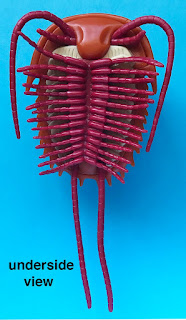
Three views (top, bottom, and side) of a plastic model of a Cambrian trilobite (12 cm length). The mineralized "shell" is  green, the numerous legs and antennae are red, and the gills (located on top of the legs) are white.


An actual specimen of a representative trilobite (28 mm length) is shown above. The left eye is better preserved that the right eye, which was "smoothed over" by weathering. This specimen, which is slightly curved, appears to show the initial stage of enrollment (curling up).

Some trilobites are found enrolled. That is to  say, their mineralized exoskeletons rolled up (partially or completely), much like modern pill bugs do. Enrollment was the way for
trilobites to protect their legs, soft undersides, and antennae from predators. 


The ability to enroll developed during early, as a few Cambrian forms have been found preserved this way. It became common in the Ordovician, Silurian, and Devonian but was not acquired by all genera.


Calymene meeki (enrolled state), Ordovician, Ohio. 15 mm width.

Some trilobites could "tuck" the end of their pygidium under the edge of the cephalon, thereby allowing more resistance to being pried apart by a predator. On the image on the right, you can see how the edge of the cephalon is indented to accommodate the projected end of the pygidium.

Wednesday, July 2, 2014

Geologic Time Scale

A geologic time scale is given here in order to help discussions
that will follow in my future posts.


For a more complete and much more detailed version, as well as one that is to scale, the link is HERE
It is from the Geological Society of America and is their 2012, version 4.0.

It is important to realize that the Precambrian accounts for about 7/8 of all geologic time. A way to visualize this is consider that if your  entire arm (from shoulder to wrist) and your hand represent all of geologic time, the Precambrian would extend from the shoulder to the wrist. The rest of geologic time is represented by your hand. 

A handy way to remember the sequence of the names of the periods of the geologic time scale involves the following mnemonic devices (by using the first letter of each period name in its respective position in the sequence):

For the Paleozoic:  "Certain old stones delight my paleontology professor."

For the Mesozoic and Cenozoic: "The jungle cat prowls nightly, quietly."