Venericardia is a widely distributed genus of shallow-marine bivalves (clams) in the family Carditidae. This genus was abundant during the Paleocene and Eocene epochs (a cumulative range of 66 to 34 million years ago). The highest biodiversity of Venericardia was in the Eocene. The genus needs detailed classification studies of all its various subgenera found throughout the world. Detailed studies are much needed to evaluate the likely possibly of over naming of species/subspecies found on the west coast of North America. The genus is now extinct, with the last survivors of this genus dying out apparently in the early Miocene.
Lamarck (1801) first described the genus Venericardia based on well preserved shells of this bivalve in the Paris Basin, France. The aragonite shells of this genus are commonly large and very sturdy, with wide radial ribs crossed by concentric growth lines on the exterior. The interior of the shells are characterized by long posterior teeth, much shorter anterior teeth, and two prominent elliptical-shaped muscle scars connected ventrally by a continuous line. Some species have prominent nodes along the inner margins of the shell.
These two images show the plaster replicas of the exterior and interior surfaces of a left-hand valve (6.5 cm high and 7 cm wide) of Venericardia planicosta Lamarck, 1801 from an Eocene shell bed at Grignon, Paris Basin, France.
Venericardia (Pacificor) lutmani Turner, 1938, lower Eocene (Ypresian Stage), southwestern Oregon; plaster replicas. Left image is the exterior of a left valve, and the right image is the exterior of the right valve of a single specimen (9.25 cm high and 10 cm wide) which, upon burial, became separated from one another.
These two images are the corresponding interior views of the same plaster replica shown immediately above.
Venericardia (Pacificor) hornii calafia Stewart, 1930, middle Eocene (Lutetian Stage), southern California. Exteriors of left-hand and corresponding right-hand valves of the same specimen (whose valves [9 cm high and 9 cm wide] are closed very tightly).
Dorsal (hinge) view of same specimen of V. (P.) h. calafia shown immediately above. Left valve is on the left side of image, and right valve is on the right side of image
Venericardia was an infaunal (burrowing) suspension feeder that lived buried just beneath the surface-water interface. Its optimum habitat was in relatively deep, shallow-marine (shelfal) environments, but its shells are commonly found as transported remains in coastal-storm beds.
Dr. Squires shares his enthusiasm for Interesting paleontologic and geologic topics with the general public.
Showing posts with label shallow marine. Show all posts
Tuesday, June 9, 2020
Thursday, July 25, 2019
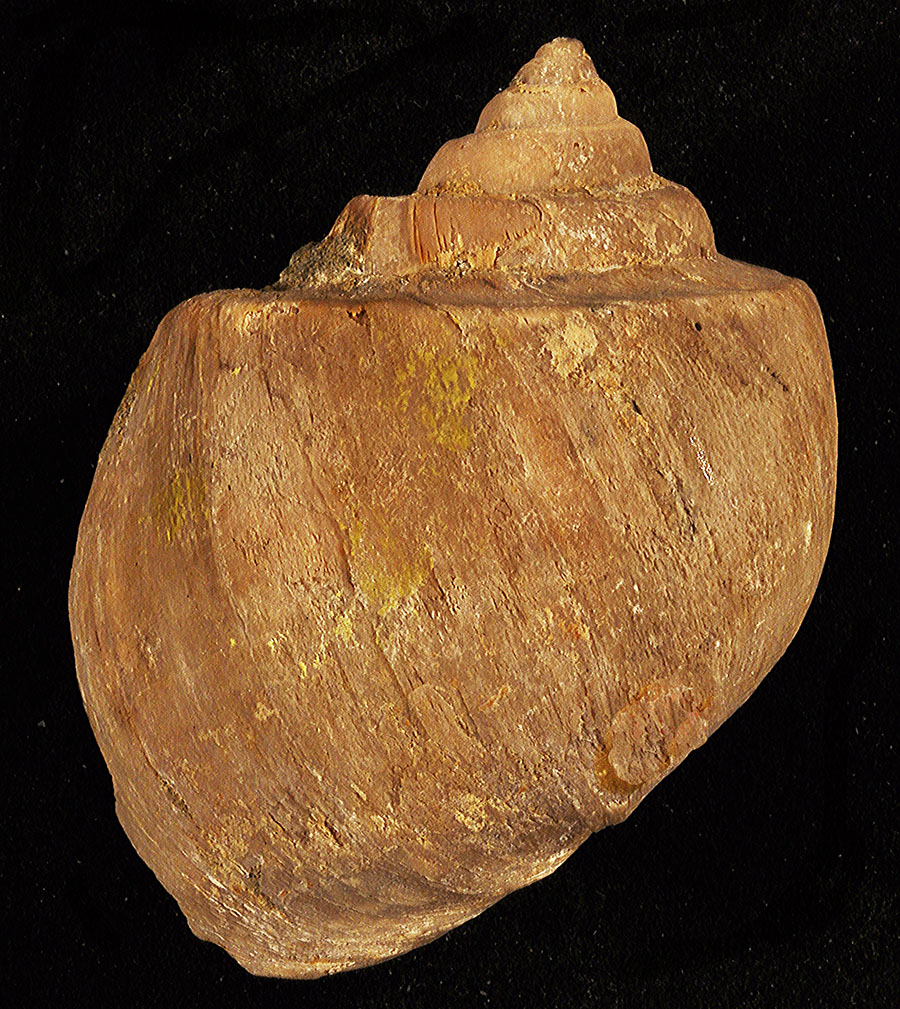
An unusual Miocene gastropod
height 77 mm, width 38 mm
Pereiraea gervaisi (Vézian, 1856) is an ususal gastropod. I acquired this specimen as an gift, but it was unidentified. I had to do some research in order to identify it, but I was pleased to discover that it is a rare, shallow-marine stromboid gastropod from Western Europe.
Genus Pereiraea is classified as within the small family Thersiteidae, which has only a few confirmed genera. This genus ranges in age from middle to late Miocene, and this specimen is of middle Miocene age (about 13 to 14 million years old). This age corresponds to the Langhian (Badenian) Stage of Europe. Pereiraea is found in Spain, Portugal, Italy, Algeria, and Solvenia. The specimen is from Sant Pau d'Ordal, Province of Barcelona, Spain.
Specimens of this species commonly are missing their their outer lip margin, and the specimen shown above is no exception. Researchers have surmised that this kind of breakage on P. gervaisi is the result of of predatory crab activity.
Pereiraea gervaisi lived in a dynamic shallow-marine environment in what is now referred to as the Central Paratethys Sea, a large inland sea. The Black Sea and the Caspian Sea are the present-day remnants of the Central Paratethys. During the middle and late Miocene, the Central Paratethys was subject to major episodes of lowering sea level, most likely following glacial activities. The sea-level drops restricted the open-marine connection to the adjacent Mediterranean Sea, and, as a result thick salt deposits (evaporites) formed in some of the deep Paratethys basins. In sum, it was a hazardous time for a gastropod like Pereiraea, which did not tolerate restricted-marine waters, to survive.
If you want to see more (and some very visually stunning) pictures of P. gervaisi, go to <www.stromboidea.de> and type in the genus and species names.
Sunday, October 28, 2018
Some representative Late Cretaceous Gastropods from the Pacific Coast of North America
There are about 200 reported genera of Late Cretaceous (about 100 to 65 million years ago) shallow-marine gastropods known from the Pacific coast of North America. This post focuses on a few examples of them.
Tessarolax is one of the most "eye-catching" examples. It is an extinct genus characterized by having four long digitations, used to support its shell on soft ocean-floor sediments. The above images are of three different species at oblique views. The specimens range from 70 to 120 mm (max. dimensions). Tessarolax belongs to family Aporrhaidae (pronounced "a-poor-rye-id-dee"). Tessarolax, which is only of Cretaceous age, was widespread in the world.
These two images of Tessarolax are of two different species showing how their shells relate to the ocean floor (substrate). Both specimens are approximately 50 mm, from left to right. Very careful collecting and cleaning are required in order to obtain such high-quality specimens. For the latest information on Tessarolax and also on the details about the species represented by the above-illustrated specimens, see the reference:
Saul, L.R. and R.L. Squires. 2015. Pacific slope of North America record of the Cretaceous aporrhaid gastropod Tessarolax: Evolutionary trends, mode of life, and paleobiogeography of the genus. Contributions in Science v. 523, pp. 37–65. (pdf available for free---just "Google" the title of the paper.
Anchura is another example of an aporrhaid gastropod having an extension of its shell in order to provide stability on the ocean floor.
For more information on Anchura, see the reference:
Elder, W.P. and L.R. Saul. 1996. Taxonomy and biostratigraphy of Coniacian thorugh Maastrichtian Anchura (Gastropoda: Aporrhaidae) of the North American Pacific slope. Journal of Paleontology 70(3):381–399. (pdf available for free---just "Google" the title of the article).
These two specimens of the gastropod Xenophora look like two small stacks of pebbles. This genus, which is extant, is known as colloquially as the "carrier shell" because it collects and carries pebbles and/or other shells (by cementing them onto its own shell), in order to provide protection/camouflage for itself. In essence, it was the first fossil collector. For more information on this fossil Xenophora, see the reference:
Squires, R.L. and L.R. Saul. 2001. New Late Cretaceous gastropod from the Pacific slope of North America. Journal of Paleontology 75(1):46–65. (pdf available for free---just "Google" the title of the article).
This specimen (height 50 mm) belongs to genus Paosia, formerly known by its junior synonym name of Trajanella. Paosia has a long geologic time range of 75 million years. It is mainly known from Europe, but a lineage became established along the Pacific coast of North America for 25 million years. For more information, see the reference:
Squires, R.L. and L.R. Saul. 2004. The pseudomelaniid gastropod Paosia from the marine Cretaceous of the Pacific slope of North America and a review of the age and paleobiogeography of the genus. Journal of Paleontology 78(3):484–500.
Trochactaeon (T.) packardi (see my Post 39 of Feb. 3, 2015): An unusual Late Cretaceous gastropod from California. The specimen on the left is 6 cm height and shows the front view. The specimen on the right is 4.6 cm height and shows the back view. This genus, which was restricted to the Cretaceous, was widespread, including California, in warm waters during the Late Cretaceous.
Alamirifica corona genus and species Saul and Squires, 2003; two views, front and back (height 37 mm). Late Cretaceous (Turonian), southern California. This specimen is exceptional because it shows all the exquisite details of its aperture. For more information about this species, see the reference:
Saul, L.R. and R.L. Squires, 2003, New Cretaceous cerithiform gastropods from the Pacific slope of North America. Journal of Paleontology 77(1):442–453.
Pentzia hilgardi (White, 1889); two views, front and back (height about 10 mm). Late Cretaceous (Campanian to early Maastrichtian). Genus Pentzia consists of only a single species, which is found only in Washington, California, and northern Baja California (Mexico). This species has an usually long geologic time range, which is approximately 13 million years. Most gastropod species last for much shorter time intervals. For more information about this genus and species, see the reference:
Squires, R.L and L.R. Saul, 2003, New Late Cretaceous (Campanian and Maastrichtian) marine gastropods from California. Journal of Paleontology 77(1):50–63.
Tessarolax is one of the most "eye-catching" examples. It is an extinct genus characterized by having four long digitations, used to support its shell on soft ocean-floor sediments. The above images are of three different species at oblique views. The specimens range from 70 to 120 mm (max. dimensions). Tessarolax belongs to family Aporrhaidae (pronounced "a-poor-rye-id-dee"). Tessarolax, which is only of Cretaceous age, was widespread in the world.
These two images of Tessarolax are of two different species showing how their shells relate to the ocean floor (substrate). Both specimens are approximately 50 mm, from left to right. Very careful collecting and cleaning are required in order to obtain such high-quality specimens. For the latest information on Tessarolax and also on the details about the species represented by the above-illustrated specimens, see the reference:
Saul, L.R. and R.L. Squires. 2015. Pacific slope of North America record of the Cretaceous aporrhaid gastropod Tessarolax: Evolutionary trends, mode of life, and paleobiogeography of the genus. Contributions in Science v. 523, pp. 37–65. (pdf available for free---just "Google" the title of the paper.
Anchura is another example of an aporrhaid gastropod having an extension of its shell in order to provide stability on the ocean floor.
For more information on Anchura, see the reference:
Elder, W.P. and L.R. Saul. 1996. Taxonomy and biostratigraphy of Coniacian thorugh Maastrichtian Anchura (Gastropoda: Aporrhaidae) of the North American Pacific slope. Journal of Paleontology 70(3):381–399. (pdf available for free---just "Google" the title of the article).
These two specimens of the gastropod Xenophora look like two small stacks of pebbles. This genus, which is extant, is known as colloquially as the "carrier shell" because it collects and carries pebbles and/or other shells (by cementing them onto its own shell), in order to provide protection/camouflage for itself. In essence, it was the first fossil collector. For more information on this fossil Xenophora, see the reference:
Squires, R.L. and L.R. Saul. 2001. New Late Cretaceous gastropod from the Pacific slope of North America. Journal of Paleontology 75(1):46–65. (pdf available for free---just "Google" the title of the article).
This specimen (height 50 mm) belongs to genus Paosia, formerly known by its junior synonym name of Trajanella. Paosia has a long geologic time range of 75 million years. It is mainly known from Europe, but a lineage became established along the Pacific coast of North America for 25 million years. For more information, see the reference:
Squires, R.L. and L.R. Saul. 2004. The pseudomelaniid gastropod Paosia from the marine Cretaceous of the Pacific slope of North America and a review of the age and paleobiogeography of the genus. Journal of Paleontology 78(3):484–500.
Alamirifica corona genus and species Saul and Squires, 2003; two views, front and back (height 37 mm). Late Cretaceous (Turonian), southern California. This specimen is exceptional because it shows all the exquisite details of its aperture. For more information about this species, see the reference:
Saul, L.R. and R.L. Squires, 2003, New Cretaceous cerithiform gastropods from the Pacific slope of North America. Journal of Paleontology 77(1):442–453.
Pentzia hilgardi (White, 1889); two views, front and back (height about 10 mm). Late Cretaceous (Campanian to early Maastrichtian). Genus Pentzia consists of only a single species, which is found only in Washington, California, and northern Baja California (Mexico). This species has an usually long geologic time range, which is approximately 13 million years. Most gastropod species last for much shorter time intervals. For more information about this genus and species, see the reference:
Squires, R.L and L.R. Saul, 2003, New Late Cretaceous (Campanian and Maastrichtian) marine gastropods from California. Journal of Paleontology 77(1):50–63.
Tuesday, November 1, 2016
The large shallow-marine gastropod Forreria belcheri, past and present history
Forreria belcheri (Hinds,
1843) is a rather large gastropod found today along the west
coast of Southern California and Baja California, Mexico. Forreria belongs to the family Muricidae, commonly referred to as the "rock shells." Forreria belcheri is the type species of genus Forreria.
This gastropod has a fossil record that extends back about 8 million years to the late Miocene. In the past, it ranged farther north (to central California) than it does today. It lives today mainly offshore on sandy bottoms in relatively shallow water of 60 to 100 feet deep, but it can also be found in bays, lagoons, and mudflats. This gastropod is carnivorous and uses its file-like radular teeth to drill holes through shells of oysters and mussels, as well as other mollusks.
Forreria belcheri is characterized by a large, heavy shell that can be
as much as 6 inches (15 cm) long. The shell is heavy and adult specimens have about 12 spiny nodes on its whorls. Its opening (aperture) is large and the anterior end of its shell is twisted and upturned.
The first two views in the below series of photographs show the front (apertural) side of a modern specimen from Baja California, Mexico versus a Pleistocene specimen from Newport Beach Mesa, Southern California. The last two views of this series show the back side (abapertural) of the same modern and Pleistocene specimens, respectively.
The next two views show the spatial arrangement of the spiny nodes on the spire whorls of the same two specimens: Modern specimen (on left) vs. Pleistocene specimen (on right). The Pleistocene specimen is somewhat worn and has its lower right-hand spire coated by bryozoans.
The first two views in the below series of photographs show the front (apertural) side of a modern specimen from Baja California, Mexico versus a Pleistocene specimen from Newport Beach Mesa, Southern California. The last two views of this series show the back side (abapertural) of the same modern and Pleistocene specimens, respectively.
![]() ![]() |
| Forreria belcheri: A modern specimen (13 cm height) vs. a Pleistocene specimen (11.6 cm height). |
This last view, which is of the side of the modern specimen, shows how the twisted anterior end also turns upward (a characteristic feature).
![]() |
Monday, March 28, 2016
Tejonia moragai
This post concerns the ampullinid Tejonia moragai (Stewart, 1927), a moderately common Eocene shallow-marine gastropod found from southwestern Oregon to San Diego. This gastropod is known only from upper lower to upper Eocene strata (approximately 50 to 38 million years ago).


Tejonia moragai is small to medium-size. The above picture on the left is the front or apertural view of an adult specimen (30.7 mm height, 22.6 mm diameter). The picture on the above right is the abapertural or back view of the same specimen.
This gastropod is characterized by having an inflated last whorl that is smoothish but with minute spiral sculpture, a somewhat moderately elevated spire with tabulate (squared-off and indented) whorls, a distinct umbilical pit, and an absence of an umbilical callus.
Tejonia moragai is small to medium-size. The above picture on the left is the front or apertural view of an adult specimen (30.7 mm height, 22.6 mm diameter). The picture on the above right is the abapertural or back view of the same specimen.
This gastropod is characterized by having an inflated last whorl that is smoothish but with minute spiral sculpture, a somewhat moderately elevated spire with tabulate (squared-off and indented) whorls, a distinct umbilical pit, and an absence of an umbilical callus.
If you look at my previous post, which concerns the Eocene Pachycrommium clarki, you will see that T. moragai resembles P. clarki. There are a few subtle differences, thus, in my opinion, the two gastropods are different species. Tejonia moragai is smaller in size, has minute-spiral sculpture (lines), an umbilical pit rather than a slit, and no umbilical callus. The sculpture, however, could easily be worn or weathered away, thereby making the distinction between these two species difficult. The main question, however, is whether they belong to the same genus? An answer requires a detailed comparative study, which has so far, been wanting.
Saturday, March 19, 2016
Pachycrommium clarki, another common Eocene gastropod
This post concerns another common ampullinid Eocene shallow-marine gastropod (for comparison, also see my recent post on Eocernina hannibali). The gastropod is Pachycrommium clarki (Stewart, 1927), a Eocene shallow-marine fossil known from southwestern Washington to Baja California Sur, Mexico. It is found only in lower to upper Eocene strata, thus is it an excellent index fossil for the Eocene time interval (approximately 55 to 36 million years ago).


Pachycrommium clarki is medium in size. The picture on the left is the front or apertural view of an adult specimen (68 mm height) of P. clarki. The picture on the right is the back or abapertural view of the same specimen.
This gastropod is characterized by having an inflated smooth last whorl, moderately elevated spire with tabulate (squared-off and indented) whorls, thin but persistent umbilical callus, and a slit-like umbilical pit.
Although it would seem as if the morphology (shape and size, etc.) of this species is well defined, in reality, there are not that many characters. In addition, there has been little information provided as to how constant these few characters are and how much they are subject to variability, caused by paleoenvironment factors or even growth stage (juvenile vs. adult). I have seen variability for this species in the height of the spire, shape of the spire whorls, extensiveness of the umbilical callus, and development of the slit-like umbilical pit.

Pachycrommium clarki is medium in size. The picture on the left is the front or apertural view of an adult specimen (68 mm height) of P. clarki. The picture on the right is the back or abapertural view of the same specimen.
This gastropod is characterized by having an inflated smooth last whorl, moderately elevated spire with tabulate (squared-off and indented) whorls, thin but persistent umbilical callus, and a slit-like umbilical pit.
Although it would seem as if the morphology (shape and size, etc.) of this species is well defined, in reality, there are not that many characters. In addition, there has been little information provided as to how constant these few characters are and how much they are subject to variability, caused by paleoenvironment factors or even growth stage (juvenile vs. adult). I have seen variability for this species in the height of the spire, shape of the spire whorls, extensiveness of the umbilical callus, and development of the slit-like umbilical pit.
Subscribe to:
Posts (Atom)