Wednesday, April 27, 2022

PLACENTICERAS

The focus of this post is an ammonite specimen with very complicated internal shell structure consisting of "sutures" or partitions. Please see the diagrams I provided in my previous blog on “Ammonite Sutures,” which I posted on Oct. 19, 2014.

Ammonites are extinct mollusks (cephalopods) that range in geologic age from the Devonian to the end of the Cretaceous. The following image shows a replica of the general appearance of many ammonites and is not the same genus as the one discussed below. The outer shell of an ammonite conceals the internal shell structures (called septa), which can be much more complex than what is visible on the outside of the shell.


The fossil ammonite discussed below is moderately large (12.5 cm tall, 11 cm wide). The first and third images illustrated below show its sides, and the second image shows its narrow, flat venter edge (2.75 cm thick). The locality of this ammonite is in the South Dakota region. It was collected nearly a century ago by an anonymous collector. The outer shell is missing on this specimen, but its internal shell details are well preserved.


The interior of an ammonite shells have many chambers, and the shelly chamber walls are called sutures. The sutures constitute lines which have have loops in them. If a loop points toward the aperture (the large opening of the shell where the main part of the animal was located), the loop is called a saddle. If a loop points in the opposite direction, it is called a lobe. Taken as a whole, each chamber wall consists of saddles and lobes. The more complicated the suture (i.e., the more it has squiggles or frills, the younger the geologic age of the ammonite). In the case of the ammonite figured here, it can be readily seen that the suture pattern has a suture line with all of its loops frilled. 


The suture pattern of the fossil ammonite shown here has very frilled sutures; so much so that they can be classified as ammonitic sutures. They help greatly in the identification of the family and the genus of an ammonite. Using its suture pattern, I was able to identify the family of this ammonite as Placenticeratidae and the genus as Placenticeras sp. Meek, 1876. This genus is Late Cretaceous in age and ranges in age from the late Cenomanian to the late middle Campanian. The genus is somewhat widespread in the world. In the United States, it has been found in the “Western Interior” region of Wyoming, South Dakota, Colorado, Utah, New Mexico, and Texas.


This paleogeographic map (http://jan.ucc.nau.edu) shows the distribution of the Western Interior Seaway (in light blue color), which existed during the time of Placenticeras.

It is important to mention that the outer shell of the above-illustrated specimen is mostly missing. In the identification of any specimen of Placenticeras it is critically important to know whether or not the outer shell had tubercles (where located on the shell and how many tubercles). On the specimen illustrate here, tThere are a few poorly preserved tubercules, but otherwise this information is not available. Identification of the species is, therefore, indeterminate. That is why it is always important to see as many specimens as possible when identifying a fossil. 


Thursday, April 14, 2022

SOME EASTERN CALIFORNIA TRILOBITES

Trilobites belong to Phylum Arthropoda, whose members are characterized by a segmented body that has fusion and specialization of groups of segments into two or three major body regions (head, abdomen, and tail). The body consists of a rigid chitinous + calcium carbonate or calcium-phosphate exoskeleton that must be shed periodically in order for the animal to grow larger. This process thereby allows for the possibility of many fossils being created by a single animal.

Shown above is Olenellus fremonti, a trilobite of Early Cambrian age approximately 525 million years old. The head (cephalon) of this specimen is very obvious, as is the abdomen. The tail, however, is hard to distinguish from the abdomen. The specimen shown here is 7.8 cm in length, but its left side is partially missing. The rock is a slightly metamorphosed brittle siltstone, that approaches being slate. The eyes of this specimen are not very well preserved, but the left eye shows the best preservation. Regarding trilobite eyes, you might want to check out one of my early posts on this subject matter. 


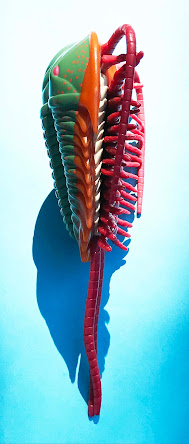
The above plastic replica (three views: top, bottom, and right side) of Olenellus is the best replica of a trilobite that I have ever seen. It shows the exoskeleton (the outer surface = green color “created” by the manufacturer of the replica), which is underlain by the gills (white color), which is underlain by the numerous thin legs (red color). This replica also shows the two antennae, front and aft, which are found on some olenellids. Their preservation, however, is very rare.


Bristolia bristolensis (36 mm length) is also of Early Cambrian age and from the same rocks that contain Olenellus fremonti. This is mostly a complete specimen of B. bristolensis. The abdominal spines present on Bristolia were undoubtedly used for protection against predators. The exoskeletons of trilobites were flexible, thus this lateral spines could be flexed upward, like prongs.  


By comparing B. bristolensis with O. fremonti, you can see that the cephalon (head) of Bristolia is more rectangular. 


Thursday, March 31, 2022

THE PUZZZLE OF THE. PLATES

The title of this blog post is the name of a commercial puzzle produced and sold by the American Geophysical Union in 1985. This puzzle, created by the geoscientist Athelstan Spillhaus, is based on the widely held scientific theory of plate tectonics, that explains the geology of the ocean floor and the geologic continuity of now physically separated continents. The lid of the box containing all the movable pieces is shown below:


The brightly colored 18 pieces of stiff cardboard comprising the puzzle are cut along tectonic plate boundaries, thereby allowing one to move the plates around to different positions so as to see how they fitted together 200 million years ago during the time of the single supercontinent Pangea. When all the pieces are fitted together, the map is about 15 inches across:


 One can also arrange the pieces together to show the modern world distribution of these same plates:


This puzzle is a very effective learning tool for students taking classes/labs in Earth Science. I acquired my copy many years ago when I was actively teaching, and I have used it in university-level classes. It could also be used in elementary-school classes that have a section on Earth Science. Some of my colleagues borrowed it from time to time, and they were all impressed by its quality and scientific accuracy.


I looked online for this puzzle but could not find it. I assume that it is now a collector’s item. However, there are somewhat similar puzzles for sale online.


Saturday, March 19, 2022

AMETHYST  

Amethyst is a very popular semiprecious gemstone because of its vivid purple color. It is also affordable as it is made of quartz, the most plentiful mineral in the Earth’s crust. Although amethyst can be found on every continent, its occurrence depends on certain conditions. The word “amethyst,” like many science words, is derived from Greek. The word means “not drunken,” and ancient Greeks, wore amethyst and carved drinking vessels from it, in the belief that this stone would prevent intoxication.

Most specimens of amethyst are formed in geodes, which are hollow spaces (cavities, vugs, cracks) in the surrounding rock, called “country rock.” The hollow spaces allow for amethyst crystals to grow mostly uninhibited, thereby forming nearly complete crystals, with crystal faces in abundance. 


The image above shows one-half of a geode vug (14.5 mm maximum diameter) filled with closely packed amethyst purple-colored crystals. Notice that there are several distinct areas of quartz material in this geode: an innermost area of purple crystals; surrounded by a layer of clearer (light purple to totally clear crystals); then a band of chalcedony (milky white cryptocrystalline quartz—see one of my earlier posts about this particular form of quartz); and a greenish thin layer making up the outside of the geode.


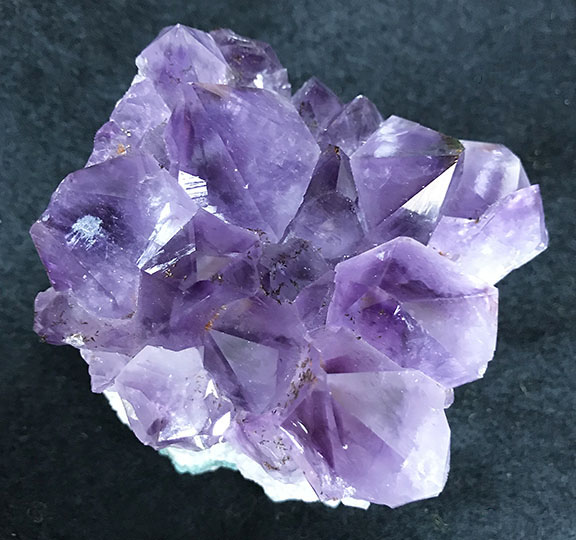
This cluster of amethyst crystals shown above is 13.5 mm length and 6 mm height, and it is a fragment of a geode.

Amethyst gets its beautiful purple hue due to two factors: 1) the presence of iron impurities in the quartz-crystal structure [the actual amount of iron (Fe+3) is low: in the range of 10’s to 100’s parts per million], and 2) natural gamma-ray radiation (nuclear decay) emanating from the surrounding rocks. It these two factors are not present, then the purple color cannot form.


This specimen, 8 mm by 8 mm, is a cluster of somewhat large amethyst crystals in a fragment of a geode. 


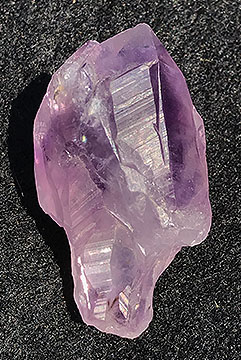
This last specimen is a single crystal (5 mm tall by 2.5 mm wide) of amethyst showing variation in hue from red/violet to purple. Variation in the hue of amethyst is a common feature, with many crystals showing range from light pink to violet to purple to dark purple, depending on the amount of iron and the intensity of radiation. The interior of the crystal shown here is darker (more iron) in its interior versus its more exterior regions. 


This single crystal also has closely spaced striations (small parallel lines) on some of its crystal surfaces. This is another common feature of amethyst. Striations (as in all minerals) are caused usually by alternating crystallization processes between different crystal faces as the crystal grows.


Regarding color variation in amethyst, it is known that the color of amethyst can fade in tone if overexposed to sunlight (UV light), but it can be darkened (by some jewelers) using artificial irradiation. Artificial heat treatment (used by some jewelers) can change also the color of amethyst to golden yellow or green, but the process is risky.


You might find it interesting to know that the purple color in “old-glass” bottles, made between 1860 and 1915, is the result sunlight (UV light) affecting with small amounts of manganese [not iron] in the glass. Traces of manganese were used as a clarifying ingredient. Prior to 1860, lead was used, and since 1915, selenium has been used to make glass.

Websites consulted in the preparation of this post are the following:

geologyin.com

Wikipedia (2021)  en.wikipedia.org


Saturday, March 5, 2022

SHORTEST AND LONGEST SCIENTIFIC NAMES

As a follow-up to my previous post ("Humorous Scientific Names"), I decided to do a post on the shortest and longest scientific names.

The shortest genus names consist of only two letters. There are at least five examples:


Ba—a land snail in the Fiji Islands (see my last post)

Ia—a bat in SE Asia

Io—a pulmonate river snail from the eastern United States

Ja—a blind carabid bettle from a cave in southern Japan

Yi—a bat-like dinosaur from China


Note: As of early 2022, the internet mentions only Ia and Yi.


The above two images show the front (apertural) and back views of a specimen of  Io fluvialis, a modern-day freshwater pleuroceridae gastropod from Cinninnati, Ohio. This specimen has a height of 35 (mm = 1 3/8 inches).


The shortest complete scientific names (genus and species) have only two letters. There are at least two examples:


Ia io Thomas, 1902—a southeast Asian bat

Yi qi Xu et al., 2015—a Chinese dinosaur.


The longest complete scientific name (genus and species) is 42 characters.  It is:


Parastratiosphecomyia stratiosphereomyioides—a small fly found in Thailand and India.

Thursday, February 24, 2022

HUMOROUS SCIENTIFIC NAMES

Prior to the early part of the 19th century, there was much confusion regarding the naming of extinct and extant organisms. Following the publication of the 10th edition of the Systema Naturae by Linnaeus in 1758, rules were established and occasionally updated for the creation of binominal names (genus and species) of names (e.g., they have to be Latinized, the genus name is capitalized and the species name is lowercase). These rules, which are given in the International Code of Zoological Nomenclature, have been adopted worldwide now and continue to fully utilized in modern times. In some cases, mild humor has made its way into the names.

In my career as a paleontologist, I have come across some humorous scientific names. Some are funny genera names, and some include funny associated species names. They are given below, with the author, the year the named was created, and some useful background information.


Agra cadabra Erwin, 1986—a carabid ground beetle.


Agra phobia Erwin, 1983, a beetle.


Agra vation Erwin, 1983—a carabid beetle from Peru.


Aha ha Menke,  1977an Australian wasp.


Ba humbug Solem, 1983—a rare land snail endemic to the Ba District of the Fijian Island of Viti Levu. This snail is highly endangered because of deforestation and probably the influence of invasive species (Pacific rat, house mouse, and various ant species).


Chaos chaos (Linnaeus, 1767)—a giant amoeba.


Disaster L. Agassiz, 1835 [if pronounced like the word “disaster”]—a fossil echinoid.


Eurygenius LaFerté-Sénectére, 1849—an antlike flower beetle.


Extra extra Jousseaume, 1894—a marginellid marine gastropod, now referred to as Marginella.


Gelae Miller and Wheeler, 2004—[pronounced “jelly”]—a round-shaped beetle found in North America and Central America. There are four species:

   Gelae bean

   Gelae rol

   Gelae fish

   Gelae donut


Godzillius Schram, Yager, and Emerson, 1966—a crustacean.


Hallucigenia Conway Morris, 1977—a Cambrian animal from the Burgess Shale in British Columbia (see one of my previous posts).


Han solo Turvey, 2005—an Ordovician trilobite from China.


Hunkydora novozelandica (Reeve, 1859)—a marine myochamid bivalve of small size from New Zealand.


Ittibitium Houbrick, 1993—pronounced “it-tee-bit-tee-um”—a very small marine cerithiid gastropod.


Kamera lens (O.F. Muller) Patterson and Zölffel, 1991—pronounced “cam-era lens”—a single-cell micro-organism.


Lalapa lusa Pate, 1947—pronounced “la-la-pa-lusa”—a large, wasp-like insect in No. America.


Meomyia Evenhuis, 1983—[pronounced “me-o-my-e-ia”]—a flying insect in Australia.


Mini mum Scherz et al. 2019—one of the world’s smallest frogs.


Pieza Evenhuis, 2002[pronounced “pizza”]—a fly from northern Venezuela. There are three species:

   Pieza kake

   Pieza pi

   Pieza rhea


Spongiforma squarepantsii Desjardin, Peay, and Bruns, 2011—a sponge-like, rubbery fungus found in Malaysia.


Ytu brutus—pronounced “you-too Brutus”—a Brazilian beetle in the genus Ytu Spanger, 1980.

___________________


For additional comments about humorous or weird names, see:


Conniff, R. 1996. What’s in a name? Sometimes more than meets the eye. Smithsonian Magazine, pp.66-68, 70.


Judd, W. 2014. Weirdest species names.


https://www.australiangeographic.com 


Wikipedia.org was also very useful in researching the author information.               www.curioustaxonomy.net


Monday, February 14, 2022

CRUCIBULUM: AN INTERESTING SEA SNAIL

This post concerns two species found today in the tropical waters of the west coast of the Americas. They belong to Crucibulum Schumacher, 1817, a genus of sea snails (gastropods) that resembles some tide-pool limpets, but is not one. By the way, Crucibulum is also a genus of fungi (found in birds’ nests), but this usage does not conflict with Schumacher’s name because snails are classified in Kingdom Animalia.

Two species of Crucibulum are illustrated below. The first is Crucibulum umbrella (Deshayes, 1830), from the state of Jalisco, which fringes the Pacific Ocean in western Mexico. This species lives on wave-swept rocks at low tide. Three views are shown:

Dorsal, side, and ventral. Notice the conical internal “cup.” At its apex, it is attached to its shell, but this “cup” is otherwise free along its margin. Note: This specimen of C. umbrella is usually large. Most specimens of this species are less than 60 mm wide, but this specimen has a maximum diameter of 87 mm and is 23 mm tall (probably a world’s record for this species). 


The second species is Crucibulum scutellum (Wood, 1828) from Baja California (exact locality not know, but this species lives from Cedros Island, Baja California to Ecuador. This species lives on other shells on intertidal mudflats to offshore depths of 27 m. Three view are shown: dorsal, side, and ventral. Notice that the conical internal “cup,” which is  attached at its apex is also attached via a narrow, curving ridge (indicated by the red arrow). The illustrated specimen is 55 mm wide, 30 mm tall, and 75 mm in length.


At first glance, genus Crucibulumthe snail, resembles a limpet gastropod, but Crucibulum belongs to a wholly different group of gastropods. Crucibulum belongs to family Calyptraeidae, commonly referred to the “cup-and-saucer” sea snails. Fossils of this family have a geologic record extending back to the Cretaceous, and the geographic distribution of this family (with its lowly moderate number of genera) is widespread.