Monday, March 28, 2016

Tejonia moragai

This post concerns the ampullinid Tejonia moragai (Stewart, 1927), a moderately common Eocene shallow-marine gastropod found from southwestern Oregon to San DiegoThis gastropod is known only from upper lower to upper Eocene strata (approximately 50 to 38 million years ago).


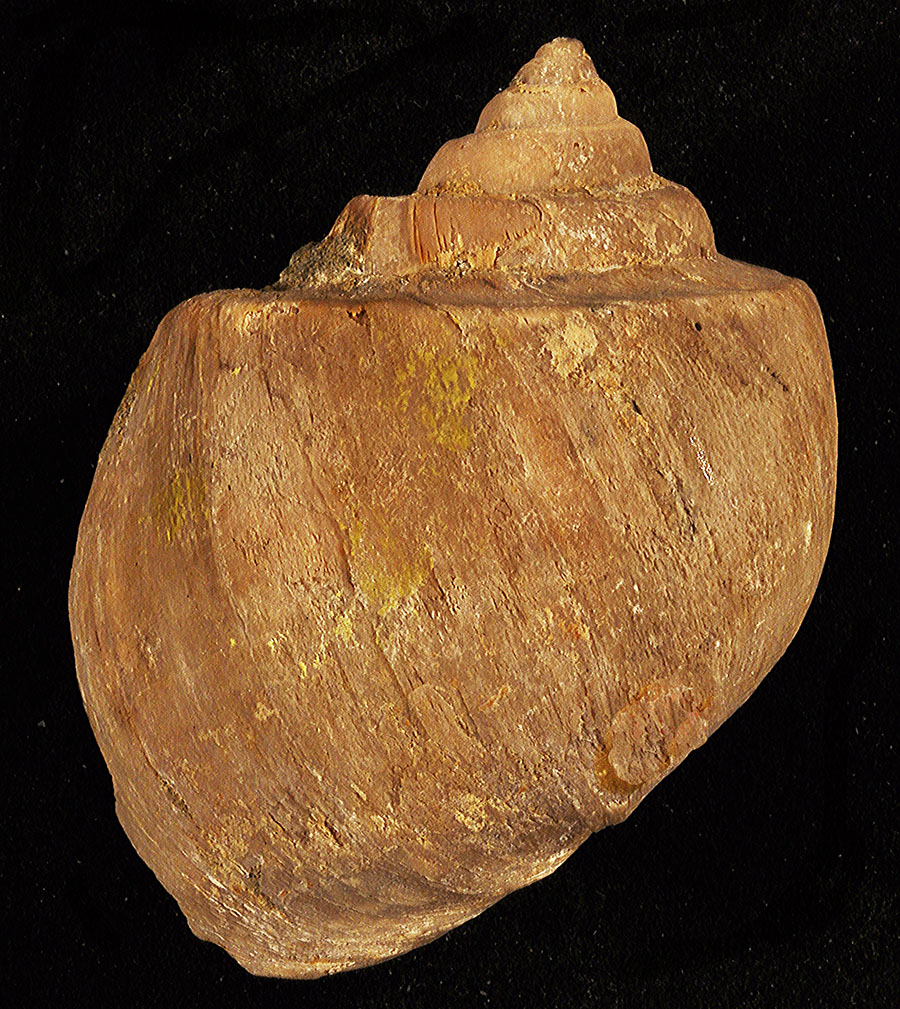
Tejonia moragai is small to medium-size. The above picture on the left is the front or apertural view of an adult specimen (30.7 mm height, 22.6 mm diameter). The picture on the above right is the abapertural or back view of the same specimen.

This gastropod is characterized by having an inflated last whorl that is smoothish but with minute spiral sculpture, a somewhat moderately elevated spire with tabulate (squared-off and indented) whorls, a distinct umbilical pit, and an absence of an umbilical callus. 


If you look at my previous post, which concerns the Eocene Pachycrommium clarki, you will see that T. moragai resembles P. clarki. There are a few subtle differences, thus, in my opinion, the two gastropods are different species. Tejonia moragai is smaller in size, has minute-spiral sculpture (lines), an umbilical pit rather than a slit, and no umbilical callus. The sculpture, however, could easily be worn or weathered away, thereby making the distinction between these two species difficult. The main question, however, is whether they belong to the same genus? An answer  requires a detailed comparative study, which has so far, been wanting.


Saturday, March 19, 2016

Pachycrommium clarki, another common Eocene gastropod

This post concerns another common ampullinid Eocene shallow-marine gastropod (for comparison, also see my recent post on Eocernina hannibali). The gastropod is Pachycrommium clarki (Stewart, 1927), a Eocene shallow-marine fossil known from southwestern Washington to Baja California Sur, Mexico. It is found only in lower to upper Eocene strata, thus is it an excellent index fossil for the Eocene time interval (approximately 55 to 36 million years ago).


Pachycrommium clarki is medium in size. The picture on the left is the front or apertural view of an adult specimen (68 mm height) of P. clarki. The picture on the right is the back or abapertural view of the same specimen.

This gastropod is characterized by having an inflated smooth last whorl, moderately elevated spire with tabulate (squared-off and indented) whorls, thin but persistent umbilical callus, and a slit-like umbilical pit. 


Although it would seem as if the morphology (shape and size, etc.) of this species is well defined, in reality, there are not that many characters. In addition, there has been little information provided as to how constant these few characters are and how much they are subject to variability, caused by paleoenvironment factors or even growth stage (juvenile vs. adult). I have seen variability for this species in the height of the spire, shape of the spire whorls, extensiveness of the umbilical callus, and development of the slit-like umbilical pit. 

Friday, March 11, 2016

Pumice floating in the ocean

This post concerns a very interesting geologic phenomenon: An "island" of floating pumice in the South Pacific ocean. You have to see the video to believe it. 

The link is HERE


Saturday, March 5, 2016

Monday, February 22, 2016

Eocene shallow-marine gastropod Eocernina hannibali (Dickerson, 1914)

This post concerns Eocernina hannibali (Dickerson, 1914), an Eocene shallow-marine gastropod (snail) commonly found in silty sandstone beds. It ranges from northwestern Washington State, coastal Oregon, all through coastal California, to the eastern Laguna San Ignacio area in Baja California Sur, Mexico. This gastropod is an index fossil (i.e., indicative of) the early and middle Eocene (approximately 55 to 40 million years ago). 


Eocernina hannibali is a medium to large-size species. The above picture on the left is the apertural or front view of an adult specimen (65 mm height, 53.1 mm width) of E. hannibali. The picture on the above right is the abapertural or back view of the same specimen. This specimen is representative of the larger individuals known for this species. Growth lines are especially apparent on the back side.

Eocernina hannibali is characterized by having a globose, smooth shell consisting a large last whorl (which contained the living animal), a rather tiny spire (or tip), and a wide smooth band (callus) adjacent to the opening (aperture) of the shell. The aperture becomes filled with sand during burial.


This picture shows the main morphologic features of the same specimen
 of E. hannibali shown above.
Locally, if the ancient environment was favorable, there will be many hundreds of specimens of this gastropod at a single locality, with sizes ranging from juveniles to late-stage adults. At these particular localities, specimens of E. hannibali are complete and so common that collecting them resembles "plucking small potatoes out of a bag." 


Dickerson originally put the species in family Naticidae and genus Natica. Recent naticids, which are diverse, are known to be carnivores that drill holes in other shells in order to reach the tissue of their prey. Modern work shows that E. hannibali belongs in family Ampullinidae, a nearly extinct family whose recent members are  herbivores that eat algae. This familial assignment is logical because E. hannibali can be extremely abundant. If it were a predatory snail, normally it would be rare to uncommon in fossil beds.

The classification of ampullinids, like many other fossil mollusks (e.g., snails and clams) is in a state of flux. To add to this confusion is that Eocernina resembles several other similar looking extinct and recent genera and species, thereby making positive generic identification a challenge. A meticulous comparative study of all these "look-alikes" is much needed.

Thursday, February 18, 2016

Digitizing museum fossils

The Natural History Museum of Los Angeles County, Invertebrate Paleontology Department (LACMIP), is now active, as are several other museums along the Pacific coast, in the process of digitizing (providing photographs) of their Cenozoic collections. The goal is to have these photographs available online to researchers. The digitizing process is funded by the National Science Foundation.

Too see a short video (with an accompanying text version) that highlights some aspects of this digitizing process at LACMIP, click

HERE http://www.voanews.com/content/museums-worldwide-push-to-get-dark-data-into-light-through-digitization/3191509.html

Friday, February 12, 2016

Extraordinary hand specimen of minerals

In addition to enjoying nicely preserved fossils, I also like to see really nice mineral specimens. This post is just one picture, but wait until you see the specimen. It is a memorable collage of calcite, quartz, and chalcopyrite from the Boldut Mine, Romania. This mine is known for its immense geodes. At least 22 minerals have been found there.

The link is HERE