Showing posts with label Stewart Mine. Show all posts

Monday, June 26, 2017

Tourmaline-bearing granite

A granite is very distinctive looking if it contains "clusters, spots, clots, or patches" of jet-black tourmaline crystals surrounded by white feldspar crystals.  Such a white-colored granite is   leucocratic (i.e., dark-colored minerals absent or, in this case, concentrated).  Black tourmaline is called schorl, and it is black because of its iron content.  Tourmaline, which is a boron-silicate mineral, is commonly found in pegmatites.  In my previous post, I discussed that pegmatites are associated with the late stages of the cooling history of granite-producing magmas.

A single large crystal (4.75 cm tall = 1.87 in.) of schorl is shown in the following image.  The overall shape of the crystal is triangular  and has striations on all of its sides. The provenance of this crystal is unknown.


Three small boulders (all about 13 inches maximum length) of tourmaline granite are shown below.  A 3/4 of an inch in diameter penny (United States) is used for scale. The "clusters" of tourmaline can be as large as 8 cm across.  The provenance (original location) of this granite is not known to me, but the boulders occurred as rock debris emanating from a man-made dam built in a stream bed in northern Los Angeles County.  I was not sure about the identification of the black mineral in these rocks, so I asked my friend and colleague, Dr. Larry Collins, who is a professor emeritus of geology to take a look at the mineral. He is an expert in mineralogy and petrology, and he recognized the mineral as tourmaline.


In this image, the tourmaline crystals are more spread out, with feldspar and quartz in between. 


This image is a closeup showing a divergent fibrous aggregate of acicular (needle-like) tourmaline crystals, which are concentrated in the upper half of the image. The tourmaline in the lower half of the image is blocky. The entire field of view is about 1 cm in height.

The image below shows a small of piece of a tourmaline-bearing granite (5.5 cm width) from a pegmatite at the Stewart Mine near Pala, San Diego County, Southern California. These crystals of schorl are somewhat massive (structureless).


Tuesday, June 13, 2017

Graphic granite

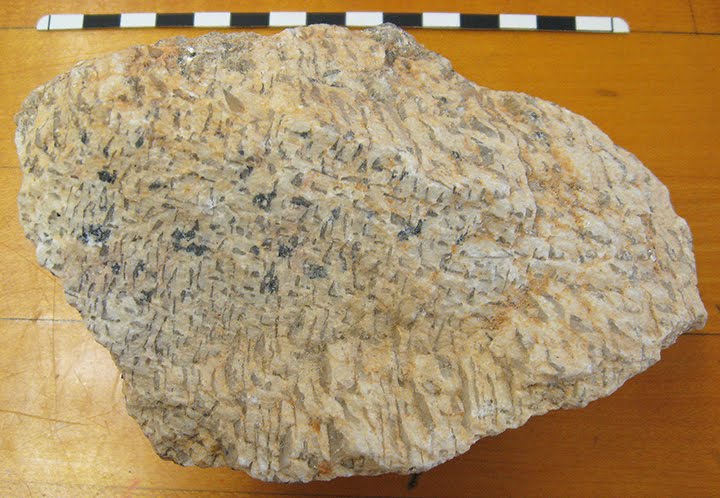
Graphic granite is relatively common rock consisting of alkali feldspar (i.e., rich in potassium, in some cases in combination with sodium) and quartz, but the rock has a very interesting texture, consisting of a distinctive repetitive pattern that resembles cuneiform writing.


The above picture and the following two pictures are of the same piece of graphic granite, which is about 7 inches long (= 18 cm; the scale is in centimeters).

The origin of graphic granite was debated for over a century. It is now known to be the result of simultaneous growth of quartz (gray color in the rock above) and feldspar (white color) under conditions that favor the planar growth of the feldspar host. 

The next two pictures are different views of the same piece of rock, but you can notice how the texture differs, depending on the view.


Graphic granite occurs in pegmatites, which form during the final stage of a magma's crystallization. The graphic granite illustrated in these three pictures came from the pegmatite at the Stewart Mine in San Diego County, Southern California (see my archived post for  September 30, 2016 which focuses on the mineral rubellite from the Stewart Mine).

Friday, September 30, 2016

Rubellite from Pala, San Diego area, California

Rubellite, a gemstone variety of the mineral tourmaline, can be transparent and possesses a beautiful reddish pink to violet or light green color. It can also be nearly colorless.  One of the best known localities for this gemstone is in the Pala mining district, at Pala, near San Diego in southern California. About 10 years ago, I was a member of a group of geologists invited to tour the historic Stewart Mine at Pala. We were allowed to search through discarded diggings, but I was able to find some nice specimens that were not too weathered. It is important to mention that this mine is on private land and getting permission to enter the land is absolutely needed.


The individual crystals of rubellite on the left side of the picture are approximately 1 cm in height. The ones that appear somewhat blackish are transparent enough to show the black color of the background material on which they were photographed. The cluster of weathered crystals on the right is 5 cm in width. 

Rubellite from the Stewart Mine is commonly in a matrix consisting of the lithium-bearing mineral lepidolite (it is purple and shines a lot like mica). The cluster of rubellite shown above is in lepidolite.


The rubellite in the Stewart Mine is found in a complex and highly mineralized granitic pegmatite-aplite dike.