Showing posts with label quartz. Show all posts

Friday, September 28, 2018

Common rock-forming minerals

The following is a very basic discussion of minerals, which is critical for the understanding the classification of igneous rocks, the topic of the next post.

Atoms (electrons, protons, and neutrons) make up elements (92 natural ones; (examples: oxygen, silicon, potassium).

Elements make up minerals (3,500 kinds).

     Minerals consisting of pure (native) single elements are rare     (e.g., gold, diamond, copper).

     Nearly all minerals consist of combinations of elements.

Only 20 minerals are common, and they are the rock-forming minerals. Seven of these are shown below.

white ("milky") quartz, 3.3 cm in height
Quartz (made up of the elements silicon + oxygen) is the most common mineral in the continental crust of Earth. The presence or absence of quartz in a rock is fundamental in the classification of igneous rocks. For more information, see my previous two posts, which review the subject of quartz.


potassium feldspar (K-spar), 3.7 cm in height
One of the largest groups of minerals is referred to as the "feldspar group," which consists of two subgroups. One of these subgroups is the "alkali feldspars,"which contain varying amounts of the elements potassium and sodium in their composition. The mineral pictured above is one of these alkali feldspars, which are generally called "potassium feldspar" or "K-spar" until x-ray and petrographic microscope studies are made to determine the exact mineral. 

plagioclase, 3.3 cm in height
The second subgroup of the "feldspar group" is called the "plagioclase feldspars," which contain varying amounts of the elements sodium and calcium in their composition. Plagioclase is characterized by the presence of striations, which can be seen as closely spaced lineations in the upper half of the specimen shown above.

flakes of muscovite, largest flake 4 cm height
Muscovite and biotite (see below) belong to the "mica group" of minerals. Both have one-dimensional cleavage, which splits into sheets or flakes. For a discussion of what cleavage is, see one of my more recent posts. Because of its clarity, large sheets of muscovite could have served as "windows" for pioneers living in wood cabins. Muscovite is common in quartz-rich igneous rocks (granite), metamorphic rocks like (schists and gneisses), and sedimentary rocks (siltstone and claystone).


large sheet of biotite, 6.5 cm height
Biotite has a more varied composition than does muscovite. For example, biotite has iron in its structure, which causes a dark coloration. Biotite occurs in igneous rocks, as well as a wide variety of metamorphic rocks. 


hornblende, 7 cm height
Hornblende has a very complicated composition and much chemical variability, depending on the chemicals available and the temperature of formation. Hornblende has two directions of cleavage (approximately at 60 degrees and 120 degrees). This mineral is found in a wide variety of igneous and metamorphic rocks. 
olivine, 3 cm height
The "olivine" group minerals contain varying amounts of iron and magnesium in their composition. "Olivine" is most common in quartz-free rocks and commonly has a green color.

In the minerals shown above, three of them occur as solid-solution series, which form when two elements can substitute for one another in a mineral. The three solid-solution series are the
alkali feldspars, plagioclase feldspars, and the "olivine" group.

Most of the minerals in these solid-solution series are not compositionally pure end members; rather they have an in-between composition.

Minerals make up rocks (3 main types: igneous, sedimentary, and metamorphic).

Rocks make up the Earth's crust (two kinds: continental and oceanic).

In the next post, igneous rocks will be discussed and illustrated, and the chart below is presented here to show how quartz is used to help define certain kinds of igneous rocks. For example, granite (think expensive kitchen-counter tops) is rich is quartz but basalt (think lava flows in Hawaii) is low in quartz.  


Sunday, July 9, 2017

Amazonite

Amazonite: A case study in how a geologist thinks

Amazonite is a bright-green variety of the mineral microcline feldspar. Amazonite occurs in quartz-rich granitic rocks, especially coarse-grained granites called pegmatites, like the one shown here.
This sample is probably from the Pikes Peak region in Colorado, where some of the highest quality specimens are found. The name “amazonite” is derived from the Amazon River because early collectors believed (erroneously) they had found amazonite there.

Amazonite (10 cm maximum dimension) in pegmatite granite. Bright green = microcline; grayish and whitish (both can be somewhat transparent = quartz; white = microcline; black = biotite). The underside of this rock is cuneiform graphic granite (see previous post).
This post presents an opportunity to point out the "visual clues" a geologist would use to explain how this rock formed. 

The rock consists of interlocking large crystals of several minerals. The interlocking of the crystals indicates that they formed from magma (molten material), and the large size of the crystals means that they cooled very slowly. The rock, therefore, is a plutonic igneous rock that cooled very slowly underground. The word "plutonic" is derived from the name of the Roman god, Pluto, who lived underground.

The presence of quartz means the rock formed late in the fractional crystallization sequence. As the magma cooled, a certain sequence of  minerals form, and the chemistry of the remaining melt changes.
This sequence is elegantly summarized by what is known as the Bowen Reaction Series (see diagram at the end of this post).


The presence of lamellae of different colors (green and white) in the overall bright green crystals means that there was exsolution of two minerals: white is albite, and green is microcline. These two minerals crystallized together when the remaining magma melt was rich in potassium, with a lesser amount of sodium. These lamellae form what is known as perthitic texture, which is common to the alkali feldspars (late-forming minerals rich in potassium). 


Amazonite (3.8 cm thick), showing exsolution lamellae of albite (white color).

 The bright green color of amazonite was a mystery to science until detailed studies showed that its color is a result of natural radiation of microcline containing a relatively high level of lead and water in the crystalline structure.  


This poster depicts a poster I made that shows the progressive sequence of fractional crystallization of the Bowen's Reaction Series. It was not made with the intention of showing it online. This explains why the the writing on the poster is somewhat hard to read. Although the dark minerals do not show up well, the poster conveys the concept of the sequence of minerals that form in  an ideal (in a chemical composition sense) magma as it cools. 

Tuesday, June 13, 2017

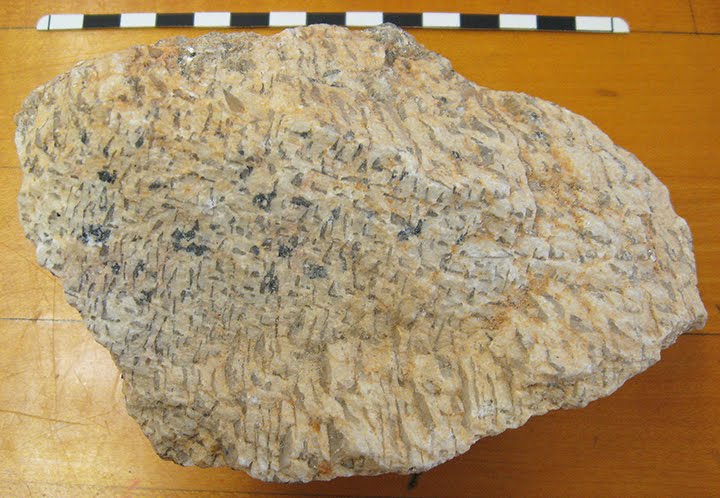
Graphic granite

Graphic granite is relatively common rock consisting of alkali feldspar (i.e., rich in potassium, in some cases in combination with sodium) and quartz, but the rock has a very interesting texture, consisting of a distinctive repetitive pattern that resembles cuneiform writing.


The above picture and the following two pictures are of the same piece of graphic granite, which is about 7 inches long (= 18 cm; the scale is in centimeters).

The origin of graphic granite was debated for over a century. It is now known to be the result of simultaneous growth of quartz (gray color in the rock above) and feldspar (white color) under conditions that favor the planar growth of the feldspar host. 

The next two pictures are different views of the same piece of rock, but you can notice how the texture differs, depending on the view.


Graphic granite occurs in pegmatites, which form during the final stage of a magma's crystallization. The graphic granite illustrated in these three pictures came from the pegmatite at the Stewart Mine in San Diego County, Southern California (see my archived post for  September 30, 2016 which focuses on the mineral rubellite from the Stewart Mine).

Tuesday, May 16, 2017

Crystals That Show Twinning

In my March 31, 2017 post concerning a distinctive granite, I showed an orthoclase crystal with twinning, which occurs when two separate crystals of the same substance share some of the same crystal lattice. Instead of a normal single crystal, the crystalline structure appears doubled. 

In this new post, I show some other common examples from my personal collection of twinned crystals. They are aragonite, pyrite, gypsum, quartz, and staurolite. 

aragonite (40 mm length)
gypsum (37 mm length)


pyrite cubes (47 mm length)
quartz (47 mm length)
staurolite (18 mm length)
pseudomorph of staurolite (40 mm)


pseudomorph of staurolite (40 mm length)


pseudomorphs are formed
when a mineral is replaced
by a foreign substance